|
|
 |
|
News
Commentary
Business&Trade
Culture & Sci-tech
China-US Dialogue
From the US Media
Major Events
Key Documents
Video
Photo Gallery
Related Coverage
Timeline Milestones
Hotlinks
Li Hong:
Export-driven road hits snag  Liu Shinan:
Teachers are not children's punching bags  Hong Liang:
Information is power for investors too  You Nuo:
A protracted war against recession  Patrick Whiteley:
Why learning Chinese is easier in Year of the Ox  President Jiang Zemin visits the United States
(Fmprc.org.cn)
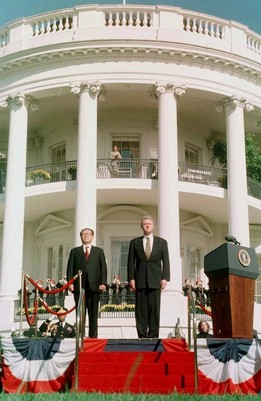
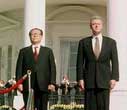
Updated: 2009-01-07 15:06 From October 27 to November 3, 1997, Chinese President Jiang Zemin visited the United States at the invitation of President Clinton. This was the first visit to the United States by the Chinese head of state in 12 years and an important visit in the history of Sino-US relations.
Before leaving for the United States, President Jiang met US reporters in Beijing. He said: "I will be visiting the United States in a friendly spirit and with the desire to increase the friendship between the Chinese and American peoples and expand the common ground and cooperation between China and the United States. It is true that there are some differences between China and the United States. But we should expand common ground and narrow differences through discussions and meetings. I believe that this visit will serve the purpose of deepening mutual understanding, expanding common ground, developing cooperation and pursuing a common future for both countries." During his visit to the United States, President Jiang held talks with President Clinton and other US leaders during which they had extensive exchange of views on Sino-US relations and major international and regional issues of mutual interest. After the talks, the two sides issued the Joint China-US Statement in which they outlined the goal for the future growth of Sino-US relations: To advance the lofty cause of promoting world peace and development, China and the United States should enhance cooperation and commit themselves to building a constructive strategic partnership oriented towards the 21st century. The two presidents held that China and the United States have areas of both agreement and disagreement. They agreed that a sound and stable relationship between China and the United States serves the fundamental interests of both the Chinese and American peoples and is important to fulfilling their common responsibility to work for peace and prosperity in the 21st century. The two sides should approach China-US relations from a long-term perspective on the basis of the principles of the three China-US joint communiqués. The US side reiterated in the statement that the United States adheres to its "one China" policy and the principles set forth in the three China-US joint communiqués. President Clinton and other American leaders reiterated on many occasions that the United States does not support "Taiwan independence", does not support Taiwan"s membership in the United Nations and does not support "two Chinas" or "one China, one Taiwan". The Chinese side appreciated the above stand of the United States and asked that the American government match its words with deeds, take concrete steps to honor its commitments and approach the Taiwan issue in strict accordance with the principles set forth in the three China-US joint communiqués. The Chinese side held that doing the above will ensure the sound and stable growth of China-US relations. During his visit to the United States, President Jiang visited Honolulu, Williamsburg, Washington, Philadelphia, New York, Boston and Los Angeles where he had extensive contacts with the prominent figures of the American political, business and scientific communities through delivering speeches, accepting press interviews and giving a press conference. He also met Chinese residing in the United States, the American Chinese and Chinese students and toured some historical sites, hi-tech companies, a financial institution and Harvard University. He gave speeches in Washington, New York, the Harvard University and Los Angeles to the American public in which he elaborated on China's policy on pursuing reform and opening-up and modernization drive and China's development prospects. All this helped deepen the American people's understanding of China and promoted the friendly cooperation between the two countries. In Washington, President Jiang delivered a speech at a luncheon hosted in his honor by the America-China Society and other five organizations. In the speech, he stated the following five guidelines for developing China-US relations: 1. To view and handle China-US relations in a strategic and long-term perspective and keep a firm grip on the overall interests of China-US relations. 2. To vigorously seek the converging point of our respective interests, taking into account not only one's own interests but also the interests of the other side. 3. To scrupulously abide by the three China-US joint communiqués which form the basis of a growing relationship. 4. To correctly hand the difference through consultation on an equal footing in the spirit of mutual respect and seeking common ground and putting aside differences. 5. To handle the Taiwan question properly. During President Jiang's visit to the United States, both sides concluded a number of agreements on increasing exchanges and cooperation between the two countries in the fields of trade, environmental protection, energy, science and technology, law, education and culture and on increasing military-to-military exchanges. President Jiang's state visit to the United States met the goal of enhancing understanding, expanding common ground, developing cooperation and creating a common future between China and the United States.  |
          |
主站蜘蛛池模板: 通道| 游戏| 吴忠市| 富源县| 敖汉旗| 当雄县| 威信县| 韩城市| 阿图什市| 密山市| 沽源县| 宁化县| 大厂| 砀山县| 维西| 侯马市| 蒙阴县| 乾安县| 咸宁市| 皮山县| 家居| 正镶白旗| 高雄县| 灵寿县| 香河县| 肥东县| 榆中县| 云阳县| 炎陵县| 鄂伦春自治旗| 陕西省| 壶关县| 蚌埠市| 衡东县| 香格里拉县| 兰溪市| 洛隆县| 西昌市| 曲周县| 宜兰市| 永年县| 隆安县| 庄浪县| 迭部县| 湘潭市| 龙南县| 河北区| 仙桃市| 都兰县| 和静县| 宝丰县| 托克逊县| 始兴县| 凌源市| 文成县| 罗甸县| 株洲市| 治县。| 五大连池市| 淮滨县| 武宁县| 汾阳市| 陇南市| 壤塘县| 牡丹江市| 镶黄旗| 高台县| 大竹县| 宽甸| 南投市| 武川县| 周口市| 新化县| 灵宝市| 太湖县| 武川县| 建瓯市| 临沂市| 广饶县| 祁连县| 行唐县| 九寨沟县|