|
|||
 |
|||
|
|||
|
|||
|
|||
|
|
||||||||||||||||||
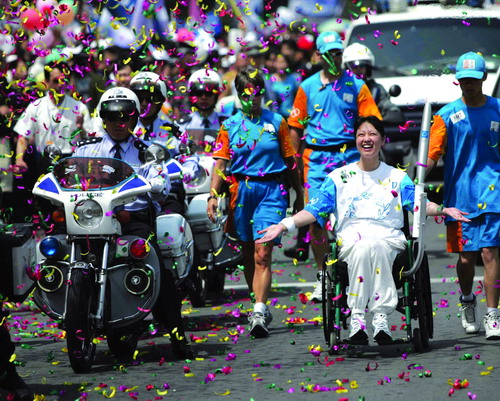
Wheelchair champion shows her character with sword(China Daily)Updated: 2006-11-17 16:13
Qi Kaili, 33, is a Chinese wheelchair fencing world champion. She served as a torch bearer during the Athens Olympic Torch Relay in 2004 in Beijing. In a recent interview with Beijing 2008 published by the Beijing Olympic Organizing Committee, she spoke of the barriers she has overcome to achieve her dream. The following are edited excerpts. When did your interest in sports emerge? I think sport is in my blood. My mother is a professor in a local sports university. She trained me and cultivated my interest in sports when I was young. I was Beijing middle school high-jump champion for five years in a row. I also won third place at the National Games for Middle School Students, and I was fortunate to be admitted to the Beijing University of Science and Technology without having to sit the national entrance examinations. But in my first year in the university, I was injured during a training session and became paraplegic. How did you become a wheelchair athlete? In 1994, I happened to be chosen to train for the 1994 Far East and South Pacific Games for the Disabled. Although I had never considered wheelchair fencing before, I won the foil fencing gold medal after only three months' training in Beijing. You also won wheelchair World Cup medals in 2005 and 2006. How did you achieve that? Although my injury left me in a wheelchair, I have always believed that I can accomplish something. I took up fencing because it was fun, but, since I have been successful, the fun has brought responsibilities and pressure. To me, the sport is quite different from when I first started. It's very tough, even cruel, to train for wheelchair fencing. Since I have no feeling in my lower limbs, I could easily damage my hip in an especially intensive training session. In 2003, while training for the National Games for the Disabled, I underwent 12 operations. My doctors told me: "Don't train anymore," because they can no longer transplant suitable muscle from my body to repair the damage to my hip. Because of my disability, I have difficulty getting in and out of taxis when I go alone to competitions overseas. In hotels, I cannot use their bathtubs. I just cannot get into them. Also, I cannot take a shower when I am overseas. In China, my husband puts water in plastic bags and pours it over me. For various reasons, I must travel abroad by myself; other athletes with disabilities from other countries can have someone accompany them. While abroad, I'll spend only 10 per cent of my energy on the competition. The rest of it is spent taking care of myself. What's the key factor in your success? I think being strong and tenacious is a key factor. Fencers show their character with their swords. After the 1994 Far East and South Pacific Games for the Disabled, I went back to school and earned a bachelor's degree in business management. Despite my hectic work and training schedule, I began to study law in 2000 and have qualified as a lawyer. What's your daily schedule like? I am a part-time wheelchair athlete. I have a job, in which I help manage an online forum for a local newspaper from 6 pm to midnight at home. I train four times a week. My husband or parents accompany me to training sessions with the national team on weekends. On the other three occasions, the coach or my teammates will come to my parents' house where my husband and I live. I practice on the wheelchair and the sofa. I also have to find time to study and prepare for examinations. What's your plan for the Beijing 2008 Paralympic Games? At the moment I am pregnant, but I plan to resume training after the middle of next year. It's hard for me to predict whether I'll be able to qualify for the Paralympic Games or win a medal. My parents and doctors have asked me to stop training. But I have the support of my husband so I think I'll try my best. For me, a gold medal, family and career, are all important. Do you want your child to be an athlete? It's up to the child. He or she can do whatever they want. |
|