Comments
  Print
Print  Mail
Mail  Large Medium Small
Former fisherman turns 'castaway' to save island from disappearing into sea. Peng Yining reports from Xiamen.
For more than 20 years Lin Beishui has lived on a remote islet in the Taiwan Straits like a modern-day Robinson Crusoe.
 Lin Beishui stands on the shore of Eyuyu Island, a remote islet in the Taiwan Straits. Lin has lived a solitary existence on the island for more than 20 years. [Photo/China Daily] |
Without any electricity or clean drinking water on Eyuyu Island, the 56-year-old former fisherman has survived largely on the food he grows. His "best friend" is a battery radio and his only protection from typhoons that hit every year is a small brick shack.
Yet, his biggest challenge is preventing his home from sinking into the sea.
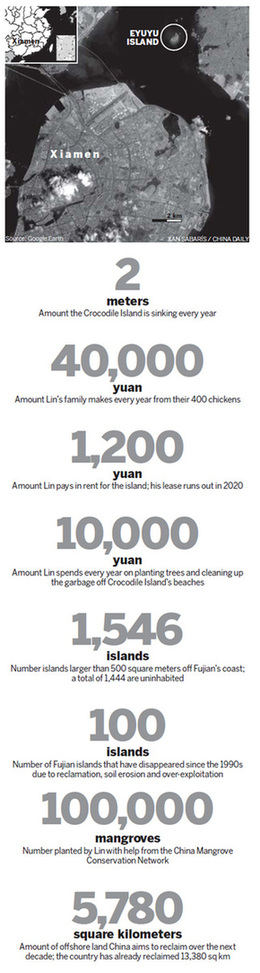
Official studies show that Eyuyu - or Crocodile Island - is shrinking by about 2 meters every year.
"The island's name comes from its appearance, but in the past 20 years the 'crocodile's tail' has completely disappeared," said Lin, who lives 30 minutes by boat from Xiamen in Fujian province.
"Almost a third of my island has already gone," he said.
Crocodile Island is roughly 100 meters by 700 meters, the equivalent of 10 soccer pitches, and its coastline of white sandy beaches can be covered on foot in less than 40 minutes.
Although 5 kilometers from the mainland, Xiamen's bright lights and skyscrapers are clearly visible from Lin's shack.
However, this leafy island paradise is slowly being destroyed by rampant soil erosion.
"When I arrived, there were only six banyans left. I watched as the waves took the earth away every day, turning the place into a desert," said Lin, who was recently joined on the island by his wife.
With help from an environmental NGO, he is now attempting to halt the erosion, and spends about 10,000 yuan ($1,500) a year on planting trees and cleaning up the garbage that washes ashore.
"I could make more money by fishing but I can't leave my island," he added. "People (in my native village) laugh at me but I don't care."
Fujian's coast has 1,546 islands larger than 500 square meters, including 1,444 that are uninhabited. According to official statistics, more than 100 islets have disappeared since the 1990s due to reclamation, soil erosion and over-exploitation.
Island retreat
Lin, a quiet father-of-two with short graying hair, arrived on Crocodile Island from nearby Qiongtou village in 1987 after suddenly losing his mother and two brothers.
It was a retreat, he explained. "I gave up fishing and stayed there for a couple of months to get me through that tough time. Later, I decided to move in."
In 1990, Lin left his wife and sons behind and rented the island from his village (he renewed that lease in 2000 for two more decades, paying 1,200 yuan a year).
"I thought I could live a free life and could earn a living for me and my family by farming on the island," he said. However, his first peanut crop was a failure due to the salinity of the soil.
It was not long before he noticed his new home was also shrinking. "I felt I was losing my island after losing my family," he recalled.
By the second year, Lin was planting Casuarina seedlings, an evergreen tree resistant to saline, on the beaches. Of the more than 20,000 he put in the ground each year, only hundreds would survive.
"They grew in the spring but slowly died in the tropical summer heat. By October, I was left with nothing," he said.
To make matters worse, in 1999 the island was hit by a fierce typhoon that uprooted more than 2,000 trees. Lin said he burst into tears the next morning when he saw the aftermath, including the tons of garbage that had been washed ashore.
Despite the setbacks, he remained upbeat and his island is now covered with trees and grass.
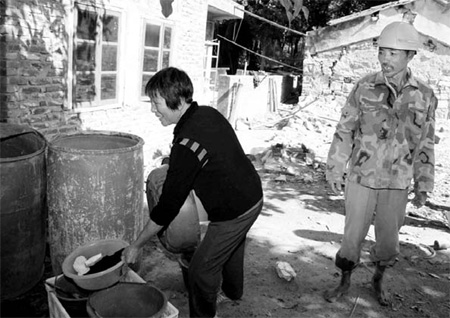 Wu Lina, wife of Lin Beishui, spends her days cooking and cleaning after joining her husband on the remote Crocodile Island 10 years ago. The Lin family is the only household on the island. |
"At least I'm slowing the erosion," said Lin, who waters each plant and tree. "I have already paid dearly for this island, so I won't give up. If I did, all my effort will be in vain.
As well as money, he has also sacrificed his family life.
In past two decades, Lin has only left the island to collect food and water supplies, taking his motor-powered sampan to Qiongtou village and back in a couple of hours. Whenever he returns it usually resulted in an argument with his wife.
Lin told China Daily he spent money set aside for his sons' education to buy more seedlings for Crocodile Island.
His eldest son, Lin Dasheng, 28, said that, since the age of 8, he has been forced to live in an old, borrowed house, paying for school by selling crabs caught on the island's beach.
"My family complains all the time. For many years, my wife was too angry to come live with me on the islet," he said. "Other villagers said I am crazy. They call me 'Old Monk' for having lived alone on an island for so long."
Wu Lina, Lin's 56-year-old wife, finally agreed to join her husband in 2000. She now spends her days cooking and cleaning while Lin plants more trees.
"I don't have any other choice," she said. "It's our home now."
Lin family's main income comes from the 400 chickens they keep at their island farm. They make about 40,000 yuan a year from the 100 or so eggs the birds produce every day.
 Looted cultural relics displayed back in China
 Zhengzhou starts rail cargo service to Hamburg
 Jobless graduates swarm to grad school
 Fu becomes oldest living person at 116
 Peking University a hot tourist spot
 Building stands alone in East China
 Rain leads to bigger waterfall in C China
 Bruce Lee exhibition to open in Hong Kong
Copyright 1995 - . All rights reserved. The content (including but not limited to text, photo, multimedia information, etc) published in this site belongs to China Daily Information Co (CDIC). Without written authorization from CDIC, such content shall not be republished or used in any form. Note: Browsers with 1024*768 or higher resolution are suggested for this site.
Registration Number: 20100000002731