For immigrants, the desire to cluster with others from one's country of origin is universal, Chen said. Chinatowns allow new arrivals to retain ties with their homeland while they get help finding a place to live, a job, legal services and other resources.
Abramson described the role of a traditional Chinatown in a 2006 article.
 |
|
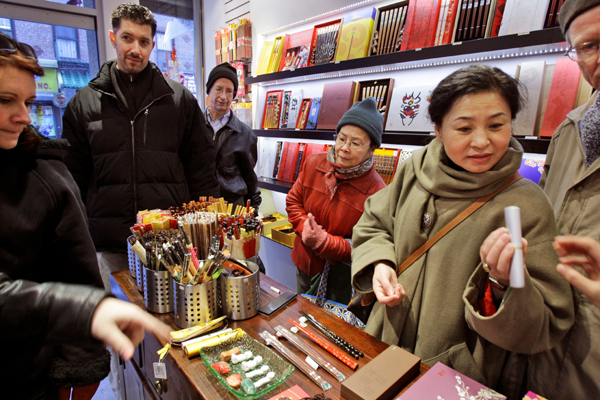
Customers crowd into the Yunhong Chopsticks store in Chinatown in New York. [Photo/Provided to China Daily] |
"Ethnic minorities themselves have found the notion of 'enclave' useful to maintain their identity, provide themselves with information and social and cultural services, and to empower themselves politically through mobilization and solidarity - all of which are made easier through spatial concentration," he wrote in the Journal of Architectural and Planning Research.
"North American Chinatowns can be seen as extreme cases of dichotomous urban ethnic space. They are typically among the most sharply-bounded urban enclaves to be found in American cities."
In recent years, the economic rise of China has helped alter the demographics of the United States' Chinese population and provided an impetus for the establishment of Chinese enclaves with new characteristics, said Sarah Swider, a sociology professor at Wayne State University in Detroit and an expert on immigration.
"The earlier wave of Chinese immigrants was more likely to be poor," said Swider. "Now, the situation is that these migrants include people across different social classes, from the global 1 percent to the poor."
The Census Bureau reports that recent arrivals from Asia are twice as likely to have a bachelor's degree as those that arrived in the US three decades ago. This shift has created a need for "one-step-up" Chinese communities such as New York's Flushing and Sunset Park, said Tunney Lee, professor emeritus of urban studies and planning at the Massachusetts Institute of Technology.
"Highly educated, higher-income immigrants are going directly to the suburbs," Lee said.
According to the Asian American Federation's Shih, the median household income in Flushing in 2011 was $45,810, with Sunset Park trailing at $32,371. The figure for Manhattan's Chinatown was $26,046.
Additionally, the population of Manhattan's Chinatown is aging, with younger generations opting for cheaper, more spacious living in Flushing and Sunset Park, Shih said. The Manhattan enclave saw a decrease of 1,858 children in its population between 2000 and 2010, according to census data.
Middle-class, educated immigrants aren't dependent on Chinatown-centered services in the way their lower-income counterparts are, the University of Washington's Abramson said.
"Wealthier immigrants tend to be better-educated and more likely to speak English," he explained. "They can get around, and they're able to hire support in the form of lawyers, insurance and real estate agents that will ease their transition. They will live like affluent Americans of the same wealth level in other areas, but they will still shop in Chinatown or other places where there's a concentration of good food and products they're familiar with."
In cities such as Seattle and Portland, Oregon, traditional Chinatowns have become almost entirely commercial districts, Lee said. He also pointed to Las Vegas' Chinatown, which is strictly commercial and actually pan-Asian in character.
This indicates a continued need for traditional Chinatowns, regardless of where Chinese choose to live, said Kevin Hsieh, who runs the online information platform SanFranciscoChinatown.
 |
|
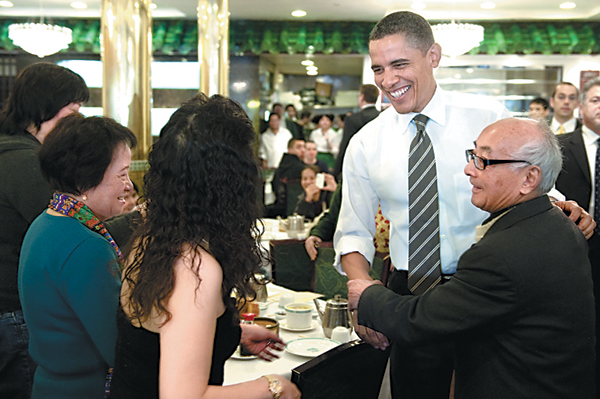
President Barack Obama greets patrons during a visit to the Great Eastern Restaurant in San Francisco's Chinatown. [Photo/Provided to China Daily] |
"Many students in San Francisco might live in another part of the city, but they come back to Chinatown to shop and eat," he said. "If you want to feel like you're home for a bit, and you know it'll be a while before you get to go home, Chinatown is where you go."
According to the 2010 census, the average Asian-American lives in an area where 20 percent of residents identify themselves as Asian; in contrast, most Hispanics live where 45 percent of people are self-identified Hispanics. However, Asian-Americans make up far less of the US population than Hispanics do, and are therefore statistically less likely to cluster, the report notes.



Copyright 1995 - . All rights reserved. The content (including but not limited to text, photo, multimedia information, etc) published in this site belongs to China Daily Information Co (CDIC). Without written authorization from CDIC, such content shall not be republished or used in any form. Note: Browsers with 1024*768 or higher resolution are suggested for this site.
License for publishing multimedia online 0108263 Registration Number: 130349