Athletics
Updated: 2012-05-14 16:00:01
(london2012.com)
|
|||||||||||


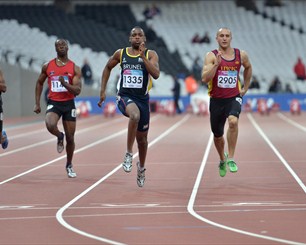
Athletics is the perfect expression of the Olympic motto 'Citius, Altius, Fortius' ('Faster, Higher, Stronger') - the competition requires athletes to run faster, throw further, jump higher and leap longer than their rivals. With 2,000 athletes competing in 47 events, Athletics is the largest single sport at the Games.
 |
Competition dates
Aug 3 - Aug 12
Competition venue
Olympic Park - Olympic Stadium (track, field and combined events) The Mall (Marathon and Race Walk)
Number of medal events
47 (24 track, 16 field, two combined and five road)
Number of competitors
2,000. Each country is limited to three athletes in each individual event and one team in each relay event (maximum six athletes, of whom four will run).
Field of play
The Athletics track at the Olympic Stadium is a 400m oval - for all track events the finish line is in the same place, at the end of the 'home straight'.
Within and around the track are the fields of play for the field events - High Jump and Pole Vault landing areas, Long Jump and Triple Jump pits, Discus Throw, Hammer Throw and Shot Put circles, and Javelin Throw runways.
The Mall, near Buckingham Palace in central London, provides the finish for the Marathon as well as the 20km and 50km Race Walks. The Marathon is run through the streets of London as far east as Tower Hill. The Race Walks are contested on a 2km loop up The Mall in St James' Park, past Buckingham Palace and Constitution Hill in Green Park.
History of Athletics at the Olympic Games
The ancient Olympic Games featured the stadium race, a sprint of roughly 192m. Winners in this event have been recorded as far back as 776 BC. The first modern Olympic Games in 1896 included a Marathon, which was designed specifically to pay homage to Ancient Greece.
At the London 1908 Games, the race's distance was extended from around 25 miles to 26.2 miles (42.195 km) so that it finished in front of the Royal Box. This distance became standard for the Marathon and is still used today.
Women have been competing in Athletics since the Amsterdam 1928 Olympic Games.
The basics
There are four main strands to the Athletics competition:
1. Track events: can be divided into sprints, middle distance and long distance events, as well as those that include obstacles such as the Hurdles and Steeplechase. The track also hosts men's and women's Relays.
2. Field events: can be divided into throwing (for example, Shot Put) and jumping (High Jump).
3. Combined events: are a combination of both track and field. These are the Decathlon for men (10 events) and the Heptathlon for women (seven events).
4. Road events: Marathon and Race Walks.
Competition format
The majority of races on the track start with heats, with the fastest athletes/teams progressing to semi-finals and then the final.
Field events start with a qualification stage, with the best athletes qualifying for the final.
Athletes in the combined events compete to earn points; the amount of points depends on their performance in each of their events, not how they do in relation to their competitors.
Officials
Athletics events need a huge number of officials. These include starters, judges, jumps and throws referees, photo finish operators, scorers and many others needed to ensure that the events run smoothly, to time and that athletes compete within the rules.
Keys to success
While the concept of most Athletics events is simple - running faster, throwing further or jumping a greater distance - the winning margins can be tiny. Athletics is such a technical sport that every aspect of athletes’ performances must be perfect on the day to ensure they finish ahead of their rivals. Even the smallest of mistakes or loss of strength or technique can result in the loss of a fraction of a second or centimetre.
Breaking the rules
Athletes can be penalised for a variety of infringements - a false start on the track, a dropped baton or illegal changeover in the relays, a foot fault in the jumps or throws, or an illegal technique in the race walks.
Jargon buster
Anchor - a team's final runner in a relay race.
Cage - the area from which competitors throw a discus or hammer. The mouth of the cage is 6m wide, and sits 7m in front of the centre of the throwing circle.
Countback - the process used to determine the winner of a high jump or pole vault competition in which two or more athletes are tied for the best jump.
False start - when an athlete moves off the starting blocks either before the gun has fired or within 0.10 sec of the gun firing.
Sprint - a track race over 400m or less.


Medal Count |
||||
| 1 |  |
46 | 29 | 29 |
| 2 |  |
38 | 27 | 22 |
| 3 |  |
29 | 17 | 19 |
| 4 |  |
24 | 25 | 33 |
| 5 |  |
13 | 8 | 7 |
| 6 |  |
11 | 19 | 14 |


Most Viewed

Gold medal moments
Age not a problem for Olympic dreams
Olympic moments to remember
Beijing Olympics just keeps on giving
Against the Olympic spirit
Olympic fashion tips
Taking success overseas
Competition Schedule