Cut back on food wastage


Diners have the stomach for the fight to save leftovers, report Cecily Liu in London, Caroline Berg in New York and He Na in Beijing.
Every few weeks, Lu Jinhua's family meets for dinner at a restaurant close to her home in Beijing's Chaoyang district. But the happy mealtime almost always ends with an unhappy scene: Her children will insist that Lu leaves the table before she can embarrass them by asking to take the leftover food home in takeaway bags.
But on Sunday, the 63-year-old Beijing resident was delighted to discover that the restaurant had implemented a number of changes. A poster on the table clearly stated, "Save food, don't waste it". Instead of persuading customers to order a wide range of expensive dishes, the waitress suggested a small order that could be supplemented later if people were still hungry. At the end of the dinner, Lu's daughter even volunteered to ask the waitress for doggy boxes.
"This is the happiest dinner I had in that restaurant so far, and I am so glad to see these changes. I used to live in a rural area and I'm well aware of the hardships farmers endure," Lu said.
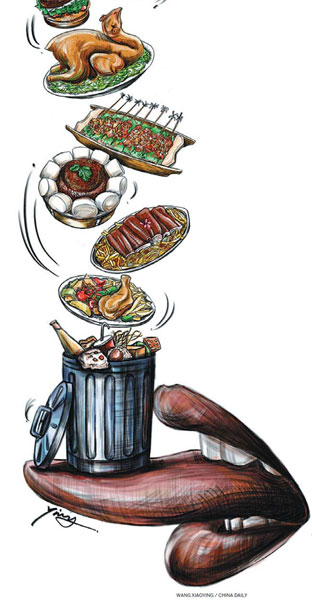
A campaign against food wastage is sweeping China, a country where 128 million people live below the poverty line.
Every year, food valued at 200 billion yuan ($32 billion) is thrown away in China. The volume is equivalent to the amount consumed by more than 200 million people during a 12-month period.
A proposal published in January, opposing waste, is part of a drive by China's new leaders to fight extravagance and advocate thrift.
Following suit, many provinces have launched their own, more-detailed versions. Central China's Henan province has ordered that business meals for cadres should feature no more than four dishes, and alcohol is prohibited. Meanwhile, the southwestern province of Guizhou has set a time limit of 45 minutes on meals paid for by the public purse.
The public has also adopted the idea, resulting in a surge in anti-waste rhetoric. For example, the Beijing Catering Trade Association, Beijing Cuisine Association and Beijing Western Food Association launched a joint anti-waste initiative in late January, which garnered a rapid response from many catering enterprises.
Smaller portions
At Quanjude Group, one of China's biggest restaurant chains, cards written in red print remind customers to order sparingly, while also pointing out that they are encouraged to take leftovers home to eat later. To discourage customers from ordering more than they can eat, the group has started to use smaller serving plates for portions. The new plates are roughly half the size than before and hold half the amount of food. Prices have also been altered to suit.
The campaign has also attracted large numbers of young people. In January, a proposal initiated on the micro blog service Weibo calling on Beijing residents to eat everything on their plate attracted the participation of 2.74 million people within the first two weeks.
Liu Qinglong, a professor at Tsinghua University's School of Public Policy and Management, was happy to see the change in attitude toward food wastage, but he said he's waiting to see how things pan out over the long term. He expressed concern that the new move may be short-lived and will fade away in the face of traditional cultural pressures.
"Ostentation and preserving face have been part of Chinese culture for thousands of years," he said, pointing out that people don't like to be seen taking food home from restaurants for fear that neighbors and friends may think them stingy or poverty stricken.
He suggested the government should introduce a media and social supervision mechanism to combat these perceptions, while also advocating the establishment of a special office to oversee payments made with public funds.
"Without effective and detailed implementation, the phenomenon will not last long," said Liu.
Although research by China Agricultural University in 2008 estimated that 50 million metric tons of food - one-tenth of China's total grain output - is wasted every year, the problem is equally, if not more, acute in industrialized countries and the phenomenon can be observed in almost every developed nation.
Roughly one-third of the food produced in the world for human consumption every year - approximately 1.3 billion metric tons - is wasted, according to a study commissioned by the United Nations' Food and Agriculture Organization.
China Daily examined the situations in the United Kingdom and the United States to see how those countries fare and how they intend to change their situations.