Artists in tune with global audiences


"In ancient times, Chinese arts and culture spread via traders along the Silk Road. Western people bought our goods and learned our culture. However, most Chinese shows that toured overseas in the past 60 years were `cultural exchange gifts' from the government. The gifts were limited and maybe not what Western people wanted. Hollywood movies, Disney animations and Broadway musicals are all (successful) commercial ventures," said Zhang Yu, president of the CAEG, founded in 1957 as the China Performing Arts Agency, the country's first performing arts outfit to engage in cultural exchange projects.
Before being assigned to the government-backed company in 1990, Zhang was an official at the Ministry of Culture, in charge of "cultural exchanges". His career path, from cultural official to arts manager, mirrors changes in the way Chinese arts are going abroad.
 |
|
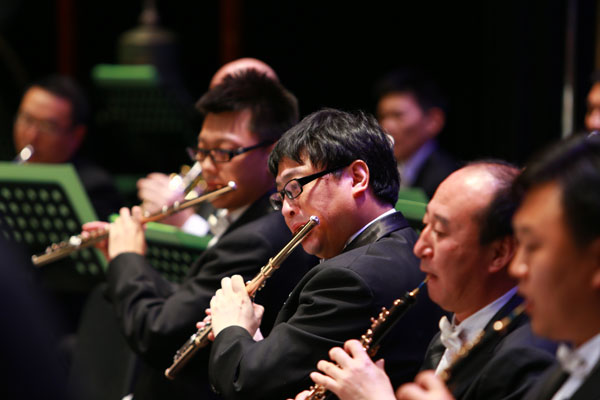
The China National Symphony Orchestra recently undertook a 30-date US tour. Feng Dan / for China Daily |
In the late 1990s, the CAEG began to sell productions to foreign companies, but most of the shows revolved around kung fu and acrobatics.
In 2010, 302 productions toured overseas, playing a combined 25,908 shows; 47 percent of the productions and 90 percent of the shows were exclusively acrobatic. By 2011, things had changed slightly, 126 overseas productions performed a combined total of 8,090 shows. Forty-four percent of the productions and 89 percent of the shows were acrobatic.
At the 2011 CCTV Business Leader of the Year Award, a young man from New Zealand challenged Zhang, the winner: "Do you have anything except acrobatics and Peking Opera?"
Zhang replied, "Yes. We have a variety of performing arts that are unknown to foreign audiences. You don't know, because we haven't offered them yet. That's what we are doing now.
"I admit that, because of language or cultural differences, Western people accept kung fu or acrobatics more easily, but we must educate them. Traditionally, Chinese people don't grow up with hamburgers but we still love McDonalds. Why not educate Western audiences to enjoy a variety of Chinese culture and arts?" he said.
Chinese culture is not a fixed form, added Zhang. The Taiwan dance company Cloud Gate is the best in China, despite modern dance being a Western genre, but Lin Hwai-min's choreography features calligraphy, paper, zen and other philosophies.
Since 2009, "Image China" has presented Kunqu Opera, dance, orchestras that play traditional Chinese music and others specializing in Western classical music, to audiences in the US, France, Germany, South Korea, Australia and New Zealand.
To better understand, and expand its share of, the Western market, the CAEG has developed a number of local partners. Zhang signed a contract with a major international arts management outfit to establish a joint company in May. In June, 2012 Zhang's team jointly founded a company with an agency in Vienna.
'Soft power'
China's rocketing economic growth has energized its "soft power", which, according to Joseph S. Nye, a professor of political science at the Harvard Kennedy School, "is the ability to get what you want through attraction rather than coercion or payment".
Culture is an important part of soft power and although the CAEG dominated cultural exchange projects 15 years ago, an increasing number of private companies have joined the fray.
Founded by Wu Zezhou and his son Wu Jiatong in 1991, Wu Promotions was one of China's first private touring companies and promoters. Now a leader in the field, one of the company's best-known projects is an annual overseas tour by traditional Chinese orchestras during the Spring Festival period.
Wu Jiatong said the problems have changed during the past 20 years. Overseas tours were once strictly controlled by the government and only government-backed companies, such as the CAEG, had the "right" to take shows abroad. Logistics was a problem, too. Now the market has opened up to private companies, but the complicated procedures required to obtain approval from the Ministry of Culture still prevent many small companies from heading overseas.