A different attitude
Zheng has already felt the impact of the reforms. She received the application forms from the local civil affairs office in Beijing on March 15 and was told that Beijing Hongdandan can apply to register straightaway. The application will be submitted soon. "The attitude of many government staff has been different from the past. I felt flattered," she said.
While Zheng is hopeful, Xie Lihua has decided to adopt a policy of "wait and see". The former deputy editor-in-chief of China Women's News pays close attention to the lives of women in rural China, and established the Cultural Development Center for Rural Women in 2001. Its programs range from suicide prevention to the promotion of political participation.
The center has also tried to register as an NGO many times, but has always failed. The lack of NGO status has disqualified it from becoming involved in the government's purchasing program, receiving funds from overseas, and participating in a number of exhibitions and meetings.
"I have waited for so many years that my black hair has gone gray. Now people say the 'spring' is coming and I want to give it another try," said the 61-year-old.
"But I want to keep calm this time. I want to see whether they (the reforms) are only like drizzle that stops quickly, or like sustained rainfall that will really help to rehydrate the NGO field," she added.
Yang Tuan, a specialist in social policy at the Chinese Academy of Social Sciences, understands Xie's concerns, but said the reduction of intervention in social management affairs is definitely a step in the right direction.
"But reform will not be an easy task," she said. "I have noticed that 19 provinces have piloted direct registration, but still some local officials have approved registration applications by NGOs by guanxi (networking and contacts)."
Despite the name, many Chinese NGOs have historical links with both central and local governments and often employ former government workers.
In light of this fact, "the reforms should also include pushing these 'government-organized nongovernmental organizations' to become more transparent and efficient, while the employees of those organizations have a vested interest in keeping the old system in place", said Yang, who leads a panel of experts that advise the Red Cross Society of China.
An unfamiliar concept
The NGO concept was largely unknown in China until the fourth World Conference on Women was held in Beijing in 1995 and a forum for NGOs was included, Xie said. "It was the first time that I and many other participants had heard the phrase," she recalled.
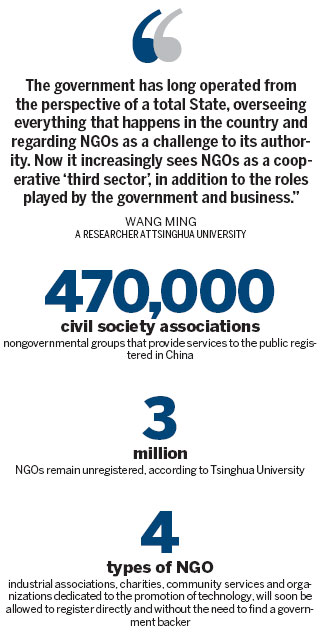
In the 18 years since, NGOs and the public have started to play an increasingly important role in providing social services and advocating changes in public policy, acting on the example set by NGOs in the wake of the 2008 Sichuan earthquake. But for many Chinese, NGOs are still an unfamiliar concept.
"I once went to the local tax bureau to do business and the staff were totally unaware of NGOs. And that was in 2011," said Wang Weina, director of Beijing NPI, a support organization for grassroots NGOs and newly founded public organizations.
In addition to the registration reform, the government should also help to incubate and foster grassroots NGOs, she said. "Some organizations are able to provide good services, but they don't even know how to write a project proposal."
Tsinghua's Wang Ming, who is also a delegate to the Chinese People's Political Consultative Conference, said many of his colleagues on China's top advisory body know little about NGOs. Some asked him to explain the concept to them when the reform plan was announced.
On a positive note, funding from local foundations is increasing and the outsourcing of social services to NGOs has become increasingly popular among local governments, because they realize the practice is more economical and efficient. In Beijing alone, 363 programs were outsourced in 2011, resulting in NGOs collecting 53 million yuan ($8.6 million) in fees.
"The reform could be a breakthrough (for NGO development)," said Liu Peifeng, a legal expert at Beijing Normal University who specializes in the study of nonprofit organizations.
He said the government should not only allocate funds, but also make social organizations, businesses and individuals the main providers of public services. "Otherwise, it is more of a policy proclamation. The real impact of the policy remains to be seen."
|
|
|
|
|
|
|
|

Copyright 1995 - . All rights reserved. The content (including but not limited to text, photo, multimedia information, etc) published in this site belongs to China Daily Information Co (CDIC). Without written authorization from CDIC, such content shall not be republished or used in any form. Note: Browsers with 1024*768 or higher resolution are suggested for this site.
License for publishing multimedia online 0108263 Registration Number: 20100000002731 


















 Op Rana
 Berlin Fang
 Zhu Yuan
 Huang Xiangyang
 Chen Weihua
 Liu Shinan