Cultural differences
Expat families attach great importance to honesty and satisfactory previous performance, so references from former employers are always required, said Xu.
However, most Chinese families don't bother with references, preferring to judge the suitability of a worker during a trial period, she said.
She pointed out that the working environment is more stable in expat families, which has a lot to do with the higher rate of pay and welfare. Most ayi work for the same employer for at least two to three years, or until the employer leaves China.
 |
|
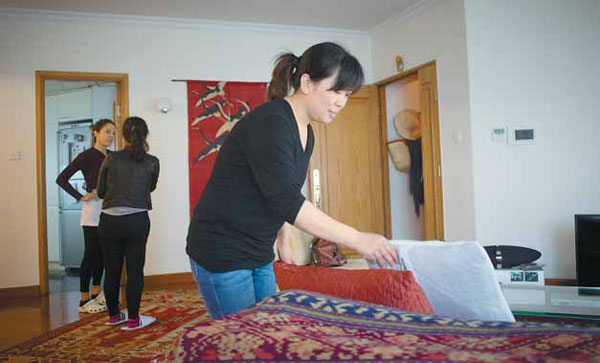
The basic requirements for ayi include cooking, cleaning and doing laundry. |
"The biggest difference between working for a laowai family and a Chinese family is that the foreigners tend to show more respect and treat you as an equal," said Cui Baoyi, 35, from North China's Hebei province.
Cui, who studied for a bachelors' degree via a correspondence course, changed jobs several times until she eventually settled down as a live-in ayi for an Anglo-Australian family in Shanghai.
"I remember at the beginning my boss told me several times that I should rest, and that after 9 pm my time is my own. I was surprised, because no one had said that to me before when I was working for Chinese families," she said.
Cui said she is happy with her current job, even through the work is arduous. Her day begins at 6 am, when she prepares breakfast and takeaway lunches for the children and their parents. She then takes the children to school, walks the dog, cleans the 600-square-meter villa, does some light work in the garden and then prepares the evening meal before finishing work at 9 pm.
It's no secret that ayi wages are low. It is part of the attraction for the foreigners. A live-in maid, who takes care of everything from cooking and cleaning to laundry, earns about 5,000 yuan a month and requires no endowment or medical insurance.
Thus, the demand for ayi in the expat community is high. However, language and lifestyle differences between Chinese and Westerners can create barriers, but those barriers can also provide business opportunities, said Sheng.
You have to collect and share tips with your ayi, she added, and different nationalities tend to have different demands. For example, German and Japanese families are very sensitive about time.
"Chinese ayi tend to stay for an additional 10 or 20 minutes after their working day ends. They wait for their employers to let them go, which is a traditional Chinese way of showing respect and dedication to the job. However, foreigners, especially those from Germany and Japan, often become upset about this, because of their understanding of 'working hours'," she said, adding that the employers are concerned that they may have to pay overtime.
Moreover, the idea of "clean" differs between Chinese and Western cultures.
"I find my ayi are very diligent when cleaning the kitchen, but sometimes they neglect dust on the bedroom floors," said Juliana, a Brazilian fashion designer who moved to Shanghai last year.
The differences often run deeper, too. "Sometimes they use the same cloth to clean the desk and the floor, and they have a different way of doing ironing and laundry," said Daniela Ingrosso, who has lived in China for six years and has just started a business that trains maids to prepare Italian cuisine for expat families.
Pasta and pizza
"It is not an easy business at all, because you have to matchmake; one group has high demands, while the other has qualities that are very different," said Sheng.
The main priority is language. Few ayi speak English, so those with better language skills earn more.
Meanwhile, cooking is also essential. The major issue for many foreign families is that ayi don't know how to cook Western-style meals. That means if they don't cook for themselves, family members will invariable end up eating Chinese food all the time.
That's one of the reasons Ingrosso started her business. Her three-day training course teaches ayi how to make pasta and three main courses - two meat dishes, dessert or pizza - and bread.
"I have trained about 10 ayi in the past few months and most of the families love it. Some of them even send their ayi to me for a second stint, so they can learn more about Western-style cooking," she said.
For Barbara T, a 42-year-old Italian who has lived in China for almost 11 years, that's definitely a welcome development.
"It's so nice that the maid can cook with the oven (most Chinese dishes tend to be fried) and make pasta or chocolate salami for us now," she said.
Because Barbara isn't a great fan of the kitchen, the family only used to eat Italian food about twice a week. The rest of the time they ate traditional Chinese meals.
Sheng's agency has access to a "special network" of ayi with experience of working for expats. Unlike ordinary ayi, or part-timers who work for Chinese families, they know how to iron clothes and bed sheets, cook Western-style food, and they all speak fluent English.
"Supply still falls short of demand and so some expat families are willing to pay more to hire a proper ayi. But, as there are no formal training institutions to teach English or serving skills, we have to focus on experienced workers or conduct informal training ourselves," she said.
|
|
|
|
|
|
|
|

Copyright 1995 - . All rights reserved. The content (including but not limited to text, photo, multimedia information, etc) published in this site belongs to China Daily Information Co (CDIC). Without written authorization from CDIC, such content shall not be republished or used in any form. Note: Browsers with 1024*768 or higher resolution are suggested for this site.
License for publishing multimedia online 0108263 Registration Number: 20100000002731 












 Op Rana
 Berlin Fang
 Zhu Yuan
 Huang Xiangyang
 Chen Weihua
 Liu Shinan