Cross-provincial plan
While some observers blame Chen's predicament on China's medical insurance program, it should be pointed out that the policy works in reverse for urban dwellers, whose medical insurance doesn't cover expenses incurred out of town. However, the double whammy of financial hardship and low-quality local healthcare services means residents with a rural hukou are usually hit hardest by the policy, migrant workers especially.
 |
|
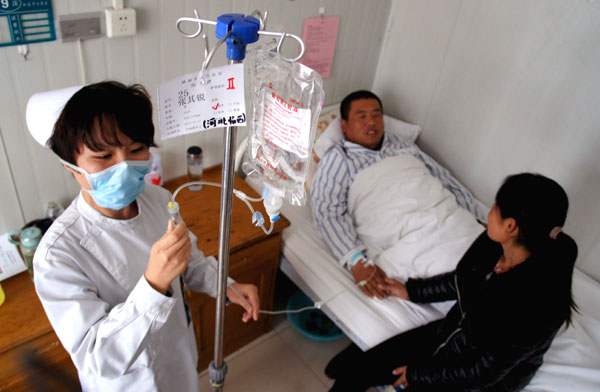
Zhang Qirui, from Heibei province, receives treatment at Liaocheng People's Hospital in Shandong province. Zhang Xianju / for China Daily |
"If they get ill in the city - and they probably will because of the grueling workload - they have two choices; they may visit a doctor in the city and pay with their own hard-earned money, or they may choose to take the train and head home where they are covered by insurance, but that doesn't take into account the cost of the ticket and the near-certainty of losing their job," said Liu.
Now, it seems the central government is taking step to rectify the situation. Preparatory work has started on the construction of a State-level information platform to support a cross-provincial "instant reimbursement" plan for all rural residents, according to Yang Qing, director of the Rural Health Department at the Ministry of Health.
Successful implementation of the platform would mean that rural residents would be eligible for treatment at hospitals outside the areas covered by their hukou and, crucially, wouldn't have to pay the full cost themselves.Instead, they would be required to pay the difference between the total treatment cost and the amount contributed by their local medical insurance program.
Currently, patients either have to pay the entire cost of treatment, or, in the unlikely case of a transfer, claim reimbursement after returning to their hometown and submitting the requisite details and forms to the local health authority.
"For most farmers, the fact that they have to pay first - although, they rarely have the money to do so - and then claim the money back is in itself an effective barrier, not to mention the large number of cases that become bogged down in the procedural swampland," said Liu. "For one thing, just collecting all the requisite materials and getting them rubber-stamped could prove maddening. In many cases, it would be a 'mission impossible.'"
The proposed instant reimbursement plan was specifically designed to address the issue. China's 260 million migrant workers - most of whom left their rural homes in search of better opportunities and higher pay in cities such as Beijing and Shanghai - were uppermost in the decision-makers' minds when they were formulating the policy.
Although the plan may sound like good news for migrant workers, they'll still have to wait for it to be implemented, and probably for a very long time, according to Zhang Yi, director of the Beijing New Rural Cooperative Medical Scheme Management Center. "As far as I know, the whole cross-provincial thing is still very much an idea," he said, referring to media reports that the plan will soon cover Beijing and eight provinces, including Jiangsu, Anhui, Henan and Hunan.
"Taking the regional differences into account, the New Rural Cooperative Medical Scheme is designed to operate at the district or county level. Each district has the right to make its own rules regarding the details, including the percentage of costs and the list of medicines covered by insurance. For example, Beijing has 16 districts and 13 of them have a combined rural population of three million. As a result, in Beijing alone more than 10 different schemes are being implemented at the same time," he said.
"China has nearly 3,000 counties. The realization of instant reimbursement nationwide would necessitate inputting all the relevant patient information into the computers at hospitals' cost-settlement centers simply so the staff could calculate and write off the amount covered by the specific insurance scheme the patient subscribes to in their hometown."
For many observers, the technical challenge is the least daunting aspect, dwarfed as it is by a much bigger problem - competing local interests. Local governments can recoup part of the cost of medical insurance through tax if an eligible patient is treated at a hospital within their province. However, the same government would be 'giving' money permanently to another province if the patient opted for treatment at a hospital outside the province. Given China's demographic flow, if the reimbursement plan is put into practice, cash-strapped rural provinces stand to lose money to their counterparts in the economically developed eastern and southeastern regions.
|
|
|
|
|
|
|
|

Copyright 1995 - . All rights reserved. The content (including but not limited to text, photo, multimedia information, etc) published in this site belongs to China Daily Information Co (CDIC). Without written authorization from CDIC, such content shall not be republished or used in any form. Note: Browsers with 1024*768 or higher resolution are suggested for this site.
License for publishing multimedia online 0108263 Registration Number: 20100000002731 
















 Op Rana
 Berlin Fang
 Zhu Yuan
 Huang Xiangyang
 Chen Weihua
 Liu Shinan