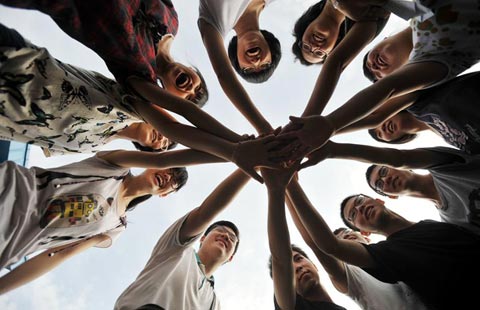
Former refugees have fond memories of their stay in the eastern Chinese city during World War II, as Zhao Xu reports.
Editor's note: History is, by definition, about past events, and while nothing can be done to change those events, forgetting them may lead to the wrong roads being taken in the future. During the coming months, China Daily will present a series of regular reports about ordinary lives during World War II and the continuing impact of the conflict on the present and the future. This is the third report in the series.
 |
|
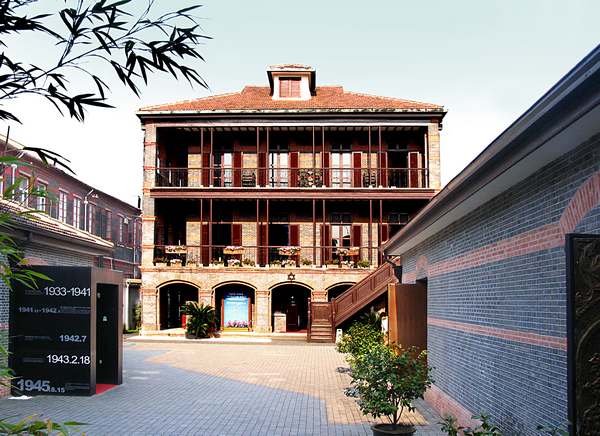
The Ohel Moshe Synagogue was built in 1927 to commemorate Moshe Greenberg, an early leader of the Jewish community in Shanghai. The building is now a museum dedicated to preserving the memory of the city's Jewish inhabitants during World War II. Provided to China Daily |
The floor of the small courtyard at the Shanghai Jewish Refugees Museum is rough and craggy. Paved with stones salvaged from a renovation project in the area nearly a decade ago, the uneven floor is intended as a metaphor, evoking the tribulations endured by Europe's Jewish population during World War II and the rugged road they were destined to tread.
For many, Shanghai became a wartime home, a haven from the storms sweeping their homelands, but the relationship began abruptly. "They were totally unprepared for each other - the Jewish refugees and the city. But eventually they found a way to get along, and almost inevitably, fell in love," said Zhang Jian, deputy director of the Institute of History at the Shanghai Academy of Social Sciences. "While the Jews, mostly from middle-to-upper-class European families, had a really hard time getting used to the splendor and squalor of a city known as 'The Paris of the Orient', Shanghai for its part had never before seen such a large influx of foreigners within such a short period of time. In fact, their arrival drove up rental prices and tightened the already competitive job market in the area in which they congregated - Hongkou, or Hongkew, as it was called in those days," he said.
Zhang has spent the past two decades researching the history of the city's wartime Jewish population. "Around that time, Shanghai was effectively in a state of confusion. The Japanese seized the city in 1937 but had yet to establish a puppet government. Because war hadn't been declared between Imperial Japan and the Allies, the city's International Settlement, which first came into being as a result of China's defeat in the First Opium War (1839-42), was still under the control of Western powers.
"Back then, all those disparate factors conspired to make Shanghai almost the only port in the world that remained open to Jews," said Zhang. "Between 1937 and 1939, about 20,000 of them - German, French, Austrian and Polish - arrived by ship from Italy via the Suez Canal, and later by the Trans-Siberian Railway. Some traveled through northeastern China to reach their southern destination, while others even crossed the ocean to Japan before arriving in Shanghai.
 |
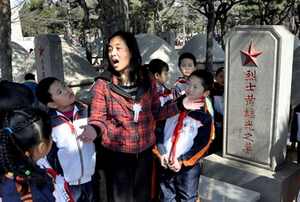 |
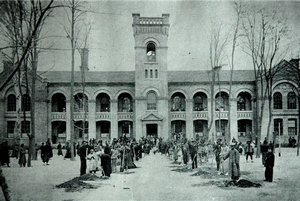
| Weihsien: Life and death in the shadow of the Empire of the Sun | In memory of unnamed war heroes |


Copyright 1995 - . All rights reserved. The content (including but not limited to text, photo, multimedia information, etc) published in this site belongs to China Daily Information Co (CDIC). Without written authorization from CDIC, such content shall not be republished or used in any form. Note: Browsers with 1024*768 or higher resolution are suggested for this site.
License for publishing multimedia online 0108263 Registration Number: 130349