 |
|
Ding Haibo from Xingfa village in Dunhua city, Jilin province, carries a discarded shell he found in a field. [Photo by Feng Yongbin/China Daily] |
Chemical weapons
The concerns expressed in Daqiao were echoed by residents of Linhuapao Forestry Farm, the site of a Japanese storage facility for chemical weapons.
In 2004, two children were injured when they inhaled mustard gas as they played on the bank of a nearby river. One of them, Liu Hao, is now a high school student, but his health is still poor. "After more than a year's treatment at the hospital, the symptoms were under control, but his immune system had been destroyed. Whenever the temperature changes dramatically, or a cold is making the rounds, he has no resistance so he automatically falls ill. He'll never improve," said Liu Tongyi, the boy's father.
"The poisoning has retarded his growth and he's much shorter than his peers. He feels inferior, both physically and mentally. We've had to pay for his treatment since he was discharged from the hospital, but because we don't have a stable income or medical insurance we often have to borrow money to buy medicine for him. I think the Japanese government should take responsibility. I want my healthy son back. He needs compensation and good care," he said.
Suicidal thoughts
Many people in Heilongjiang are also living with injuries inflicted by chemical weapons. In 2003, Qiqihar resident Liu Jianbin was hurt when mustard gas leaked from a shell at the recycling center where he works. "Suicidal thoughts have lingered in my mind for many years. I suffer constantly from headaches, coughs and vomiting. Not a single day goes by when I'm free of aches and pains," he said.
On April 28 and 29, a dozen people injured by chemical weapons presented their cases at a hearing in Harbin attended by 10 Chinese lawyers and five lawyers from Japan.
"We have pursued many lawsuits against the Japanese government over the years. Although they have ended in failure, we believe that if we persist, we will win some day," said Li Wanchun, a director of the Heilongjiang Qingyu Law Firm.
Norio Minami, a Japanese lawyer who has worked with Li, hopes the publicity surrounding the legal challenges will raise Japanese people's awareness about the history of their country's invasion of China, and cause the Japanese government a high degree of concern.
The desolate village
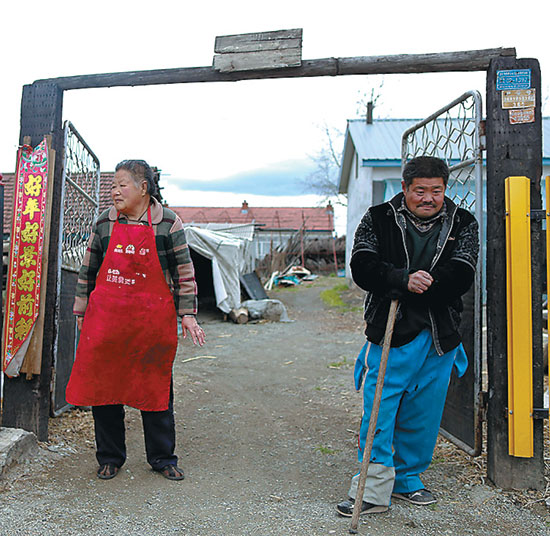
When a large number of mustard gas shells were dug up in Lianhuapao, a forestry farm in Dunhua, and transported to the Haerba Mountain Range to be destroyed and buried, the city authorities moved the residents into new homes.
However, because they lacked the skills required to work in an urban environment and the houses were of poor quality, many villagers returned to their old homes and began planting crops again.
Now, the farm gate and most of the houses have been demolished, and all that's left is a row of abandoned red houses and several small temporary shelters. With only about a dozen people working in the fields, the region has a desolate air.
"Before the shells were dug up, they were everywhere. They were even used as 'stones' to make a foundation for a new road," said Liu Jun, a former resident.
"When logging was prohibited, we lived by planting crops, but those skills were useless when we moved to the city, so we lost our source of income. We had to go back to working in the fields," he said.
"However, the transport service, electricity and water were all cut off, greatly inconveniencing our lives and work. Travel from the farm to the city in farm vehicles takes three hours, and to make matters worse, in many people's minds Lianhuapao equals 'poison'. People don't buy produce if they know it comes from here. We don't want to lie and deny the source of the food, but we have to live and raise our families," he said.
Another returnee, Wu Guihua, 68, makes a living by raising frogs and selling them to restaurants. "Many former residents died of various cancers and strange illnesses, so we think the vegetables, frogs and other foodstuff may be polluted. Without unpolluted soil, water, and air, and a stable income, how can we survive?" she asked.
Contact the writer at hena@chinadaily.com.cn


Copyright 1995 - . All rights reserved. The content (including but not limited to text, photo, multimedia information, etc) published in this site belongs to China Daily Information Co (CDIC). Without written authorization from CDIC, such content shall not be republished or used in any form. Note: Browsers with 1024*768 or higher resolution are suggested for this site.
License for publishing multimedia online 0108263 Registration Number: 130349