 |
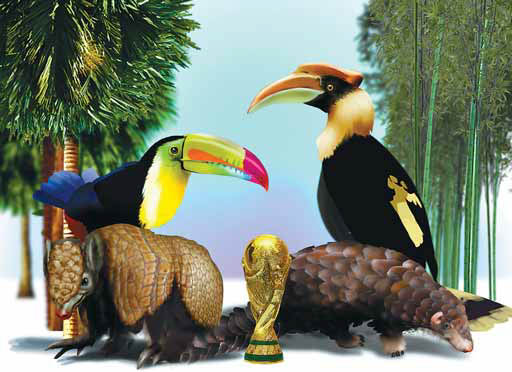
| SIMILAR BUT NOT THE SAME: Although they look alike, the pangolin is of the order pholidota, while the armadillo is classified as part of the order cingulat. A newspaper erroneously labeled the toucan as the “god bird” of the Jingpo people in Yunnan. In truth, that bird is the hornbill. |
Some claim World Cup mascot related to Chinese pangolin, Yang Wanli reports from Kunming.
In the run-up to the FIFA World Cup 2014, Chinese soccer fans have been attempting to wrap their tongues around some of the exotic names from the national squads, with Sokratis Papastathopoulos and Lazaros Christodoulopoulos of Greece, and Reza Ghoochannejhad of Iran among those that have proved the most perplexing.
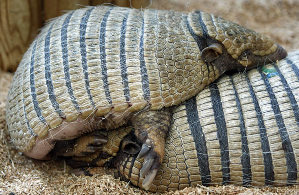
However, the most popular name by far isn't that of a human being, but a shy, retiring creature called the Brazilian three-banded armadillo, or the tatu-bola, which has been chosen as the mascot for the world's biggest soccer tournament, which begins in Brazil on Thursday. The name, which is Portuguese in origin, comes from the animal's ability to curl up into a ball, or bola, at the first hint of trouble. In fact, it's one of just two species of armadillo that can achieve this feat.
 |
| IN POPULAR CULTURE: The three-banded armadillo, or tatu-bola, has been chosen as the mascot for the FIFA World Cup 2014, which begins in Brazil on June 12. The name, which is Portuguese in origin, comes from the animal’s ability to curl up into a ball, or bola, at the first hint of trouble. |
"It's the first time I've seen the name of this animal, and I have no idea how to pronounce it," wrote "Sweet Sugar" on her micro blog on Sunday. Her post prompted scores of comments from netizens, most of whom were equally mystified.
Having learned the correct pronunciation, many people turned their attention to gathering facts about the tatu-bola. Guokr, one of China's top websites for science enthusiasts, has published several short introductory articles via its micro blog in response to questions from the public about the living habits, diet and place of origin of the animal, known in Chinese as qiuyu.
Online sports chatrooms and Sina Weibo - the Chinese equivalent of Twitter - have been bombarded by soccer fans discussing the qiuyu. Meanwhile, on soccer.hupu, a popular bulletin board site, a fierce discussion has raged over whether the tatu-bola has blood ties with the Chinese pangolin.
Physically, the two animals have marked similarities: Both have long snouts, strong claws and the same sort of protective armored shell. To the Chinese, the pangolin is a familiar creature, partly because it has been used in countless cartoons, where its amazing skill at digging holes is fully illustrated, and also because its scaly epidermal armor is used in traditional Chinese medicine to treat inflammation of the breast tissue, among other conditions.
Unrelated 'relations'
However, to many people's disappointment, zoologists have refuted claims that the animals are related. "They are totally different and belong to entirely different orders. The Pangolin is classed under the order Pholidota, while the armadillo is a member of the order Cingulata," said Wang Yingxiang from the Kunming Institute of Zoology, under the Chinese Academy of Sciences.
"The armadillo is indigenous to Brazil and doesn't exist in the wild outside South America," Wang said. "The only real characteristic shared by the armadillo and the Chinese pangolin is their favorite food - white ants."
But how can it be that two animals that look almost identical and share similar habits are not even distantly related? The answer lies in the way in which scientists classify living things.
The modern system of biological classification was introduced by Carolus "Carl" Linnaeus (1707-78), a Swedish physician, botanist and naturalist. The system - which is built on seven categories: kingdom; phylum; class; order; family; genus; and species - is like a mathematical tree graph, where the kingdom is the main stem and the species are the branches and twigs.
According to Rao Dingqi, an expert on amphibians at Kunming Institute of Zoology, the time scale required for animals to develop into two orders usually takes tens of millions of years, and then additional millions of years for creatures within the same order to develop into distinct families. "This may help people to understand the extent to which two animals can differ from each other," he said.
Cingulata consists primarily of armadillo-like animals, according to Wang, and the name refers to the girdle-like shell of present-day armadillos. The armadillo is the only surviving member of Cingulata, and the five other species that were once in this order are now extinct and are only known from fossilized remains.
 |
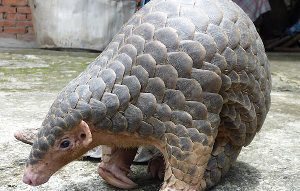 |
| ARMADILLO: Known as qiuyu in Chinese, its scaly epidermal armor is used in traditional Chinese medicine to treat inflammation of the breast tissue. | PANGOLIN: The animal shares one thing in common with the armadillo - a love of their staple food, white ants. |


Copyright 1995 - . All rights reserved. The content (including but not limited to text, photo, multimedia information, etc) published in this site belongs to China Daily Information Co (CDIC). Without written authorization from CDIC, such content shall not be republished or used in any form. Note: Browsers with 1024*768 or higher resolution are suggested for this site.
License for publishing multimedia online 0108263 Registration Number: 130349