|
 |
|
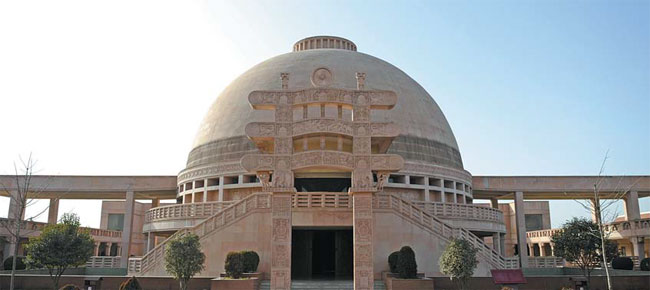
The Indian Buddha hall is seen on Dec 30, 2012. LI BO / XINHUA |
The shrine covers about 3,000 square meters and will be broadened into a temple complex of more than 10,000 sq m. Thai supporters provided most of the funding for the extension.
|
Help from the Land of Smiles In a Buddhist temple complex in Henan province, nine Thais have been working from 6 am to 5 pm almost every day for more than three years. The workers break for lunch for only half an hour. They are put up in small living quarters and, apart from watching DVDs they have brought from home, they have no other form of amusement or leisure. The workers are racing against the clock to extend a Thai-style shrine at White Horse Temple in Luoyang. The shrine was built in 1995 and funding for its construction came from Thai donors. One of the nine Thai workers is power engineer Manot Pakpoomjit, who is monitoring the project. The 25-year-old came three months ahead of graduating from university. He looks forward to returning home to visit his 80-year-old mother about twice a year. "An old monk had asked me if I wanted to come to China but I said 'no' almost immediately," said Manot. But Manot soon changed his mind after learning that the monk was asking him to help build a Thai-style temple complex in China. When he found out that he would be helping to build the first such temple complex in China, Manot packed his bags for the country. He would be able to help "make Chinese see a Thai temple without going to Thailand". Manot said he can make 10,000 ($1,600) to 20,000 yuan a month in Thailand with his expertise, but he makes only 6,000 yuan a month in China. "I'm here not for money. We Thais are strong believers of Shakyamuni (Gautama Buddha). We want more Chinese to know Thailand," he said. Facing barriers like language when he first arrived, Manot has overcome them and now communicates easily with his Chinese colleagues and friends. "I didn't even know what 'nihao' (how are you in Chinese) meant when I arrived," he said. Getting used to local life has not been easy for the nine. "It's hot with high humidity in Thailand and the temperature doesn't change much," he said, "The temperature here can drop greatly when it rains, from more than 28 C to less than 10 C. That makes us catch cold easily." As a meat eater, Manot also has to settle for simple vegetarian breakfasts and lunches with the monks. The Thais will cook their own meals in the evenings but even these will be made up of vegetables. "Sometimes, we add some special seasoning to the dishes to make it taste like meat," Manot said. The Thais will venture out of the temple to eat meat two or three times a week. Manot has since put on 20 kg after arriving at the temple. "Eating mostly vegetarian dishes makes me hungry very fast after work. So I end up eating a lot," he said. The Thais can also go out of the temple for amusement, but are usually too tired to do so after a hard day's work. Still, he believes it is all worth it. "The temple we build here is beautiful, even more beautiful than those in Thailand. We are building it with our heart." Contact the writers at houliqiang@chinadaily.com.cn and qixin@chinadaily.com.cn |
The White Horse Temple is expected to see more Buddhists from other countries, especially from those in Southeast Asia.
An international Buddhism research institute will also be built in the temple, Yinle said.
"With the shrines and temples in foreign styles acting as bridges, we will strengthen Buddhism communication with Southeast Asian countries, especially those countries that built the shrines," said Yinle.
"We will make full use of the White Horse Temple, the oldest temple in China, as a historical platform and invite Buddhists from Southeast Asia to give lectures here."
Buddhists of the White Horse Temple currently give lectures during the weekend. It is also planning to invite famous Buddhists nationwide and from Southeast Asia to lecture after the institute is completed, said Wang.
The shrines or temples built in foreign styles and the research institute, together with other extension projects, will make White Horse Temple the largest of its kind. The total area of the temple complex will be increased to 86.7 hectares.
Bridging role
Besides Buddhism communication, the temple is certainly becoming more important as a bridge for diplomatic ties.
Before Myanmar President Thein Sein, former Indian president Pratibha Patil as well as former Indian prime ministers P.V. Narasimha Rao and Atal Behari Vajpayee visited the temple.
More exchanges at the religious level are expected to help boost diplomacy and understanding across borders.
Huang Xianian, a researcher on Buddhism studies and cross-culture religious comparison at the Institute of World Religions under the Chinese Academy of Social Sciences, said religious contact between China and Southeast Asian nations is an "influential catalyst of great effectiveness for public diplomacy".
Especially during China's Tang Dynasty(AD618-907), booming cross-border religious exchanges between nations in China, South Asia and Southeast Asian nations prompted policymakers to upgrade grassroots-level exchanges to official relationships, and prominent religious figures played critical roles in it.
"Buddhism has long been one of the most influential religions in Southeast Asia and Northeast Asia, where it enjoys nationwide adoration ... Buddhism is one of the top resources for boosting diplomatic contacts with neighbors," he said.
The legacy of Buddhism continues to shape the landscape of many Southeast Asian nations such as Myanmar, Thailand and Sri Lanka. Cambodia's official religion is Theravada Buddhism and more than 93 percent of its residents are Buddhists.
In 1992, about 90 percent of the Myanmar population followed Buddhism and a deeper understanding of Buddhism's role in Myanmar leads to broader recognition in the country's evolving politics and society, said Li Chenyang, a professor of Southeast Asian studies at Yunnan University in southwestern China.
"The ways of thinking, moral standards, values, judgment and linguistic customs - many of them are still shaped by Buddhism. Images of high-ranking officials praying at a Buddhist temple also prevail on national TV," Li said.
The idea of developing Buddhism is gathering momentum in Asia and in addition to shared historical factors, its boost to tourism and economic growth is also welcomed, Huang said.
Amid a boom in the construction of exotic temples in China, Buddhists in the country are also expected to build more temples overseas to help "China's public diplomacy and promotion of Chinese culture".
Contact the writers at houliqiang@chinadaily.com.cn, Zhang Leilong contributed to the story.


Copyright 1995 - . All rights reserved. The content (including but not limited to text, photo, multimedia information, etc) published in this site belongs to China Daily Information Co (CDIC). Without written authorization from CDIC, such content shall not be republished or used in any form. Note: Browsers with 1024*768 or higher resolution are suggested for this site.
License for publishing multimedia online 0108263 Registration Number: 130349