At home in Beijing, but still not locals


|
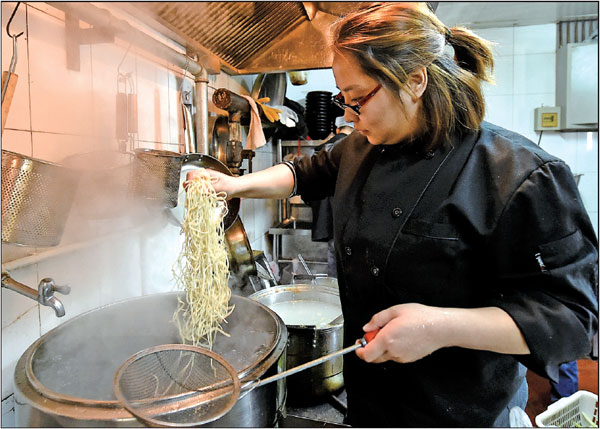
Zhang Ziyu prepares food for customers at the noodle restaurant she owns in Beijing. Even though she does not hold Beijing hukou, the Chongqing native has been pursuing her dreams in the capital city for four years.Photos By Cao Yang / For China Daily |
As the capital's population grows the city government is facing a growing challenge arising from the application of the household registration system. Du Juan reports.
Editor's note: This is the first in a series of reports looking at the effects of hukou, China's household registration system, on the lives of ordinary citizens who have left their homes to work in other areas and regions. More reports will follow in the weeks to come.
More than 20 million people live in Beijing, the capital of China and one of the world's great cities.
There are many ways to define the city's residents: gender; age; employment status; interests; and personality. One category stands above all others, though - the hukou, or household registration, system.
Unlike people's personal ID cards - similar to a social security number in the United States - which can be used on most occasions to determine a person's identity, the hukou system can affect life at a much deeper level.
Under the system, which was introduced in the late 1950s, people are awarded hukou in the place their parents are registered, irrespective of their place of birth. As long as the person remains in the area in which they are registered, the system provides them with access to services such as education, healthcare and public housing, along with employment opportunities and retirement benefits.
However, it is hard to transfer hukou, which means people who relocate for work or family reasons are often unable to register with the local authority, which denies them access to social and education services.
The problem is particularly acute in Beijing, which sees thousands of new arrivals every year, swelling the population and presenting the government with a major challenge.
There are only a few ways of obtaining Beijing hukou. First, people can apply if their parents were registered in the city at the time of their birth. However, people born in the capital to unregistered parents are ineligible.
Second, graduates can apply if they land a job in a government department, educational institution or a company that has been allocated a hukou quota for Beijing.
Third, the Beijing government has the option of granting hukou to successful entrepreneurs and industry leaders, in bid to attract them to work or invest in the capital.
China Daily canvassed the views of unregistered citizens in Beijing to discover how they face the challenges presented by a lack of hukou and how they see their lives developing.
Wang Xin, graduate student
Wang is searching for a job in Beijing. "To be honest, my main priority is not a large salary or career development opportunities, but whether the employer can offer me Beijing hukou or not," said the graduate media student at Beijing Normal University.
Wang, 25, was born in Harbin, in the northeastern province of Heilongjiang, which means he is registered there.
The greater number of opportunities on offer in the capital means he is reluctant to return to his hometown.
"If I returned to Harbin, I could only get a job with a local TV station at best. The platform in Beijing is much wider," he said. "I want to stay in the city after graduation, so Beijing hukou would give me a sense of security, and the right to buy property. Moreover, if I get married here, my child will be able to attend a public school in Beijing."
He added that making money is not his prime consideration at this stage in his life. Even so, it's still getting more and more difficult to find a job that offers hukou.
The reason is simple: Too many people live in the city and the number is growing.
Faced with limited land, transportation, medical services and education resources, the government has stepped cautiously with regard to population management.
As a result, companies that were previously able to offer a job with a Beijing hukou can no longer do so, because the city government has cut the quota in recent years.
Meanwhile, government departments and municipal-level bureaus no longer accept applications from job seekers without Beijing hukou, which has closed the door to students such as Wang.
"I know that smog is a serious problem in Beijing and it's harmful to people's health, but I still want to make every effort to stay because it offers opportunities that are not available anywhere else."