|
|
 |
|
30th Anniversary Celebrations
Economic Development
New Rural Reform Efforts
Political System Reform
Changing Lifestyle
In Foreigners' Eyes
Commentary
Enterprise Stories
Newsmakers
Photo Gallery
Video and Audio
Wang Wenlan Gallery
Slideshow
Key Meetings
Key Reform Theories
Development Blueprint
Hong Liang:
Government role decisive for recovery  Brendan J. Worrell:
Polish PM earns praise  OP Rana:
Saving the Earth more important  Li Xing:
Teachers like Li need our support   Flying united
By XIAO LU (China Daily)
Updated: 2008-08-18 07:09
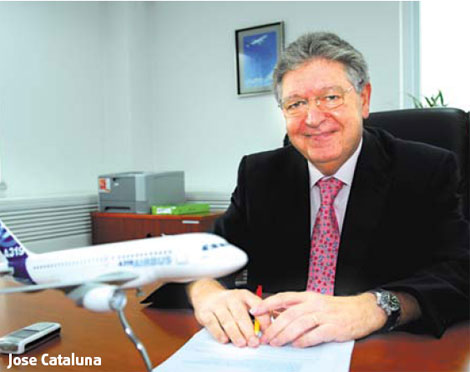 From supplying components, to hosting the site of an aircraft final assembly line, the Chinese aviation industry is increasingly being integrated into Airbus' industrial organization and vying to become a risk-sharing industrial partner of the European aircraft manufacturer. The Airbus (Beijing) Engineering Center recently received a business license as a Sino-foreign joint venture and held its first board meeting. Airbus controls 70 percent of the center, while Hafei Aviation Industry Co Ltd takes the second biggest share with 18 percent and Jiangxi Hongdu Aviation Industry Co Ltd holds 7 percent. China Aviation Industry Corp I (AVIC I) holds the rest of the shares. Hafei and Hongdu are both affiliated to AVIC II. AVIC I and AVIC II are China's leading aviation manufacturers and have been supplying components to Airbus and Boeing. The joint venture will carry out 5 percent of Airbus' outsourced airframe design work of the A350XWB. The A350XWB is Airbus' answer to the runaway success of US rival Boeing's B787 in the lucrative market for long-range, mid-sized, twin-aisle planes. "It will design the components that later on might be manufactured in the different factories of AVIC I and AVIC II. We are giving them the possibility to be full risk sharing partners of Airbus," says Jose Cataluna, general manager of the center. The center has recruited 140 Chinese engineers, including 26 engineers from AVIC II and 14 from AVIC I. The rest are fresh graduates from leading Chinese universities. The center is expected to employ 200 Chinese engineers by the end of this year. "AVIC I and AVIC II have sent the best manufacturing engineers of their plants and the center will train them to become design engineers," Cataluna says. "Our main task is to develop the capability for designing a specific component for an aircraft." The Beijing joint venture is one of Airbus' five outsourced engineering centers around the world. The others are in Wichita, Kansas, and Mobile, Alabama in the United States; Moscow and Bangalore. They are closely linked with Airbus' design offices in Europe. For example, the center in Russia supports Airbus engineering people in Hamburg and Toulouse, focusing primarily on fuselage structure, stress and systems installation. The Wichita center is involved in wing design for the A380 and other long-range aircraft and has real-time communication links with their British colleagues in Filton. "Airbus is trying to become a more and more global company. The way to develop that philosophy is to use the capacity we can develop in each country," Cataluna says. The Toulouse-based aviation manufacturer launched a restructuring plan at the beginning of last year to face challenges such as the US dollar weakness, increased competitive pressure and the financial burden related to the A380 delays. A highlight of the restructuring plan is a new operational model for Airbus to outsource half of A350XWB's aerostructure work to development partners as the aircraft maker seeks better distribution of development costs and risks. This is about twice as much as in the company's earlier programs. Airbus will offer 5 percent of its outsourced work to China. The work packages being proposed are likely to include a high proportion of composite parts, mainly moveable parts on the wing surfaces and the horizontal and vertical tails, flaps and rudders. Airbus will set up a joint venture with Harbin Aircraft Industry Group Co (HAIG), a company affiliated to AVIC II, early next year to produce aircraft composite material parts and components for the A350XWB. The two companies signed a framework contract in July during the 2008 Farnborough International Airshow. Airbus will control 80 percent, while HAIG owns the rest of the shares. Airbus has been increasing its industrial footprint in China. Before 2004 it purchased less than $20 million of its aircraft components per annum from Chinese factories. But by the end of 2007, its subcontracting volume to China exceeded $70 million. The company plans to increase that number to $120 million per annum in 2010 and $450 million per year in 2015, Laurence Barron, Airbus China president, told China Business Weekly earlier this year. "As we look to achieve that target, a very important issue for us is to create a solid team in China for design," Cataluna says. (China Daily 08/18/2008 page6) 
|
       |
主站蜘蛛池模板: 井陉县| 安仁县| 营山县| 濉溪县| 都江堰市| 玛沁县| 韶山市| 嘉定区| 马关县| 榆林市| 特克斯县| 泸水县| 中卫市| 德州市| 普兰店市| 永顺县| 贡觉县| 长武县| 南昌市| 丹巴县| 东辽县| 荃湾区| 怀柔区| 松潘县| 浦城县| 康保县| 孝昌县| 娱乐| 罗田县| 志丹县| 忻州市| 芷江| 榆树市| 光泽县| 兴化市| 高密市| 于田县| 西畴县| 西林县| 赫章县| 江门市| 泰顺县| 陈巴尔虎旗| 临城县| 双流县| 收藏| 阳朔县| 治多县| 蓬莱市| 彝良县| 台中市| 永嘉县| 贡山| 芜湖市| 宁阳县| 肇源县| 汉寿县| 湘潭市| 内丘县| 广饶县| 磐安县| 汽车| 西平县| 堆龙德庆县| 双桥区| 承德市| 满城县| 嘉义市| 酉阳| 青龙| 拉孜县| 西贡区| 深水埗区| 富顺县| 彭州市| 隆化县| 巨野县| 怀远县| 肇庆市| 广水市| 西青区| 绵竹市|