|
|
 |
|
30th Anniversary Celebrations
Economic Development
New Rural Reform Efforts
Political System Reform
Changing Lifestyle
In Foreigners' Eyes
Commentary
Enterprise Stories
Newsmakers
Photo Gallery
Video and Audio
Wang Wenlan Gallery
Slideshow
Key Meetings
Key Reform Theories
Development Blueprint
Li Xing:
Teachers like Li need our support  Alexis Hooi:
Going green in tough times   Hong Liang:
Bold plan best option for economy   Play days
By You Nuo (China Daily)
Updated: 2008-10-06 15:04
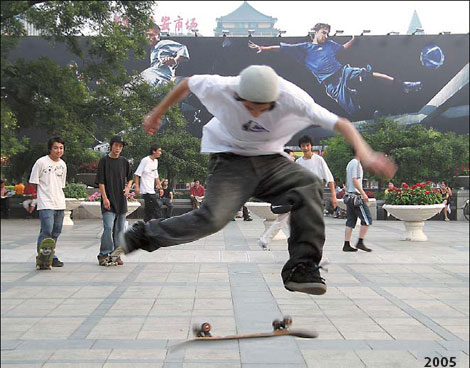
We have a change this week. Instead of having one picture of the past and another of the present, we have two taken in 2005. One shows teenagers in Beijing, both dressed and behaving like their peers in developed countries, on skateboards. In the other, rural kids clowning around on rafts in the river on a holiday probably have no skateboards. So although taken in the same year, the two photos show different worlds. While the urban world points to the future, the rural world still reminds people of the past.
Indeed, how people spend their free time and holidays reveals a great deal about the economy. In China, the comparison between the countryside and the city is most revealing in the gap between the comfortable middle class and those who are still poor and whose living standards may not seem much different from the early days of the Chinese economic reform. China, in economists' eyes, used to be a typical case of what they called a "dual economy". It means one country with two economies, or an odd pairing with one economy that was on the fast track, and the other that was slow to follow. There was a geographic difference. While one featured large industry and rising living standards in the cities, or at least some cities, there were very few changes in the countryside. But economists also point out that once the market forces begin to work, the dual economy would start to become more integrated. With more highly-paid factory and office jobs, the urban economy would begin to absorb labor from the rural areas, whose products can no longer compete with the cities' in terms of prices and profit. Hence, the young rural migrant workers are filling all the new manufacturing jobs, and most of the service jobs as well, in the more affluent coastal cities. The migrant workers usually send most of their wages home to help their parents and young siblings eke out their livings. In doing so, many can also help their younger brothers and sisters avoid having to begin working at a very young age in paddy fields or vegetable gardens. But life in the villages is still far below the living standards in the cities. Kids are helpless if they want to play like their urban peers. But if the opportunities arise, there are still lots of activities waiting for them in the cities to help them experience increasingly rapid changes. 
|
       |
主站蜘蛛池模板: 永宁县| 正定县| 名山县| 无为县| 唐河县| 濉溪县| 赣榆县| 托克逊县| 桑植县| 舟山市| 安国市| 拜城县| 营口市| 卫辉市| 绿春县| 宁晋县| 繁昌县| 泰安市| 京山县| 赤壁市| 诏安县| 卢湾区| 肥西县| 方正县| 炉霍县| 芦溪县| 阿克陶县| 台山市| 安图县| 绥宁县| 睢宁县| 宁乡县| 香河县| 准格尔旗| 鹰潭市| 南靖县| 湘潭县| 万宁市| 眉山市| 镇远县| 沁阳市| 汾西县| 龙山县| 德保县| 新沂市| 莱芜市| 秭归县| 上蔡县| 宜章县| 南通市| 大兴区| 桃江县| 闻喜县| 大城县| 瑞安市| 普定县| 湘乡市| 莱芜市| 海城市| 北碚区| 晋城| 邵阳县| 望谟县| 桃园市| 新泰市| 林芝县| 峡江县| 海南省| 耿马| 漾濞| 扎赉特旗| 鄯善县| 黄龙县| 定兴县| 安泽县| 洛川县| 都江堰市| 临沭县| 岫岩| 沙坪坝区| 基隆市| 铁岭县|