

|
|
 |
|
30th Anniversary Celebrations
Economic Development
New Rural Reform Efforts
Political System Reform
Changing Lifestyle
In Foreigners' Eyes
Commentary
Enterprise Stories
Newsmakers
Photo Gallery
Video and Audio
Wang Wenlan Gallery
Slideshow
Key Meetings
Key Reform Theories
Development Blueprint
Li Xing:
Teachers like Li need our support  Alexis Hooi:
Going green in tough times   Hong Liang:
Bold plan best option for economy   Stitches in time
By You Nuo (China Daily)
Updated: 2008-10-13 15:44
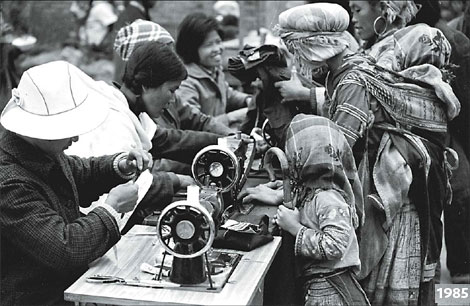 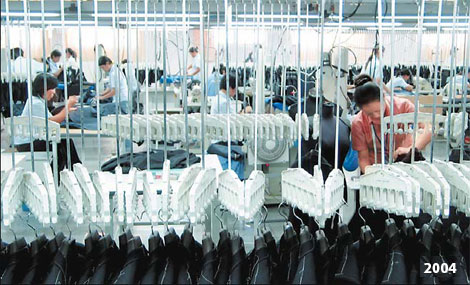 Buying new clothes was not easy in China through the 1960s and 70s. Clothes and fabrics to make them were generally unavailable, even if people had the money. In an economy bogged down by bureaucratic inefficiency many supplies were rationed, including clothes and basic. Understandably, a sewing machine was an important household asset - to help make and mend clothes. People who were fortunate to own a sewing machine (a manual one had to suffice, for China still couldn't make electrical ones) could practically make a business with it by running a community tailoring service. This was exactly the case in the black-and-white photo taken by China Daily photographer Wang Wenlan. A few women with a few sewing machines were enough to open a small marketplace. The photo was taken in 1985 in China's southwestern frontier province of Yunnan, a land on the upper reaches of the Mekong. Although the locale was far from Beijing and Shanghai, and the time was long before China grew into one of the world's leading textile and garment makers, the beginning of a change was beyond doubt. You already had some market economy and private initiatives there. Indeed, those women making or mending clothes for their customers (some of minority nationalities, as one can tell from their dress) should be regarded as pioneers of the nation's market-oriented reform. When they moved their iron sewing machines to the village fair most of China's industry was still under monolithic State ownership, and very few services were available - from large cities to small townships. Without personal efforts from millions of people, successful or otherwise, there could not have been enough driving force for China to experience the sweeping change which economists call development. By the same token, without those seamstresses and many others like them in other cities and towns, probably China would not have had as many modern garment-making factories as shown in our color photo. It was taken in a garment factory in coastal Zhejiang Province in 2004, during the golden time for China's textile merchants. When people come to talk about China's economic success, they tend to define it as a success of development. But as our photos tell, the true history is that China already began to change when development was still to come along. It's the market economy that leads all the change in China.

|
       |
主站蜘蛛池模板: 大新县| 通道| 酒泉市| 房产| 吴桥县| 五大连池市| 台南市| 嘉义市| 镇远县| 台江县| 吉安县| 特克斯县| 宜黄县| 仙居县| 仁寿县| 穆棱市| 周口市| 简阳市| 东乌| 武山县| 泰兴市| 永德县| 乌兰浩特市| 杂多县| 广州市| 曲周县| 吉首市| 和田市| 洪洞县| 咸丰县| 宜宾市| 昌吉市| 新营市| 乌兰察布市| 北京市| 镇安县| 株洲市| 沂源县| 佛山市| 方山县| 山阳县| 霍山县| 汶川县| 钟山县| 宜丰县| 滁州市| 库尔勒市| 屏东县| 新乡县| 郓城县| 巫山县| 佛冈县| 五指山市| 永顺县| 黎川县| 屯留县| 肃宁县| 大埔县| 横山县| 深水埗区| 察哈| 阿尔山市| 建宁县| 奉新县| 竹山县| 炉霍县| 渑池县| 长葛市| 镇原县| 花垣县| 安溪县| 舒兰市| 舟曲县| 岑溪市| 延庆县| 仁怀市| 咸宁市| 买车| 明水县| 南溪县| 望谟县| 麻江县|



