|
|
 |
|
30th Anniversary Celebrations
New Rural Reform Efforts
Political System Reform
Changing Lifestyle
In Foreigners' Eyes
Commentary
Enterprise Stories
Newsmakers
Photo Gallery
Video and Audio
Wang Wenlan Gallery
Slideshow
Key Meetings
Key Reform Theories
Development Blueprint
Liu Shinan:
Don't go too far in name of sex education  Hong Liang:
US should fix its own economic woes first   Chen Weihua:
Need for medical privacy  OP Rana:
This world dream can't be deferred  Backward into the future
By YOU NUO (China Daily)
Updated: 2008-11-03 07:52
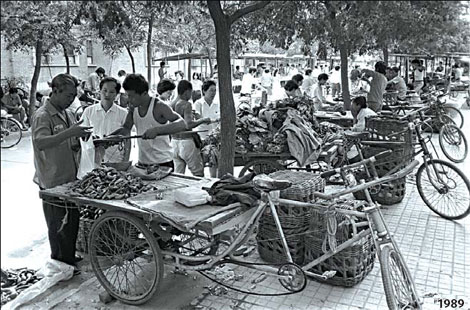
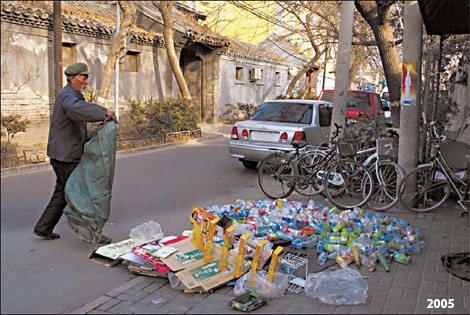 Six hundred years ago Beijing was consisted of narrow streets called hutong. Those that exist today are under government protection in the inner city and must be at least more than 200 years old. Except for a few hutong under the government's special renovation program to attract tourists and shoppers, many of the old narrow streets have remained, the scenes of their daily lives evidence of the changes that the country has gone through. Buying groceries from mobile vendors who carried and hawked their goods on oversized tricycles cruising from one hutong to another used to be the morning activity of the hutong residents. Towards evening there would be another shopping session, with every vendor claiming his or her goods - from tender green onions to fruits - to be fresh from the suburban farms. In the early days of economic reform when the very phrase "market economy" was still a taboo, roadside markets were spontaneously formed by small and privately funded grocery vendors as you can see from our old photo this week. They were referred to awkwardly as a "commodity economy". What looked like a timid step, or half-step, in theory was a great leap forward in practice. As it turned out, the "commodity economy" in the 1980s was indeed China's starting point for the market economy. Nowadays, hutong has returned to their quiet pre-market normal life. Gone are the morning and evening markets and noise of vendors' hawking and boisterous bargaining between buyers and sellers. One can easily appreciate it by taking a stroll through a hutong in a weekday afternoon. Most people now get their groceries from the supermarkets and convenience stores where, of course, few items are truly fresh. Even the passing noise made by children going to and coming back from schools can in no way compare to the past, when people having fewer children and the urban population - not including the migrant workers - are aging. However, change continues. New ideas and new practices have come to stay and are reflected in the details of people's daily lives. The hutong neighborhoods are not only responsible for tidying and cleaning themselves, but are also engaged in many civil campaigns such as protecting the ancient architecture and trees. One of the changes, seemingly small but significant, has been recycling - the theme of our color photo this week. Organized collecting and recycling of household waste such as used paper, plastics and metals has been going on in hutongs, thanks in part to the close-knit neighborly relations. Some old hutongs are more advanced in the environmental movement than their suburban, middle class counterparts and perhaps also more careful than many industries.
 (China Daily 11/03/2008 page1) 
|
       |
主站蜘蛛池模板: 四子王旗| 东城区| 文登市| 大宁县| 石台县| 岐山县| 晴隆县| 永年县| 获嘉县| 沙洋县| 固阳县| 黄龙县| 临汾市| 延吉市| 县级市| 博乐市| 温泉县| 远安县| 烟台市| 友谊县| 临汾市| 施秉县| 新化县| 保靖县| 清河县| 台山市| 许昌市| 灌阳县| 佳木斯市| 巫山县| 中卫市| 合山市| 九龙城区| 德令哈市| 门头沟区| 尚志市| 连山| 娄底市| 章丘市| 桦川县| 兴海县| 化州市| 常州市| 清丰县| 山阳县| 中宁县| 合阳县| 哈密市| 锡林浩特市| 永定县| 桐乡市| 探索| 菏泽市| 松桃| 兴海县| 隆安县| 东乌珠穆沁旗| 通化市| 青龙| 旬阳县| 夏津县| 罗田县| 那曲县| 南宁市| 略阳县| 两当县| 富蕴县| 黑水县| 安吉县| 兰州市| 苏州市| 喀喇沁旗| 防城港市| 武山县| 廉江市| 新闻| 孟津县| 金乡县| 九龙县| 建瓯市| 右玉县| 扶风县|