|
|
 |
|
30th Anniversary Celebrations
New Rural Reform Efforts
Political System Reform
Changing Lifestyle
In Foreigners' Eyes
Commentary
Enterprise Stories
Newsmakers
Photo Gallery
Video and Audio
Wang Wenlan Gallery
Slideshow
Key Meetings
Key Reform Theories
Development Blueprint
Ravi S. Narasimhan:
At 3 yuan a beer, it's a tough life   Alexis Hooi:
How 30 years changed my view of the world  Dan Steinbock:
US pushing world economy to redeflation  Zhang Tuosheng:
Aso's positive signals on Sino-Japanese ties  Track to the future
By Alan Simon and Wang Ru (China Daily)
Updated: 2008-12-19 08:02
We're often advised to enjoy the journey more than the goal. In that case, you'd better be quick if you want to savor the bullet train to Tianjin.
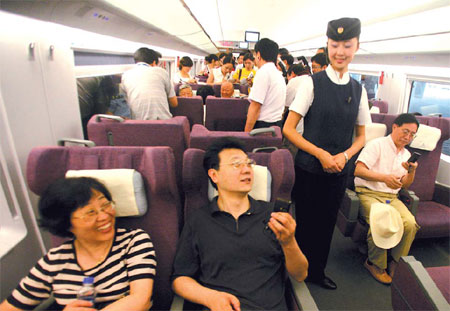
The world's fastest inter-city train covers the 120 km in just 29 minutes, reaching a peak of 350 km/h. If you like to read a book or gaze at the passing countryside, this isn't for you. If, on the other hand, you want to be whisked from A to B quickly, cheaply and comfortably, China's new trains are heaven-sent. For some, it might seem predictable, even mundane. A booming country, money to burn, flexing its new economic muscle on the back of an acclaimed Olympic Games. Not so 65-year-old Yuan Yishan. He appreciates the good times because he still remembers the bad. The accountant from Tianjin has been traveling to and from Beijing for about 45 years. When we met, he had zipped up to Beijing South first thing, completed his work inside three hours and by lunchtime was waiting for his trip home to south Tianjin to prepare dinner for his grandson. "Forty years ago, it was impossible to travel between the two cities in a day and the slow train made the short trip uncomfortable," he said, looking utterly contented. 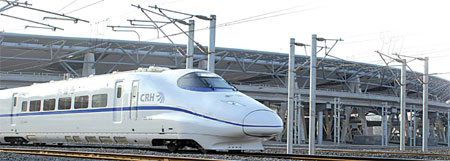 "My first train to Beijing was in the early 1960s. It was a slow steam train and took about four and a half hours. We had to sit on hard wooden benches and my back was aching all over when I got off at the old Yongdingmen Station." No wonder, then, that when Beijing South made its grand debut on the eve of the Olympics, he was an immediate fan. "It feels like flying on land!" he beamed. "One day I noticed the speed reached 320 km/h. Apart from the speed, the big soft chair and free mineral water made the journey comfortable and relaxed. "Now there are trains to and from Beijing every 15 minutes and there are restaurants and coffee shops in the station hall. I really enjoy these trips." The second-class ticket for 59 yuan ($8.3) also went down well. For Australian businessman Charles Brent, the bullet train marks an end to ghastly road trips. "I used to drive back and forth," said the investment specialist, who paid an extra 10 yuan for a wee bit more space and comfort in the first-class carriage. "It used to take three and a half hours and it was quite dangerous. Invariably I would see an accident, often a fatal one. It was so bad I wouldn't even consider doing it at night. Trucks would stop in the middle of the road and put you at risk of decapitating yourself if you drove into the back of them. Other drivers would stop to change wheels when you least expected it." Brent believes this is just the start. "I reckon China's railway network will lead the world in design and efficiency, both for passengers and freight, within 15 years," he said. "I have dramatically increased my use of trains in the last two years - they have become so much faster, safer and more pleasant than driving." Price and speed were the motivation for Cai Meijuan, 34. Cai, a native of Qingdao, landed a sales job in Beijing in 2001 and ever since has been returning home twice a year to visit her parents. She has recently had to make the trip several times and has switched to the new high-speed trains. "A one-way flight cost me 700 yuan ($100) and the new train is only 200 ($29)," she said. "The new train to Qingdao takes about five hours, twice as quick as the old one. The flight time might be quicker but you have to arrive at the airport at least an hour before to check in and it takes an extra hour to get home from Qingdao Airport, so the train makes a lot of sense for me." The only complaint Cai had was access to the rest of Beijing from the new train station. She is relishing the day the new subway lines are connected, slicing even more money and time off her journey. Australian factory owner Bill McGuinness planned to spend as much of his three-week business trip to China on the new trains. "I'd use them every day of the week," he said as he prepared to start his four-hour 30-minute journey to Jinan. "It's the best way to see the country."

|
       |
主站蜘蛛池模板: 郎溪县| 河西区| 湄潭县| 阳新县| 巫山县| 马公市| 温宿县| 安化县| 论坛| 尼木县| 鹤峰县| 布尔津县| 大丰市| 旬邑县| 富宁县| 江门市| 浦北县| 江油市| 横山县| 射洪县| 鹤壁市| 读书| 电白县| 娱乐| 鹤山市| 嘉鱼县| 商洛市| 蒙城县| 峡江县| 庆云县| 祁阳县| 肇州县| 肇东市| 陵水| 潍坊市| 洛宁县| 石柱| 荆门市| 蒙城县| 巴马| 冀州市| 新安县| 内黄县| 会宁县| 白山市| 花垣县| 广昌县| 绥棱县| 个旧市| 图木舒克市| 墨竹工卡县| 临猗县| 眉山市| 登封市| 科尔| 沁阳市| 安国市| 武宁县| 临湘市| 二连浩特市| 资中县| 娱乐| 保定市| 武邑县| 苍南县| 双城市| 乌拉特前旗| 新密市| 盘山县| 遵化市| 同德县| 通江县| 会昌县| 青铜峡市| 横峰县| 丰都县| 临西县| 石首市| 江阴市| 彭阳县| 张家口市| 饶阳县|