Parade
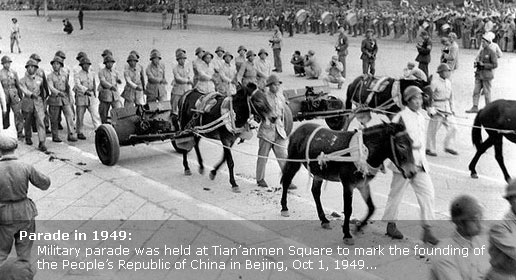
Military parade during the founding ceremony of the PRC in 1949
(CCTV.com/chinamil.com)
Updated: 2009-08-26 15:48
The CPPCC Preparatory Meeting summoned in June 1949 decided to hold a military parade at the PRC founding ceremony. The Central Committee of the Communist Party of China (CPC) attached the greatest importance to this parade and established a preparatory committee for the PRC founding ceremony. Zhou Enlai was the committee director, Zhu De was the parade commander, Nie Rongzhen was the parade commander-in-chief, and Yang Chengwu, vice-commander of the North China Military Area Command, and Tang Yanjie, chief of staff, were the director and vice-director of the parade commanding office respectively.
|
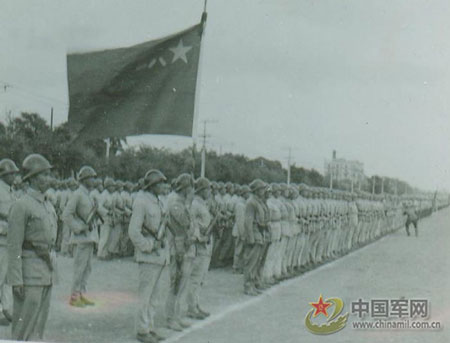 Soldiers stand at attention during the military parade at the founding ceremony of the People's Republic of China, Tiananmen Square, Beijing, October 1, 1949. [chinamil.com]  |
Because it was their first large-scale military parade, the comrades in charge of its organization had no experience and felt tremendous pressures. Yang and Tang personally led people to spend a great deal of energy in referring to historical Chinese and foreign data, and consulted many people. Liu Bocheng knew something about military parades because he had once studied in the Soviet Union and had personally seen a military parade in the Red Square in Moscow. He described to Yang the details and important matters relating to the parade, saying "The parade is simply a type of etiquette with special contents; it is a form. We can achieve our goals by successfully undertaking this form." Chen Yi was outspoken, stating bluntly, "There is no difficulty in organizing the parade, it is no big deal. We have already won many battles, is it possible that we cannot prepare a military parade well? It is just about marching, is it not? We will display our military prestige to the Chinese people through marching and will let them know that this is the army of the New China". The speech by these two marshals showed a clear direction for the parade preparations.
The parade's commanding office extensively solicited opinions and researched for a long time before carefully formulating a plan for the military parade ceremony, fully considering and arranging all the details such as choosing and organizing the troops to be inspected, the parade procedures, the parade ceremonial music and the pre-review training. The CPC Central Committee approved this plan which was essentially followed in the parade at the PRC founding ceremony.
At 3 pm on October 1, the PRC founding ceremony began. After Mao Zedong read the declaration from the Central People's Government, the military parade began. All the troops to be reviewed passed in front of the Tiananmen Rostrum from East to West with the Tiananmen platform as the center, according to the sequence of the navy, the army, and the air force. Commander-in-chief Zhu De, in military uniform, reviewed the troops from his parade car with Nie Rongzhen. The troop consisted of the navy, army and air forces. The march followed. The first to pass Tiananmen Square were the navy formed by personnel chosen from the northeast navy college and East China navy fleet. The army followed next, formed by personnel chosen from 199th infantry division, 619th regiment of the independent 207th division, the temporarily established 4th artillery division, the 3rd panzer division and the 3rd cavalry division. Among them, the infantry division was formed by three infantry regiments, and battalions of Tommy guns, light machine guns, communications, heavy machine guns, light mortar, heavy mortar, anti-tank guns and mountain artillery. The artillery from the artillery division included 75mm field guns, 105mm howitzers as well as 37mm and 75mm anti-aircraft guns which passed the Tiananmen Rostrum from small to big, and from low to high. The panzer division was formed by regiments of motorized infantry, armored infantry and tank forces. This was followed by the cavalry division, formed by three cavalry regiments and one 75mm field gun battalion drawn by mules. The last group to pass was the air force, formed by a P-51 fighter squadron, a DE?HAVILLAND Mosquito bomber squad as well as a PT-19 and L-5 training plane squad under the command of North China Military Area Command Aviation Office. When the panzer division entered Tiananmen Square, the air force planes flew over each division in two-plane and three-plane formation, coordinating with the ground panzer division.
Attending the parade were in total: 16,400 soldiers, 119 cannons, 152 tanks and armored vehicles, 222 autos, 2,344 warhorses and 17 planes from the PLA. The parade lasted for two and a half hours with spectacular scenes, displaying PLA's powerful and grand lineup. The reviewed troops included a variety of sectors from the navy, the army and the air force; the troops were mainly infantrymen from the army because the navy, air force and many other sectors of the military were still being established.
The parade in the PRC founding ceremony established the basic framework of PRC's military parade. Up to now, except slight changes in divisions and personnel as well as in the variety, scale and quantity of military equipment, there have been no profound changes in the National Day parade procedures and contents.
Translated by LOTO