60 People, 60 Stories
People's defender
By Zhou Lihua and Hu Yinan (China Daily)
Updated: 2009-09-30 06:14
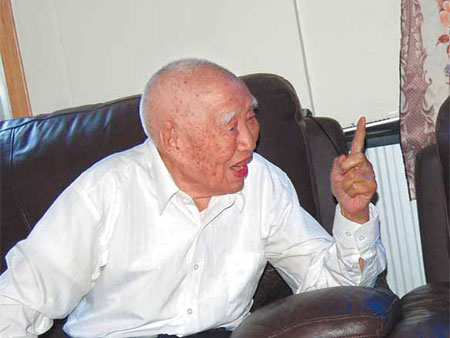
Poor and marginalized in a village in Shandong province, Kong decided then to join the Kuomintang army for a guarantee of food and some security. Two years after he enlisted, Kong fought in the bloody Central Plains War that broke out between Chiang Kai-shek and a number of warlords. The fighting claimed more than 300,000 lives.
In winter of that year, his troops were mobilized to Anhui province in an attempt to wipe out the Red Army. Kong, however, was not willing to fight the people he believed were fighting for the poor.
"All the poor under heaven belong to the same family," says Kong in Wuhan, capital of Hubei province, where he served as Party chief in the early 1970s.
"If I were to fight, I'd die a Communist, fighting for the poor."
Now 98, Kong is one of the last surviving veterans of the Chinese Revolution.
In 1931, his battalion revolted, with about 100 of its soldiers joining the Red Army. Kong, then 20, was one of them. Seeing common civilians in the Soviet zones supporting their troops by sending food, water and cheers, something he had not seen or ever imagined, made the youth extremely excited.
Kong never looked back. He fought on, rising from a rank-and-file trooper to division commander at the end of the Long March just five years later.
When Japan launched an all-out offensive against China, the Communists formed a United Front with the Kuomintang and reduced its Red Army from three army groups to three divisions.
Kong became a battalion chief and later a regiment commander, repeatedly launching his lauded midnight offensives against Japanese forces. After Japan surrendered, Kong, born in the same year the Republic of China was founded, began to fight his final war - a war to emancipate all the poor under heaven - as an army corps commander of the freshly established People's Liberation Army (PLA).
"The deceased didn't make it to see the times we enjoy now," he says.
Kong was made a lieutenant-general with 176 others in 1955. Only eight of them are still alive today. Not one of his comrades who joined the Red Army in 1931 lived to see the founding of the People's Republic.
The PLA progressively picked up new roles as constructors, rescuers and peacekeepers. In 1970, Premier Zhou Enlai asked Kong to take over as construction chief for Henan and Hubei provinces and build bridges, railroads and tunnels, as well as make cars.
The 2.3 million-strong PLA, which remains the world's largest army, has become more modernized and is opening to new ideas and promoting a balanced vision of development.
It has also conducted many joint military exercises with foreign countries in recent years.
"The days are really getting better, especially now that we're advocating a scientific concept of development," he says.
"That came from generations of lessons from the Revolution."
|
 |
Time Line 1949 The People's Liberation Army (PLA) liberates all of China except Hainan, Tibet and Taiwan. 1950 The Chinese army of volunteers joins the Democratic People's Republic of Korea (DPRK) in fighting the US-led invasion. 1958 The Chinese army of volunteers fully withdraws from the DPRK. The shelling of Taiwan's Dajinmen, Xiaojinmen, Dadam, Erdan and other islands starts. 1962 China and India fight a brief border war. 1965-75 China sends a total of 320,000 troops to assist Vietnam in its war against US invasion. 1965 The PLA's system of military ranks is abolished. 1969 China and the USSR engage in sharp border clashes in March. 1979 The shelling of Taiwan's Dajinmen, Xiaojinmen, Dadam, Erdan and other islands stops on Jan 1. Chinese troops launch a counterattack against Vietnamese aggressors in Guangxi and Yunnan in February, and withdraw from Vietnam a month later. 1985 Deng Xiaoping announces a decision to cut China's army by 1 million. 1988 The system of military ranks is reintroduced. 1992 Border clashes with Vietnam end. July 1, 1997 The PLA Hong Kong Garrison assumes defense responsibility in Hong Kong. 2009 The PLA holds its largest military exercise, one that involved the deployment of about 50,000 heavily armed troops over thousands of km, in August.
|