60 People, 60 Stories
Ground work
(China Daily)
Updated: 2009-09-30 07:41
|
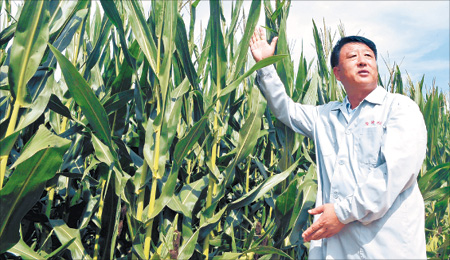 Li Denghai, who holds the world record for the highest yield of summer corn, says his success boils down to a love for crops. [Zhu Zheng]
|
| ||||

But the 60-year-old from Shandong province has made scientific breakthroughs that have made major contributions to the world's most populous country's food security.
His particular work has been in achieving higher yields from corn production and in the breeding technology of compact maize.
Li, who holds the world record for the highest yield of summer corn, says his success owes to his love of growing his crops.
"Maize has a life," he says. "It sings and dances. If you listen clearly, it can speak to you."
Agriculture has always been central to the Chinese economy. After New China was created in 1949 there was a focus on organizing farmers into mutual aid teams.
Then in the mid-1950s large government-operated collective farms were formed.
After reform and opening up in 1978, the commune system was broken up and individual farmers were given the freedom to produce their own crops.
There has also been a keen focus on agricultural science and obtaining greater yields from crop production as well as a major focus on organic agriculture.
Li's lifelong passion for research into maize began in 1969 when the then 20-year-old, who had just dropped out of high school, read an article which pointed to corn yields in the United States being six times higher than those in China.
Until then, he hadn't been aware his country's agricultural methods had been so out of date.
"I was shocked," he recalls.
He set out working on just a small piece of land round the clock to see if he could increase the yield of the corn.
His dedication extended to walking around the field with a battery torch late at night, if he had been away during the day.
By careful nurturing he managed to double the yield to 500 kg per mu (0.067 hectare).
His path to success has not always been a smooth one. There have been many experiments that have failed, some almost devastating him.
Once, hailstones destroyed a year's effort.
Another time, a bull rushed onto his land and stepped on a vital new bud.
Li says he has experienced first hand the potential poverty of eking out a living from the land.
"I starved. I know how it feels," he said. "We have a lot of people in this country and increasingly less land available for agriculture. Only by improving yield can we feed ourselves."
He was awarded the "China Award for Significant Contribution to the Maize Industry" in 2005, the same year he floated his company on the Shenzhen Stock Exchange.
Over the last 30 years, Li has nurtured 30 high-yield corn seeds, including the world's highest yield summer maize.
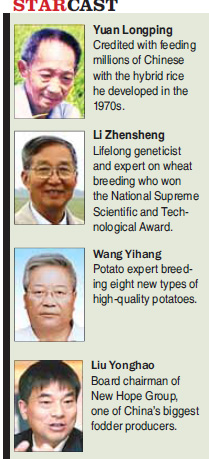
His name is now being mentioned in the same breath as another agricultural pioneer, Yuan Longping, the leading Chinese agricultural scientist who developed hybrid rice in the 1970s.
"Corn is special because it is not only food, forage, but a source for biology fuel. The increasing demand for it is what motivates my work," he says.
Few now doubt that the country's journey from food scarcity to self-sufficiency has been partly due to agricultural technology advances that have been achieved by Li and others like him.
Li, however, is never happier than when he is in the middle of his cornfields.
"I can forget my tiredness and talk to my corns," he says.
TimeLine
1949-1953
Land reforms for the peasantry are initiated throughout China. Landlords are purged.
1953-1956
Agricultural cooperatives are set up on a massive scale.
1958-1980
Rural cooperatives are reorganized into "people's communes".
1978-1982
China starts promoting household responsibility system as market reforms are kicked off. By January 1982, over 90 percent of rural production brigades have introduced multiple forms of responsibility systems.
1983
The central government decides to dismantle all communes.
1990s
As market reforms deepen, so do agricultural and rural problems.
2001
Rural cadre Li Changping coins the term "sannong problems", namely issues related with agriculture, farmers and the countryside, in his open letter to the premier.
2005
Agricultural taxes are abolished for the first time.
2006
The law on professional rural cooperatives is passed as China renews the push for agricultural mechanization to boost production.
2008
The CPC Central Committee allows rural land-use rights to be leased or transferred between farmers.