60 People, 60 Stories
Idea factory
By Andrew Moody (China Daily)
Updated: 2009-09-30 07:41
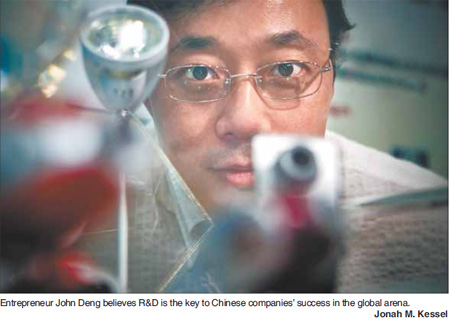
Former Silicon Valley entrepreneur John Deng is at the sharp end of China's research and development (R&D) efforts.
Deng, 40, is chairman and chief executive of Beijing-based Vimicro, a maker of multimedia chips used by major companies such as Sony, Samsung, Philips and Lenovo.
After receiving $1.2 million in start-up capital from the Chinese government, Deng's company was the first Chinese technology firm to launch on the New York NASDAQ exchange in 1999.
Deng, who studied at the University of California in Berkeley, and who after working for IBM set up his own business in the United States, returned to China with the aim of becoming an entrepreneur.
|
||||

"When I came back in the late 1990s, there was a lot of research activity in the university fields but there wasn't the number of start-ups being spun out of universities like in Silicon Valley. There was a lot of research and development knowledge but people didn't know how to commercialize it," he says.
"We became the first such venture investment in China with the government holding the stock."
China is now the world's largest investor in research and development after the US.
In 2008, the country spent 457 billion yuan, or 1.52 per cent of its GDP, on developing innovation.
Corporate expenditure in this area is also growing fast - increasing 23 percent annually between 2001 and 2006, compared to between just 1 and 2 percent in the US and Europe.
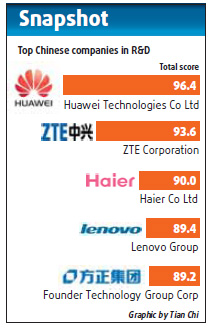
Companies at the forefront of its effort are telecom equipment makers Huawei and ZTE, as well as hybrid-electric vehicle maker BYD.
Since its inception, the People's Republic has placed great emphasis on research and development.
There were only 50,000 people engaged in science and technology throughout the country in 1949, with only a few of these conducting research.
As a result, the Chinese Academy of Sciences was launched, which proved the catalyst for large numbers of scientists to return from overseas. By 1955, there were some 400,000 scientists working in China.
In 1956, the country also launched its first long-term plan for scientific and technological development.
"The focus in the early days was satellite and nuclear technology. There was also an emphasis on technologies that could be applied to agriculture," Deng says.
He says China was making up for trailing behind the rest of the world over the previous two centuries.
"China 600 years ago had been very advanced in mathematics, physics and in the production of ceramics but had fallen behind," he says.
The reform and opening up saw a renewed focus on research and development, with late leader Deng Xiaoping launching the transformative "Spring of Science" conference in the Great Hall of the People in Beijing. By 1998, there were 20 million people working in scientific and technological areas, nearly five times the level of 1975.
Chinese companies also entered into research and development joint ventures for the first time.
Since the late-1990s, with technological start-up businesses like Vimicro emerging, the prospect of China producing the next Microsoft or CISCO is no longer an unrealistic prospect.
Deng believes there needs to be more focus on ensuring that China's research and development efforts are harnessed to drive the economy forward.
"There is too much research in universities that has nothing at all to do with industry. There is still a big gap between technological development and application," he says.
"Our research and development still tends to follow a traditional or planned economy model. It needs to become more market driven."
As a member of the National People's Congress, the country's top legislative body, Deng wants a new research and development body set up to provide venture capital funding for new businesses investing in technology.
"We need this sort of funding to promote technology start-ups in China," he says.
"We need to commercialize our research and development expenditure so that Chinese companies become the global corporations of the future."
Time Line
1949
Chinese Academy of Sciences is opened in Beijing to boost China's scientific base.
1950s
China's scientific efforts focus on satellite and missile technologies as well as agricultural science. First long-term plan for science laid out.
Late 1970s
Deng Xiaoping addresses the "Spring of Science" conference, which leads to a fivefold increase in workers in China's scientific field over 20 years.
1990s
Chinese companies begin joint ventures with foreign companies. Emergence of new breed of private-sector technology businesses.
2009
Prospect of Chinese companies becoming the 'Microsofts of tomorrow' now realistic.