60 People, 60 Stories
Name game
By Andrew Moody (China Daily)
Updated: 2009-09-30 07:41
|
 Chinese brands have some way to go in emulating multinational giants in their branding, PR guru James B. Heimowitz says.
|
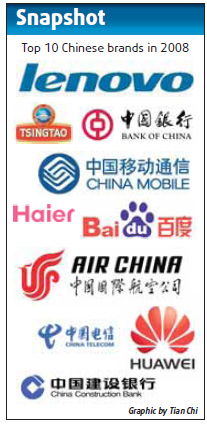
James B. Heimowitz believes Chinese brands could be on the brink of making a global impact.
The North Asian president and chief operating officer of international public relations firm Hill & Knowlton says a number of Chinese companies may soon be household names in the West.
"Chinese companies are going to be more important both in China and on the global stage," he says.
"It won't be long before Chinese firms understand markets in Europe, the United States and Africa in a meaningful way."
|
||||

But this testifies only to a reawakening of China brands, which were the pride of New China.
China was a farming country with very little industry in 1949. In its drive for industrialization, the Chinese also took a lot of pride when they produced many firsts with Chinese brand, such as Liberation trucks, Red Flag sedan cars, Flying Pigeon bicycles, Snow Flake refrigerators and Peony radios.
However, "when I came to China as a student in the late-1970s, there was no real concept of branding in a Western sense," says Heimowitz, 48. "There was just one form of soda, qi shui, which was orange-flavored, but it was not a brand since every factory made the same product."
There has always been a question as to whether the number of Chinese brands have the same value in China as in the West.
It was not until the 1980s that Western advertising as well as branding and public relations companies appeared in China.
"The first time anyone actually saw a product was when they went into a store and saw it on the shelves. If they liked it they would tell other people and that is how brands took off," he says.
Heimowitz says many of the first Chinese brands to make an impact globally have been in the business-to-business market, manufacturing vital components that go into a vast variety of well-known branded products.
"There are many Chinese companies, making private label products from mobile phones to switching gear, that work for world class international companies," he says.
Chinese companies are still a long way from emulating the success of multinational giants like Procter & Gamble, whose brands are deeply ingrained in many markets around the world, Heimowitz says.
However, Heimowitz says some Chinese brands such as Bee & Flower soap, made by the Shanghai Huayin Commodity Co, as well as Tsingtao beer, have already had an impact in international markets.
"Bee & Flower is quite a niche product but Tsingtao is being exported and appreciated in markets such as America and Germany," he says.
"The million-dollar question is how Chinese companies are truly going to be able to be successful in exporting their brands around the world," he says. "It is going to be a big challenge."
Time Line
1949
Foreign brands quit the Chinese mainland market in the wake of the establishment of the PRC and consequent Western blockade.
1956
China starts public-private partnership. More than 16,000 recognized homegrown brands join the move.
1950s-1970s
Lekai film (1958), White Rabbit candy (1959), Tsingtao beer (1964), Flying Pigeon bike (1965) and Peony radio (1971) become household domestic brands.
1978
Reform sees the emergence of private sector companies interested in concepts such as branding.
1980s
Western advertising, public relations and branding agencies emerge. Famous foreign brands also begin making their mark.
1990s
A number of China brands targeting the Chinese market appear.
2000s
Foreign brands become keen on being associated with the Beijing Olympics and Chinese companies look to build brands to take on the world.