60 People, 60 Stories
Between lines
By Liu Wei (China Daily)
Updated: 2009-09-30 09:40
|
 Author Yan Geling pens her works in Chinese and English. [China Daily] |
| ||||

Over the past two decades, the 50-year-old writer has penned her works in Chinese and English, traveling across vast territories with her US diplomat husband.
But Yan is an outsider in the Chinese and Western literary worlds.
She occasionally feels lost and lonely in the dazzling literary trends of the two countries, but her outsider status also endows her with an objectivity to study Chinese literature and Chinese writers in the West.
Still, she was first struck by reading US author J. D. Salinger's Catcher in the Rye in 1982.
"Literature can be like this!" she remembers saying after reading the novel that depicted teen rebellion and defiance.
It is not hard to understand her reaction.
Between 1949 and 1966, the most popular of Chinese literature could be categorized into those eulogizing the new country and its leaders, recalling a miserable past and battling old doctrines.
Famous works of foreign literature included those of the former Soviet Union.
Many Chinese writers also stopped writing during the "cultural revolution" (1966-76). Prevalent literary works in that decade were Yangbanxi, or modern Peking opera, advocated by notorious Gang of Four leader Jiang Qing.
Similarly, the most popular novelist then was Hao Ran, who wrote about flawless role models in the countryside, who adhered to socialism and fought with anti-revolutionists and the petite bourgeoisie.
Then came the early 1980s, when Yan and peers became fired up by the hundreds of Western literary works and once-forbidden Chinese classics that hit the shelves shortly after the country's reform and opening up.
Yan calls that era the best for Chinese literature after 1949.
She devoured works by F. Scott Fitzgerald, John Updike and Gabriel Garca Mrquez. Around her were 2,000 poetry societies and more than 20 literary magazines.
When a poetry festival kicked off in Sichuan province in 1984, its 2,000 tickets sold out rapidly. The event was as popular as a Beatles concert in its heyday. Audiences rushed to the stage for poets' autographs, while Chinese bards such as Bei Dao and Gu Cheng had to hide under desks from their crazed fans.
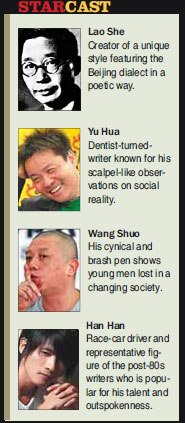
But in a more open atmosphere, many Chinese writers also searched for more personal and versatile ways of expression. Novelists such as Mo Yan and Yu Hua, who started making their mark in the 1980s, created their signature works in the 1990s.
Today's Chinese literary world is becoming increasingly similar to that in the US, Yan says.
"Those who are accepted by the market are stars, so everybody wants to be a star before cultivating their writing skill first," she says.
Such post-80s writers include Han Han and Guo Jingming, who boast good looks and frequently make headlines with their attitude, bestsellers and wrangles with the old school.
But Yan believes that when the market is mature enough, it will provide various writers their own niche. Pulp, serious and other kinds of writers will co-exist, and have their own target readers.
Still, having published two English novels and expecting her third one next year, Yan is not optimistic about Chinese writers' future in the West.
Chinese literature is in urgent need of good translation, she says, as English is the most popular international language.
But resonating with readers remains the biggest challenge, Yan says.
"If you don't share the same experiences, finding a topic the readers can relate to will still be very difficult."
Time Line
1949
Launch of People's Literature (Renmin Wenxue), the first literary magazine of New China.
1950s
Contemporary literature with a socialist Realism focus prospers. Many pioneering works like The Song of Youth are adapted into films and translated.
1960s-1970s
Revolutionary romanticism becomes popular. A new generation later includes grassroots writers like Hao Ran, a farmer who rises to fame with The Golden Road (Jinguang Dadao), which praises rural collectivization.
1977
Liu Xinwu publishes The Headmaster (Ban Zhu Ren). The work is considered a signature piece of Scar Literature, a school reflecting on the "cultural revolution" (1966-76).
1985
Han Shaodong raises the concept of "root-searching", with the idea that literature's root is in traditional culture.
1999
Literary website "rongshuxia" (literally "under the pagoda tree") is set up. Online writing becomes a platform for literary lovers to share works.
2005
Penguin Books pays a record $100,000 for the worldwide English rights to Jiang Rong's Wolf Totem (Lang Tuteng).
2007
Guo Jingming and several other post-'80s authors join the conservative Writers Association of China.