60 People, 60 Stories
Going places
By Matt Hodges (China Daily)
Updated: 2009-09-30 10:41
Shanghai resident Li Xuesong comes from an upper-middle-class family but he does not have any memories of going anywhere with his parents when he was young, not even to places in China.
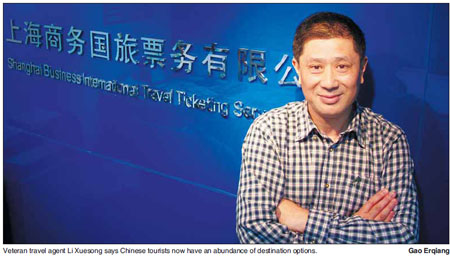
"Thirty years ago, people had no concept of traveling abroad," Li says.
China was struggling to feed and cloth its huge population while most Western countries placed all types of sanctions against the young socialist nation.
In the 1960s, Air China flew only to a few cities in the world, such as Moscow and Karachi.

Now, as a travel agent with two decades' experience, Li sees Chinese students flooding foreign universities and the country standing on the brink of an outbound tourism boom.
He took his daughter Jiayi to Thailand when she was just six years old and she is now studying in Berlin.
"Things have changed so much. Back in the 1970s, there was so much propaganda about 'Western imperialists' that we had to be careful even talking to foreign tourists," he says.
Before China started mobilizing its travel industry at that time, only the privileged few could travel overseas. Those included public servants on official visits or people with relatives abroad.
Even officials had to get "political authorization" for their travel and destinations were few.Many of the early travelers were actually technicians and other Chinese specialists sent overseas to help foster bilateral relations, he adds.
Like foreign tourists, who were not allowed to buy or spend yuan until some 15 years ago, Chinese had to get difficult-to-obtain Foreign Exchange Certificates, a second medium of exchange allowing them to purchase foreign currencies.
But whereas international travel was fraught with difficulty, there was little travel for leisure at home. Most people who visited tourist sites were doing it on the sideline of business trips.
Domestic travel was cheap in comparison with today's white-collar salaries. "When I started in the business in the 1980s, one-way tickets from Shanghai to Beijing cost 90 yuan, or 101 yuan from here to Guangzhou," Li says.
After two decades of solid economic growth, what once seemed normal now seems backward.
"I traveled to Cuba in 2006 and it was exactly like China 20 years, what with the two currencies they use," he says.
Southeast Asia was one of the initial draws for Chinese with passports and cash to burn, then Australia and New Zealand. Entering the 21st century, Europe opened up with the lure of the Schengen Agreement, offering Chinese tourists a free pass to hop across 10 countries' borders on just one visa.
"People used to flash their passport stamps and show off by saying 'ba guo you' (8-country-tour). Then, after a few years, they realized that you couldn't soak up any of the local atmosphere from these whistle-stop excursions so they began to wind down," he says.
"Now it's more popular to fly into Paris and out of Rome 7-9 days later," Li says, adding that next year's FIFA World Cup host South Africa, and especially its precious stones, was one of the hottest draws for his customers this summer, along with the pyramids of Egypt.
Domestic attractions like tropical Hainan Island, mountainous Sichuan, Tibet and the lime-karst rocks of Guilin in Guangxi have also spurred local travel, with 1.7 billion Chinese taking domestic trips in 2008 alone. It marked an increase of more than 30 percent from three years earlier.
While the bulk of Chinese satisfy their travel bugs domestically, Li estimates that one-in-five residents in major cities like Shanghai and Guangzhou now travel overseas each year.
China's opening up with the outside world also saw it welcome more than 46 million foreign tourists in 2006 to rank as the 4th most-visited country in the world, World Tourism Organization figures show.
Present and future trends include a growing rate of do-it-yourself holidays, with local websites like Ctrip.com.
"I remember when Ctrip started, I looked down on them because they gave out small name cards and no one had heard of them, but now they are the No 1 operator in China," Li says.
"Even my wife and daughter are now bugging me to travel alone rather than go for (cheaper) group tours."
Time line
1949-1974
Access to China is very restricted save for select foreign visitors.
Late 1970s
China begins rapidly assembling its own travel industry.
1978
China welcomes 230,000 foreign tourists.
Mid-1980s
More than 250 cities open to foreign tourists.
1995
Foreign Exchange Certificates, a currency reserved for foreigners, finally phased out.
1998-2002
Number of travel agencies jumps from 6,222 to 11,552 as outbound tourists spike from 3.2 million to 10.1 million people.
2008
Travel ban to Taiwan lifted; the US is also given coveted Approved Destination Status.