60 People, 60 Stories
Ping-pong legacy
By Lei Lei (China Daily)
Updated: 2009-09-30 11:07
|
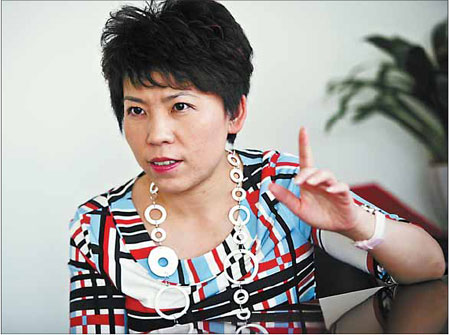 Table tennis legend Deng Yaping continues to contribute to the country's sports. Courtesy of Deng Yaping [China Daily] |
| ||||

"China has been getting stronger and the results we achieved at the Beijing Olympics have proven that sport in the country has reached new heights," Deng says.
The legendary paddler herself has been instrumental in the country's sporting success.
Deng picked up the sport 31 years ago when she was 5, starting her road to table tennis fame from her hometown of Zhengzhou, capital of Henan province.
In a sporting career spanning two decades, Deng has won more titles than any other paddler. Upon her retirement from the sport in 1997, she had four Olympic golds and 18 world championship titles under her belt.
She reigned as world No 1 from 1990 to 1997 and was voted China's female athlete of the century. In 2003, she entered the International Table Tennis Federation Hall of Fame.
Deng's prowess in the game grew out of a longtime emphasis on sports.
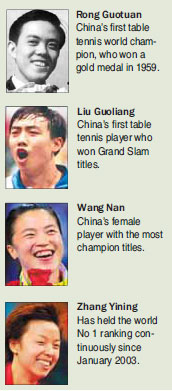
In 1952, the authorities established national training camps for about 10 sports that included table tennis. In 1959, men's table tennis player Rong Guotuan claimed China's first world champion title at the 25th World Championships, arousing a national interest toward the sport.
"From the founding of New China to the 1980s that was a period that laid a solid basis for sports in the country," she says.
"Table tennis was one sport that got popularized since almost everyone played the game at that time, more talented paddlers emerged and China began its dominance."
For Deng, the road to success was not all smooth and it was the difficulties she faced early on that left deep impressions.
"The situation was very tough when I was training early on in the amateur sports school in my hometown. It was very cold in winter but there was no heating system in the training room," she says.
"The situation improved somewhat when I was selected for the provincial team."
Deng says it was "heaven" when she finally trained with the national team in Beijing in 1988, although it is still hard to compare those times to what it is like now.
While she did not have the opportunity to train in the new, advanced table tennis hall in the State General Administration of Sports Training Bureau, Deng says she is glad the fighting spirit of the team has been passed to the younger generation to help maintain China's lead in the sport.
"Better training conditions will make it more comfortable for players, but it does not mean that they will gain better results just from improved facilities," Deng says.
"Chinese players were also able to reach the top of the world during difficult periods."
Chinese paddlers have since continued to rule the Olympic and world rankings, with numerous players heading overseas to become crucial members of other countries' teams.
After retiring from sports in 1997, Deng pursued a bachelor's degree at China's renowned Tsinghua University. She also earned a masters and doctorate from Britain's University of Nottingham and University of Cambridge, respectively. But her link with sports did not stop then.
Upon her return home, Deng, who claimed gold medals in the women's singles and doubles at the 1992 Barcelona Olympics and repeated the same glory four years later in Atlanta, witnessed Beijing winning the right to host the 2008 Games in 2001 with the bidding committee. She later joined the organizing committee for the Beijing Games as the deputy director of the Olympic Village department in 2003.
"From 1992 to 2008, I think it was full circle for me from an athlete to an organizer. I'm very lucky to have worked for the Olympics both in front of and behind the curtain," Deng says.
Time line
1952
China sets up national training academy for table tennis.
1953
China enters the Championships for the first time.
1959
Rong Guotuan is the first Chinese world champion in any sport.
1961
Chinese men's table tennis team wins the World Championships team title for the first time.
1965
Chinese women's team wins the World Championships team title for the first time.
1971
"Ping Pong Diplomacy" sees table tennis playing an important role in international diplomacy when several teams are invited to China for a series of friendship matches after the 1971 World Championships.
1988
Chen Jing claims the gold medal at the Seoul Olympic Games, clinching China's first table tennis Olympic gold.
2008
About 330 million TV spectators in China follow the women's team finals at the Beijing Olympics between China and Singapore.