'Wrong turns' in wind power







|
|

Too much emphasis placed on size rather than technology: analysts
China is placing too much emphasis on size rather than technology to harness wind power and the country may have overestimated the advantages of the resource compared to coal, energy analysts say.
The robust growth of wind farms across the country generated an aggregate 50 million kilowatts of electricity at the end of 2010. A study by Harvard University of the United States and Tsinghua University projects that wind power will satisfy China's entire energy needs by 2030.
"I don't think so," counters Yu Lijun, professor from the Institute of Thermal Energy Engineering of Shanghai Jiao Tong University. Yu studies new energies and energy-saving technologies.
"I am afraid the researchers who produced that report were economists rather than engineers because they took into account only the estimated capacity of the wind farms but ignored the difficulties of connecting the power generated by these wind farms to many faraway locations," Yu says.
Wind energy, he says, is intrinsically unstable because it depends on "nature's whims".
For that reason, most countries only allow no more than 20 percent of their power grids to be loaded with electricity generated by wind power. That is because the wide swings in electricity flow could cause damage to the grid, Yu explains.
"As wind energy is quite unstable, it can take up about 15 to 20 percent in the entire power grid. Otherwise, it will affect the safety of the grid. And it is a universal problem posed to every country dedicated to developing wind power," Yu says.
Although wind costs "nothing", the investment in equipment to convert that into electricity is invariably high.
"The generation of electricity with today's technology is very cost inefficient compared to coal and other fossil fuels," says Shi Pengfei, vice-president of the Chinese Wind Power Association.
"China will need to add a substantial amount of coal-fired power capacity by 2020 to meet the needs of its expanding economy, and the idea is to bring some of the capacity earlier than necessary in order to facilitate the wind-power transition," Shi says.
The cost of wind power is estimated to be about 1.5 times of coal. Other alternate sources of energy including solar power are even more costly.
"Although burning coal will inevitably emit carbon dioxide, the harm brought by this gas has been much exaggerated. Carbon dioxide is crucial for plants to conduct photosynthesis normally. And without this gas, the temperature on the earth will drop by 15 to 20 C, which will make the planet inhabitable for most creatures," Yu says.
"What researchers should do now is to increase the operation rate of burning coal, which is more efficient than investing a large amount of money in developing wind energy technologies," Yu says.
The swift development of wind power in China is fueled mainly by heavy government subsidies, which are based on capacity rather than on innovation. As a result, power-generating plants are investing mostly in expanding the capacities of their wind power equipment rather than on research and development.
Yu says that Chinese engineers are good at building larger wind generating units but they lack the interest to advance the technology in energy conversion. For instance, wind powered generating units in China generally have a capacity of 3 mW to 5mW, which can provide sufficient electricity for 1,500 1,100-watt air conditioners working at the same time, Yu says.
But the key technologies of these mammoth generators are acquired from foreign, mainly Danish or German, companies, Yu says.
"These countries have a longer history in developing wind power technologies than China."
But "relying on the purchase of other people's patents to build your own power plants is a very short-sighted way of doing things," he adds.
The government should revise its policy to pay a larger portion of subsidies to technology development and innovation rather than on capacity, Yu and other analysts say. The development of alternative energy power is like "putting the cart before the horse", Yu says.
There is no shortage of institutions in China investing in wind power research. But they are scattered all over the country with weak links to share their results, Yu says.
"This decentralization of scientific manpower and resources is a terrible waste."




Today's Top News
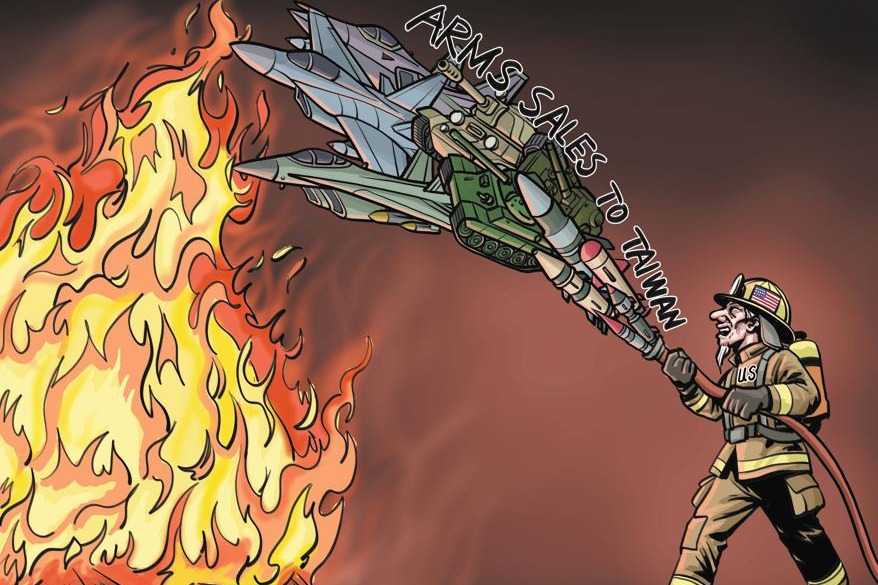
- US actions fail to match its words on Taiwan question
- China's diplomacy to blaze new trails
- Visits point way to better future for all
- PLA tests joint combat strength for second day
- Xi stresses advancing rural areas' vitalization
- US arms sale to Taiwan will lead secessionists toward destruction