Make the world great – part two: economic cooperation and institutional reforms







|
|
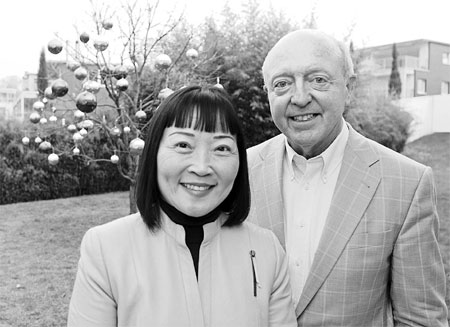
| Hans Boller-Wu, vice-president of the Swiss-Chinese Chamber of Commerce, and his wife Amy Wu are seen in this file photo. [Photo by Xie Songxin/chinadaily.com.cn] |
As discussed in part one, the world has to overcome the fragmented view where every nation maximizes only its own narrow interest and instead build a "community of shared future for mankind" (Xi Jinping).
This closer international cooperation has to go along with a reform of the existing global institutions. The re-composition of the IMF Special Drawing Rights basket with the inclusion of the Chinese RMB is certainly a step in this direction. Others have to follow in order to revive the somewhat sluggish globalization process. Event of recent months have indicated that this process is not irreversible. It can be damaged by acts of protectionism and isolationist moves.
What is needed at this juncture are renewed efforts to establish mutually beneficial networks of free trade and investments worldwide so as to foster further growth and prosperity. Peace and sustainable development are two notions of the same reality and condition each other.
The planned free trade area of the Asia Pacific is one example, another is the UN 2030 agenda for sustainable development. Also meant as part of the necessary global institutional reform is a courageous proposal for a new International Monetary System by Lin Yifu, Professor and Honorary Dean at the National School of Development, Beijing University, and former chief economist of the World Bank. Lin challenges the present reserve currency regime on the ground that it no longer reflects the composition of the world economy and would create instability. Instead he proposes "replacing the system of using national currencies as reserves with a global reserve currency called paper gold (p-gold)". This new currency which echoes the bancor proposed by John Maynard Keynes at the end of WWII would "avoid inherent conflicts using national currencies as international reserve currencies" (Lin) and yet be as flexible as paper money. Of course, the introduction of p-gold would require and new international treaty and an international Central Bank while the countries would have to fix the exchange rate of their national currency to p-gold.
However, the most ambitious and promising institutional initiative in this context is by far the so called "double silk road initiative" which includes the silk-road economic belt and the 21st century maritime silk-road. It is arguably the largest and most comprehensive endeavor of its kind ever undertaken by mankind.
Different from the Marshall-Plan to rebuild war-torn European States, the double silk-road initiative is inclusive and invites all countries to participate. It offers a perspective for growth and prosperity even to remote and neglected areas in Central Asia and Africa. Connectivity is the keyword also for the European-Chinese relationship. The ancient silk-road started in China and ended in Europe; in the present globalized world the silk-road-network begins and end in both Europe and China. It is in this logic that Europe and China should join efforts to build a shared peaceful and prosperous future.
The author is director of the Boller-Wu foundation in Switzerland