China's medical robots take on foreign rivals







Domestic models are competing effectively on both precision and price
In 2015, surgeon Tian Wei came across one of the most challenging orthopedic surgeries in his 30-year career. A 43-year-old patient had complained of progressive numbness in the limbs on his right side for 14 months, caused by a deformity in his upper cervical vertebrae.
The patient was in dire need of surgery to implant a screw to help support his neck bone, but the operation was risky. Any minor mistake could lead to paralysis or a life-threatening hemorrhage. Many hospitals were unwilling to treat him.
But Tian, who also is president of Beijing Jishuitan Hospital, decided to do the surgery-with a little help from another "surgeon".
| A doctor uses Phecda, a surgical robot developed by Tinavi in an orthopedic surgery procedure at Beijing Jishuitan Hospital in 2016. |

The operation was completed in an hour with help from Phecda, a surgical robot with a 3-D high-definition visual system that can "see" the internal orthopedic structure and a "hand" that can guide medical tools to the proper location within 0.8 millimeters.
Developed by Beijing Tinavi Medical Technology Cowith the help of Jishuitan Hospital, Phecda is part of the broad effort by Chinese companies to compete with foreign rivals just as the country's use of medical robots is set to take off, thanks in part to the country's aging population.
Medical robots are highlighted in the country's Made in China 2025 strategy, which was designed to promote high-end manufacturing.
"That was the world's first robot-assisted surgery on upper cervical vertebrae," Tian says, describing the 2015 clinical trial. "Phecda is more precise than foreign products and its cost is lower."
Phecda, which is the third-generation surgery robot developed by Tinavi, is ready to be commercialized this year after obtaining approval from the China Food and Drug Administration in July.
Chinese medical robot-makers like Tinavi are working hard to outshine foreign companies in both price and quality as they benefit from ample demand, strong policy support and manufacturing prowess, company executives and experts say.
By 2050, more than 400 million Chinese people will be over 60 years old, accounting for more than 30 percent of the population, up from about 11 percent now, official data show.
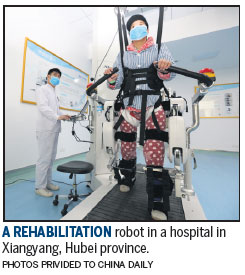
"The growing number of senior citizens will offer a sizable quantity of clinical cases, and enterprises can leverage a huge database to accelerate research and development," says Zhang Songgen, chairman of Tinavi.
In April, China unveiled its plan to sell domestic service robots worth more than 30 billion yuan ($4.4 billion; 4.1 billion euros; ??3.5 billion) by 2020. Medical robots are an important part of the ambitious goal. In 2016, China's medical robotics market was valued at 791 million yuan, up 34.4 percent from 2015, according to a report by the Beijing-based research company GCiS.
"From surgery, rehabilitation, drug delivery and home care, robots are set to transform China's healthcare industry," GCiS predicts.
With Tinavi, whose robots have completed around 2,000 surgeries since 2010, there are many new players. One of them is Chongqing Jinshan Science and Technology. The company started as a maker of capsule endoscopes, or pill-sized cameras that record images of the digestive tract. Its products, approved by US medical authorities in 2008, are available in more than 60 countries.
Jinshan has become a partner with the well-regarded Harbin Institute of Technology in producing the country's first minimally invasive surgical robot for thoracic and celiac diseases. It is scheduled to go into clinical testing soon.
"China's medical robot sector is still in its infancy. But homegrown enterprises and universities are more united than ever in the R&D of core technologies. They are narrowing the gap with foreign leaders such as US company Intuitive Surgical's da Vinci surgery robot," says Guo Xuan, deputy director of Beijing-based Yizhuang Smart Robotics Industry Research Institute. Strong policy support has helped, Guo says.
Public hospitals are also encouraged to play an active part. China's PLA Navy General Hospital has developed the neurosurgical robot, Remebot, through a partnership with Beijing University of Aeronautics and Astronautics.
"It is very important to win support from hospitals because they are the buyers of most medical robots and know exactly what is needed," says Luo Jun, CEO of the International Robotics and Intelligent Equipment Industry Alliance.
masi@chinadaily.com.cn
(China Daily European Weekly 02/17/2017 page14)






Today's Top News
- US quits 66 intl organizations under Trump's order: White House
- Handcrafted gold market gaining increased luster
- Demonstration held in Venezuelan capital, demands release of Maduro by US
- Time for US to stop violating UN charter
- China, Africa share harvest of strong ties
- US conducting operation to seize Venezuela-linked oil tanker in Atlantic: US media