Product inspectors look back on early UK challenges







Now, as two-way trade expands with China, their business is booming
Huang Shouyun still remembers the challenging first 10 years of China Certification & Inspection Group's London expansion.
As a new market entrant establishing a London base in 1991 - and competing head-to-head with Western incumbents in the trade certification industry - the group secured little more than 100,000 ($124,500; 117,800 euros) of revenue from its certification work each year during the early years, back when there were only four employees.
"Our first decade of expansion into the UK was mainly a time of gaining experience," says Huang, CCIC London's managing director, speaking from his office in North London.
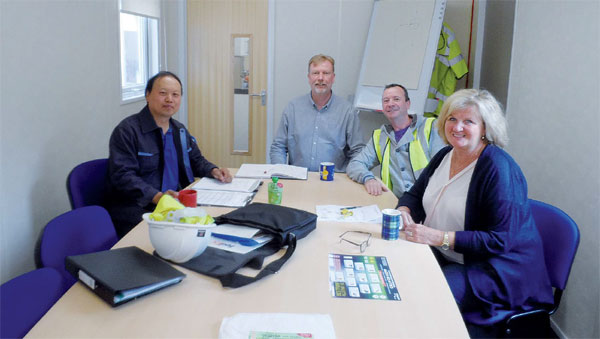
| An employee of CCIC London meets with a client to discuss certification work. Provided to China Daily |
Today, the group's activities have grown, thanks to strong China-UK trade that has translated into a significant number of UK exporting companies and exported products needing certification and inspection. CCIC London's workforce has also grown to 24 employees.
The company now collaborates with major British and international organizations, including The Recycling Association, London Metal Exchange and the European Bank for Reconstruction and Development.
"We are in the UK not just to make a profit but also to share knowledge about export and import requirements and certification processes, so we can help British and Chinese companies sell more products internationally," Huang says.
In 2016, CCIC established a collaborative partnership with London-based EBRD, which invests in and manages the procurement processes for industrial equipment connected to many projects in countries along the Belt the Road Initiative. CCIC learns from EBRD about its requirements in connection with those projects and relays the information to Chinese industrial equipment producers that are keen to bid for contracts.

"We want to help more Chinese industrial equipment makers export into countries on the Belt and Road map," Huang says. "This will help them internationalize and help China address its domestic industrial overcapacity issue. Therefore, understanding the standards and conformance of infrastructure projects along the Belt and Road is very important. We wanted to help, especially, the many small companies that have good products to export but may not have the resources to understand international procurement requirements."
Another key milestone for CCIC was being approved by the London Metal Exchange as a listed sampler and assayer in 2016, making it the first Chinese company to earn the accreditation. The move means CCIC can certify the quality of metals traded on the exchange.
More specifically, CCIC can sample metal products, test and analyze those samples, and issue analysis reports that can be used as important trade documents.
"Our certificate for the metals traded is a stamp of confidence for the metals' quality. Once certified, this particular metal product can change hands many times through trading activities at LME. Our certificate allows traders to be sure of what they are buying," Huang says.
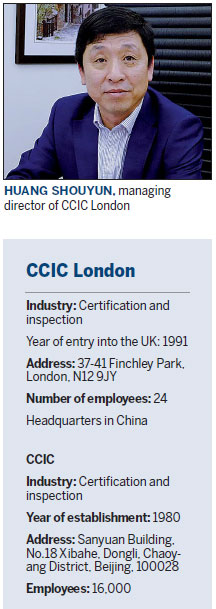
CCIC was founded in 1980 in Beijing and is China's largest certification and inspection group. As a state-owned enterprise, it works closely with Chinese regulators to make sure products imported into and exported from China meet quality requirements. Among the most commonly inspected commodities are oil, agricultural products, industrial products, consumer products, food and vehicles.
To date, CCIC has about 300 offices globally with 200 collaboration laboratories. Collaboration laboratories are used to test samples of products. CCIC employs 16,000 staff globally, with a network covering more than 20 countries and regions.
CCIC's London office was one of the first to be established overseas. Huang notes that CCIC's strong links with the Chinese government give it an advantage in the UK because it can assure clients it has a good grasp of Chinese import regulations.
"We have a good understanding of the difference in standards between China and the West, and we help British firms understand what is expected in China," he says.
But the journey to where the company is today was not a smooth one. Existing players, including France's Bureau Veritas, were in a strong position and had built a reputation for certifying British exports to other markets, including China.
"In the first decade of our time in the UK, we mostly certified small amounts of exports, mainly British chemical fertilizers, to China. But over the years the situation changed due to increasing China-UK trade volume," Huang says.
The value of UK exports to China grew by 108 percent between 2010 and 2016. China is the UK's third-largest export market, and the second-largest destination for UK investment, according to UK government figures.
Most of the products certified by CCIC are food, recyclable material and old electrical products. CCIC London normally certifies products at its client organization's offices. Occasionally, when products need additional analysis, items are sent to laboratories or partner laboratories in nearby countries, including the Netherlands.
Exports to China of wastepaper and scrap metal are important but rarely attract attention.
"These recyclable materials are very important for China, because the cost of wastepaper and scrap metal is significantly less than new. China needs these materials to fuel its economic growth, and has a big recycling industry to turn those materials into useful resources at reasonable cost," Huang says. "Take wastepaper, for example. Reusing a ton of wastepaper can help us save 17 trees from being cut down and save 10 tons of water and 1.2 tons of standard coal. So, China's purchase of recyclable material from countries like the UK is playing a big part in combating global climate change."
Going forward, CCIC is considering setting up a laboratory in the UK to increase its certification capability.
"We are hoping to increase certification of food, chemicals and electrical products in the UK, so our new laboratory could help our work in those areas," Huang says.
Huang's optimism for increasing certifying activities in the UK is backed by the prospect of an expected free trade agreement between the UK and China, as proposed by British Chancellor Philip Hammond in 2016 when he attended the G20 Finance Ministers' meeting in Chengdu.
The prospect of new categories of food exports to China - beef, for instance - would further boost demand for certification. For the first time, last year Chinese officials went to a beef farm and abattoir in Surrey to observe the levels of animal welfare and the UK's disease-control measures. The move was part of China's assessment of whether it should be open to British beef exports.
Further talks will be held in April when Chinese inspectors return for technical reviews.
British exporters are closely watching the progress of the review because Chinese imports of beef have doubled during the past two years, but Britain has been missing out because British beef was banned following the outbreak of BSE - so-called mad cow disease - in the 1980s.
"We believe the potential for UK exports to China is great, both in volume terms and types of exports. We hope our experience of over 20 years in the UK, our global experience accumulated across different countries and regions, and our customer-centric approach will make us a good partner for UK exporters," Huang says.
"Meanwhile, we will continuously collaborate with the UK government and inspection industry regulators to ensure our certification work is coherent with British rules. We will also closely watch new trade regulations and changes to standards post-Brexit and adjust our services according to the latest rules."
cecily.liu@mail.chinadailyuk.com
(China Daily European Weekly 02/24/2017 page30)



Today's Top News
- New Year's address inspiring for all
- Xi congratulates Science and Technology Daily on its 40th anniversary
- Xi congratulates Guy Parmelin on assuming Swiss presidency
- China Daily launches 'China Bound'
- Manufacturing rebounds in December
- PLA wraps up military drills around Taiwan