Fear is the real problem with artificial intelligence







The fast development of robotics has raised public concern about robots replacing workers not only on factory floors but also in offices, and causing a global unemployment crisis. To an extent, people's concerns seem justified.
For example, Apple Inc's largest original equipment manufacturer, Foxconn Technology Group, has started using robots in large numbers, resulting in many workers losing their jobs.
An equally fearsome threat is the wide application of artificial intelligence, because it can render many professionals, including financial analysts, jobless. Japan-based Fukoku Mutual Life Insurance Co, for instance, laid off 30 percent of its employees in the claims settlement department in January, as those posts were to be taken over by machines with artificial intelligence.
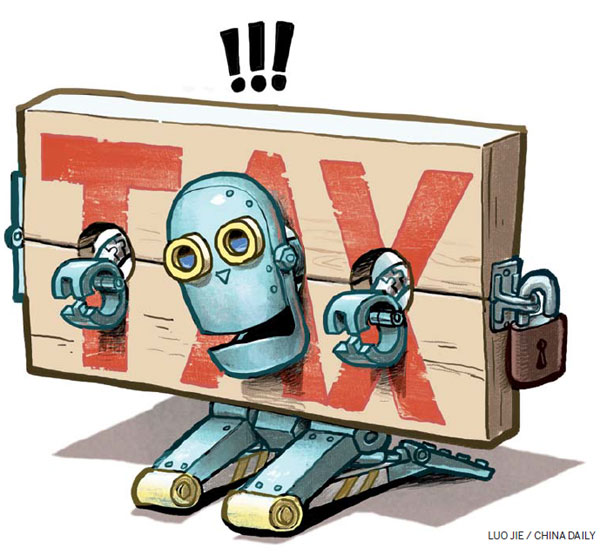
The other major concern is that the already large number of jobless people around the world will increase further, worsening the already skewed wealth distribution. More money will flow into the wallets of capitalists, and common people's incomes will drop remarkably, because the value of their labor and skills will dwindle. The widening income gap, if unchecked, will cause serious social problems around the globe.
Some countries have already realized this problem and taken some countermeasures to address it. The European Parliament recently held a vote on a proposed bill on the use of robots in industrial, healthcare, entertainment and other sectors. The bill will entitle governments to levy taxes on the use of robots in these sectors, and the money collected would be spent on training jobless people so that they can be employed. Although the bill has not been passed because of opposition, it reflects a changing social reality.
Opponents to the bill think the robot tax will have a negative impact on enterprises' innovation capacity and job market competition. Which raises a valid question: How to strike a balance between job protection and innovation capacity?
To begin with, European countries should not pass laws like the United Kingdom's Red Flag Act of 1865, which throttled the auto industry's development by imposing excessive restrictions on the movement of mechanically propelled vehicles on roads. The robot tax bill, similarly, represents a clash between conservative thinking and the innovative spirit.
In a recent interview with the Quartz news website, Microsoft founder Bill Gates said he agreed with the idea of levying a tax on enterprises employing robots, so that the revenue can be used to train unemployed workers.
It will be a bad thing, Gates said, if people's fear of innovation outweighs their passion, because it will prevent the robot industry from developing in a positive direction. Therefore, collecting tax is better than banning the development of robotics.
But since the robot industry is still in its infancy stage, it is too early to impose a tax on the use of robots in certain sectors; it will restrain research and development, and thus innovation.
The use of robots will help adjust the labor structure, instead of wiping out jobs. The industrial trend is to use robots to produce more commodities, offer more services and more liberate humans from hard labor so that more people can focus on more important jobs, such as education and medical care, which require human qualities. In this sense, the use of robots will help make human labor more valuable and structured.
People's fears over the use of robots are, to a large extent, based on their imagination. The overall loss resulting from restricting the use of robots or banning them on the basis of imagination will far outweigh the gain.
The article was first published in Beijing Youth Daily on March 1.
(China Daily European Weekly 03/03/2017 page13)






Today's Top News
- Trump says Maduro to be transported to New York
- Venezuela sends letter to UN Security Council, condemning US armed aggression
- China strongly condemns US use of force against Venezuela
- Britain 'not involved in any way' in US operation in Venezuela: British PM
- EU urges de-escalation in Venezuela
- What we know