Life is sweet for sugar lovers







Editor's note: China is divided into as many culinary regions as there are different ethnic groups. Its geographical diversity and kaleidoscopic cultural profiles contribute to an unending banquet of flavors.
Sugar is much maligned these days, blamed for countless ills. Anything eaten in excess does the body no good and sugar is no exception. The key to good health has always been moderation.
Of the five tastes - saltiness, sourness, sweet, bitter and spicy - sweet is probably the first we experience as babies. It is something we appreciate all our lives.
In Chinese cuisine, chefs have elevated sweetness to an art. They have long understood that a savory dish needs a pinch of sugar to balance the flavors, just as a pinch of salt will somehow make a sweet dish stand out more.
| In Chinese cuisine, chefs have elevated sweetness to an art. Photos Provided to China Daily |
Certain regional cuisines tend to be sweeter than others.
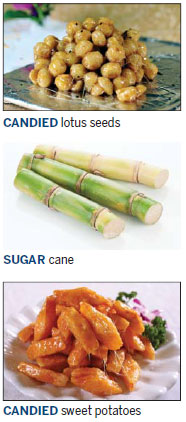
In Chaozhou, on the eastern edge of Guangdong province, there are large stretches of sugarcane plantations. Sugar is very much part of the regional cooking style.
Raw cane sugar cooked into a syrup is applied liberally to roast ducks, which are then smoked with the sugarcane pulp. The result is a tender, smoky sweet bird that has become a local culinary speciality.
Raw sugar is also used to make sweet-savory desserts of pumpkins and yams, and that very famous yam puree cooked with sugar and lard which is a Chaozhou banquet standard.
Sugar is cooked into a thick taffy and pulled into snowy white candy sticks that are eaten wrapped in a crepe filled with crushed peanuts. The locals call these sugar scallions.
Oddly enough, there is one region in China well known for its sweet cuisine, but it does not produce any sugar locally. This is Wuxi in eastern China on the banks of Taihu Lake.
The cooking style is very similar to that of Shanghai, its nearest megapolis neighbor.
Sugar is a main seasoning ingredient here. One good example is the famed Wuxi pork ribs, slathered in a dark sweet syrup and cooked until the meat falls off the bone. Think baby back ribs in a very sweet barbecue sauce.
Shanghai, too, tends to have a sweeter palate than most. For example, many regional cuisines have their versions of braised belly pork, but the Shanghai version tends to have a syrupy sauce.
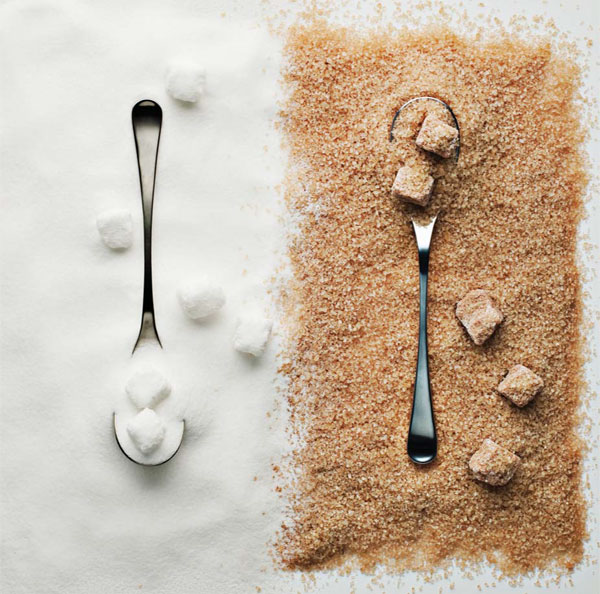
There are many varieties of sugar used in China.
The most characteristic is rock sugar. In its most primitive form, it is used for sweet soups, tonics and medicine, and it comes in large irregular lumps that are pure sugar crystals.
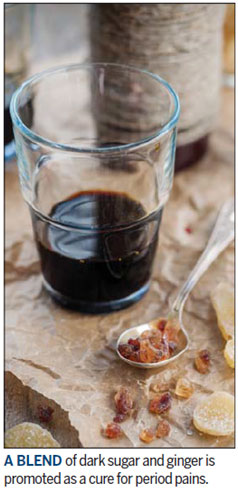
Then there are the dark ingots of raw sugar popular in the southwest provinces of Yunnan and Sichuan. These have a caramel aftertaste and are often given to new mothers or recuperating patients. Sometimes, they are further flavored with old ginger.
Over on Taiwan island, they have developed instant drinks using dark sugar and ginger which are promoted as a cure for period pains.
In the Cantonese kitchen, you are likely to find little golden slabs of raw sugar, pantry basics that go into sweet soups. Again, these slabs are made from sugar cane juice that is slowly cooked down, and they have a distinctive fragrance all their own.
In Beijing, I've noticed they like something called "cottony white sugar" or mianbaitang, which is a processed sugar with a very soft texture almost like that of damp icing sugar. It has a very low melting point.
Are there any natural sugar substitutes in China? Absolutely. There is the luohanguo, the Luohan fruit, which grows wild in the mountains of Guangxi. It is now cultivated for medicinal uses, and research is ongoing on how to use it as an organic sweetener, similar to stevia.
Sugarcraft is an ancient skill in China, and at temple fairs everywhere during the Spring Festival you may see an old craftsman with a vat of hot sugar syrup.
In front of him, he will have an oiled slab of metal or ceramic. That is his canvas. He pours hot syrup into a tiny funnel and the magic begins. As the delighted audience watches, dragons, unicorns, fairies or the Monkey King will be sketched out at top speed.
Finally, he inserts a bamboo skewer underneath the candy art and carefully lifts it, handing it to his lucky customer, usually an impatient child eager to lick it all up.
Of course, you cannot talk about sugar without mentioning that most classic of northern Chinese desserts - basi. It literally means "pulling sugar strands", and the nearest Western equivalent I can think of will be toffee apples or the fairy sugar strands surrounding a croquembouche.
But for the Chinese, it is an art that takes place tableside, with a bit of diner participation thrown in for drama.
Sugar is heated into a thick syrup, and bananas, sliced apples, yam or sweet potatoes are tossed in the liquid. The sugar must be hot enough to coat and cook, but it cannot be allowed to crystallize.
While it is still piping hot, the dish is served, together with a bowl of ice water. The idea is that diners will take a chosen piece and dunk it into the cold water.
The result is a crisp, crunchy sugar coating that envelops the hot fruit inside.
paulined@chinadaily.com.cn
Candied Bananas
Three to four bananas, lemon juice
500 g sugar
Two tablespoons vegetable oil
A few tablespoons of sesame seeds
A bowl of ice water
In a cold wok, add the oil and the sugar. Do not stir, but allow the sugar to melt over medium low heat.Cut the bananas into big chunks and drizzle with lemon juice so the pieces do not oxidize.When the sugar is melted to a light golden brown, add banana chunks and lightly toss to coat. Sprinkle with sesame seeds.Plate and serve with the cold water.Dip a piece of candied banana into the cold water to crisp the sugar coating. Use a large wok for this. The larger working area will prevent accidents, it will also distribute heat more evenly.You can use peeled, sliced apples, pineapple chunks, steamed yam or sweet potatoes. Avoid overly acidic fruit like kiwi fruits.
(China Daily European Weekly 03/10/2017 page18)



Today's Top News
- US conducting operation to seize Venezuela-linked oil tanker in Atlantic: US media
- Visits reflect commitment to relationship: China Daily editorial
- Mainland sanctions diehard 'Taiwan independence' separatists
- China's postal delivery volume hits 216.5b items in 2025
- 2025 in review: A year of shifting horizons
- Decade-plus high for key A-share index