Middle class hoping to sock away wealth







Where to invest poses a dilemma for many as returns on savings drop
When he delivered the Government Work Report on Mar 5, Chinese Premier Li Keqiang may have been reflecting the financial aspirations of the nation's 109-million-strong middle class, among other things.
During his speech to the annual plenary session of the National People's Congress, Li highlighted government efforts to help boost people's wealth through productive work, so that they can reach their life goals. The country's personal per capita disposable income grew by 6.3 percent in real terms in 2016, he said.
The reference to "disposable income" seemed timely because, of late, the middle class - people with net assets worth between $50,000 and $500,000 each - have been groping for high-return options that increasingly appear to be few and far between, due to the changing economic growth trend, stricter regulations and fluctuating currency.
Personal finance and wealth management have become hot topics among China's retail investors. He Ziying, 32, a human resources manager at a private construction company in Beijing, is one such retail investor.
She is concerned about her family's financial future although her current situation suggests there is no real cause for worry.
Thanks to their parents' support, He and her husband own a two-bedroom apartment, which they bought outright, without a mortgage. They drive a VW Passat. Married in 2011 and yet to have their first baby, both hold stable jobs that pull in about 200,000 yuan ($29,000; 27,344 euros; 23,600) a year.
But He has been uneasy ever since she began thinking of having a baby. Her parents will soon turn 70.
"I get anxious as I think about it," He says. "I don't want to leave my family's financial future to chance."
She wants to support her planned child's overseas education and her parents' twilight years, and maintain the quality of her own life after retirement.
To do all that, she needs to protect and grow her family's wealth. She is on the lookout for a sound financial plan. Only, there don't seem to be many around due to shortage of investable assets. This is what makes her anxious in the current low-rate environment.
He wants to invest her family's savings in relatively safe instruments or schemes that could offer satisfying returns. But China's easy monetary policy, which has helped stimulate the economy, has also inflicted financial pain on small investors.
Consider new loans. In recent years, they have been growing at around 11 percent annually, higher than the GDP growth rate range between 2008 and 2016.
The abundant money supply has driven down real interest rates as well as investment yields across all asset classes.
"It used to be easy to find investment products that offered more than 10 percent returns," He says. "Now, easy profits are no longer available. I'd be happy if my wealth manager offered me something with a rate of return above 4 percent."
Over the past decade, China's GDP grew from 21.9 trillion yuan in 2006 to 74.4 trillion yuan in 2016, a record, with this year's GDP forecast to grow at 6.5 percent. The yuan appreciated from 7.8 to the dollar at the end of 2006 to 6.96 at the end of 2016. This led to a steady rise in people's incomes and family wealth.
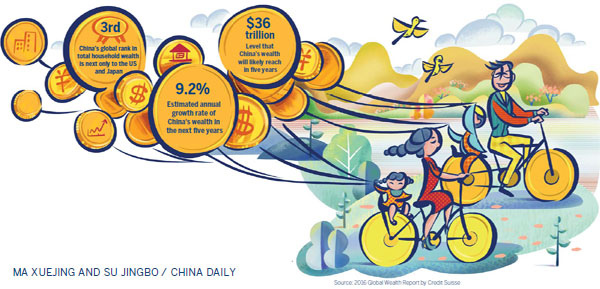
China ranks third after the United States and Japan in terms of household wealth, according to the 2016 Global Wealth Report by Credit Suisse.
But, even as GDP growth slows, in the next five years China's wealth will likely remain on a strong upward trajectory, growing at 9.2 percent annually, to reach $36 trillion in 2021, the report says.
The consequent massive demand for financial products and professional wealth management services has not been matched by adequate supply.
This means stocks and property have remained key investment avenues. But the roller-coaster ride of the stock market in 2015, and the latest round of tightening measures by the government to tame runaway home prices, have created a deep sense of uncertainty about investment prospects.
Driven by the desire to preserve and grow their wealth, small investors are seeking alternative investment options.
Life insurance, hedge funds, online financing, peer-to-peer or P2P lending - even trading in the virtual currency Bitcoin - have all come into investment focus of late.
But some analysts say high-yield but risky investments ought not to be the right choice for small investors.
Thomas Deng, chief investment officer for China at UBS Wealth Management, says Chinese families would do well to buy property in prime locations in top-tier cities such as Beijing and Shanghai.
The CPI (consumer price index) is around 2 percent for 2016 (and forecast to be 3 percent for 2017), which means inflation is not an immediate concern, Deng says. "But every family can get a sense of it when they compare the rise in their income with the rise in housing prices, food prices and their children's education costs."
Xu Yongwei, chief investment officer of insurer Manu-life-Sinochem Co, says Chinese families should consider allocating a portion of their wealth to mutual funds.
"They are less risky and more transparent. When picking a fund, one needs to look at its investment performance for at least the past five years, instead of just focusing on the promised rate of return," Xu says.
Andrew Wang, chief investment officer of Manulife Teda Fund Management Co, says tighter regulation will be positive for the mutual fund industry as it will help channel money from risky investment products to more transparent products.
lixiang@chinadaily.com.cn
(China Daily European Weekly 03/10/2017 page26)




Today's Top News
- US conducting operation to seize Venezuela-linked oil tanker in Atlantic: US media
- Visits reflect commitment to relationship: China Daily editorial
- Mainland sanctions diehard 'Taiwan independence' separatists
- China's postal delivery volume hits 216.5b items in 2025
- 2025 in review: A year of shifting horizons
- Decade-plus high for key A-share index