It pays to cater to tourists







Ant Financial is making life easier for Chinese shoppers in Europe
Chinese e-commerce giant Alibaba is now virtually a household name in the West, but its lesser-known sister company, Ant Financial is also making its mark as it rolls out its global mobile payment system across Europe.
Two years after expanding into Europe, Ant Financial is working with powerful European banks, including BNP Paribas, Barclays and UniCredit, to enable 930,000 merchants to join the payment network of Alipay, Ant Financial's payment platform.
Alipay is not really competing with Western mobile payment providers like Apple Pay and Samsung Pay, but it is significantly improving Chinese tourists' overseas experiences by giving them a convenient and secure payment method and offering lots of travel advice.
| Alipay service is available at a hotel in Finland. Cecily Liu / China Daily |

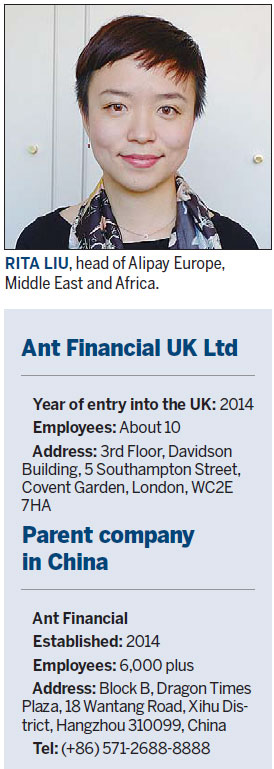
This customer experience is what Rita Liu, head of Alipay Europe, Middle East, and Africa, calls "fin-life", a new method of easy and convenient living enabled by financial technology.
"We hope to champion the concept of 'fin-life' to make payment easy, and we want to build a big network globally so that Chinese tourists traveling abroad can feel that they are enjoying payment convenience as if they are still in China," says Liu.
"Our expansion overseas has two considerations. We do see the outbound Chinese tourist market as a big opportunity for payment method provision, but also we think from our customers' perspective, to provide them a service they truly need."
With 450 million active users in China, Alipay is now used by European hotels, retailers and other tourist attractions keen to lure high spending Chinese tourists.
Luxury retailer Tripidi at Frankfurt Airport became the first to accept Alipay in 2015. Now it is used in many other famous shopping locations, including Harrods in London and Printemps in Paris. Alipay was used by 120 million users overseas last year.

Its European network operates in collaboration with leading Western payment companies, including Germany's Wirecard and France's Ingenico and BNP Paribas, Switzerland's Six Payment Services, Italy's Unicredit, the UK's Barclays and ePassi in Finland.
"Our expansion model focuses on collaboration with local banks and payment companies, leveraging on their local market reputation, their wide networks with European merchants and other partner," Liu says.
"I find our international expansion is greatly welcomed by our European banking and other payment partners. From my communications with them, I realize they value the future of fintech and mobile payment very much and they are very keen to be partners with a pioneering company in this industry like Ant Financial," Liu says.
The collaboration is really a win-win story. The European payment firms and Alipay each collect a commission on each transaction processed, and Western retailers can sell products and services to Chinese tourists.
Most important, Chinese tourists no longer need to carry so much cash on their trips. They just pay for their purchases by using the Alipay app on mobile phones to scan a QR code provided by merchants. Transactions are processed in seconds.
In addition, tourists can find more local market information on the Alipay app's Discover platform, including details of local markets, restaurants and shops, as well as hot tourist spots and ticket information. The Alipay app's Discover platform now includes information on more than 570,000 European merchants across 20 countries.
Alipay also benefits by working with existing European payment methods such as ePassi, Finland's biggest mobile payment platform, which has helped Alipay become accepted by more than 100 merchants, including hotels, shops and restaurants.
"Our existing reputation in Europe means many merchants trust Alipay even though they may not have heard the name before. Since we launched promotional activities to spread Alipay's name in Finland, many Finnish merchants have been approaching us to install Alipay," says Alexander Yin, chief financial officer of TCG, parent company of ePassi.
The fact that ePassi already owns a payment institution license from Finnish regulators means Alipay's entrance into Finland requires no additional approval.
As an intermediary, ePassi collects payments from Alipay and distributes them among European merchants. Merchants use the ePassi app to take payment in the same way they would take payments from Finnish customers of ePassi, so the fact the payment came from Alipay users made no difference to them.
Jeongwen Chiang, a professor of marketing at China Europe International Business School, says Alipay's European expansion is effective due to the high volumes of Chinese travelers abroad and European retailers will be "sure winners" in Alipay's expansion.
"Besides being able to make more sales to Chinese customers, when their Chinese customers use Alipay the retailers will be able to view the shopping habits of these consumers. This information may help them to develop ways to attract more Chinese customers," Chiang says.
Alipay's history goes back to 2004, when it was still the payment arm of China's ecommerce giant Alibaba. Over the years Alibaba and Alipay both grew very fast. Alibaba separated Alipay from the group and in 2014 its affiliate company, Ant Financial, was created as the parent company for Alipay.
Alipay is the standard payment provider for China's large e-commerce shopping population on Alibaba, so it has a large user base, but it still lags behind Western competitors. Apple Pay dominates this market with "tens of millions" of monthly active users worldwide as of June 2016, which represents a 450 percent year-on-year growth.
Alipay has not reached out to provide services to non-Chinese users so far but industry analysts believe this should be its next step.
Howard Yu, a professor in strategic management and innovation at IMD Business School in Switzerland, says Alipay's international expansion is now at an "inflecion point" where great benefits can be achieved if it starts serving non-Chinese customers.
"They can bring value especially by helping to connect Western customers with China's payment market. They could serve Western tourists traveling to China, or Western businesses in China," Yu says.
Their existing international reputation would be helpful, and they are bringing a valuable service because, for Western travelers and businesses, carrying cash to China is difficult. It is helpful for Alipay to bring a unique proposition, leveraging its China market expertise, rather than engaging with the whole international market and trying to compete with Google Wallet and Apple Pay, which are already very big internationally," Yu says.
Perhaps one reason Alipay has not yet engaged with Western customers could be due to resource allocation, because Alipay is competing in China's domestic market with other payment providers such as Wechat Wallet. Wechat Wallet, the payment platform affiliated with Wechat, the Chinese WhatsApp, is experiencing big user number growth. Its active users reached 768 million in September 2016, representing a 35 percent year on year growth.
With such significant domestic growth it is, of course, plausible to think that WeChat wallet hopes to consolidate its presence in China, but Yu believes Alipay should place more emphasis on international expansion, leveraging on its existing connections internationally.
"Its historical connection with Alibaba means it already has connections with international customers, many of whom are Western importers and exporters doing business with China."
Yet another huge future potential opportunity for Alipay in China and internationally is to develop targeted products and services with the big data it gathers about what consumers buy, and when and where they make those purchases.
Liu says the Ant Financial team is keen to devise new ways to use such data, although no concrete plans have yet been made.
Looking into the future, Liu says Alipay will continue to expand its European partner networks, so that Alipay can be used by more retailers in Europe.
"We also hope Alipay's product can constantly innovate to improve user experience and provide extra value to retailers by making use of the consumer data it collects," Liu says.
cecily.liu@mail.chinadailyuk.com
(China Daily European Weekly 03/17/2017 page30)






Today's Top News
- China reports 20% rise in inter-regional trips on first day of holiday
- China rebuffs criticism over drills around Taiwan
- Mainland pledges deeper cross-Strait integration in 2026
- Lai's 'separatist fallacy' speech rightly slammed
- Xi's message for New Year widely lauded
- Swiss bar fire kills around 40, injures more than 110