Xi leads ecological civilization







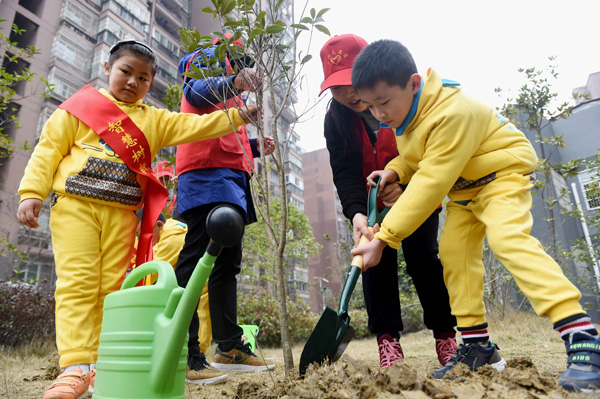 |
| Volunteers and children plant a tree together in a community of relocated residents in Hefei, Anhui province, earlier this month to promote the awareness of caring for trees and the environment. [Photo by Xie Chen/For China Daily] |
President says development to focus on quality and efficiency
As part of China's efforts to improve the environment, the construction of nine national parks with a combined area of nearly 170,000 square kilometers is underway, and the country will this year formulate an overall plan for the national park system.
Some of the parks are devoted to endangered wild species, such as the giant panda in the southwest and northwest, and the Siberian tiger and Amur leopard in the northeast, while others are for the headwaters of the Yangtze, Yellow and Lancang rivers, China's three major waterways.
China is determined to improve environmental governance, with the "river chief" rule to be implemented in more than 20 provincial-level regions this year. Under the plan, local government officers will be named river chiefs and will be responsible for dealing with water pollution.
"The concept of innovative, coordinated, green, open and shared development should be implemented, with improving growth, quality and efficiency at its core," President Xi Jinping said in a group discussion with lawmakers during the annual session of the National People's Congress, the country's top legislature, in Beijing on March 10.
Man-nature harmony
"Ecological civilization" was listed along with economic, political, cultural and social progress as one of the five goals in the country's overall development plan at the 18th National Congress of the Communist Party of China in 2012, when Xi was elected general secretary of the CPC Central Committee.
The key tenets of ecological civilization include the need to respect, protect and adapt to nature; a commitment to resource conservation; environmental restoration and protection; recycling; low-carbon use; and sustainable development.
Lucid waters and lush mountains are as valuable as gold and silver, Xi said.
Ecological civilization is an important element of national rejuvenation, and it is of huge importance to the world given the role of China as the most populous nation and second-largest economy.
"The CPC Central Committee, with Xi at its core, considers ecological progress as vital to the future of both China and the world," said Zhang Xiaode, director of the Chinese Academy of Governance's Ecological Civilization Research Center.
Reforms in full swing
China has focused on its ecological civilization drive over the past four years, both institutionally and practically.
Last year, the Central Leading Group for Deepening Overall Reform, headed by Xi, passed about 20 reforms to advance ecological progress.
The series of guidelines cover compensation for environmental damage, law enforcement, green financing, national parks, river chiefs and setting ecological red lines to strengthen environmental protection and restrict industrial projects.
Nationwide, more than 10 provinces have demarcated zones under the protection of the ecological red line. Sichuan province and Guizhou province, in the upper reaches of the Yangtze River, marked 40 percent and 32 percent of their respective land areas as protected by the red line. Eleven provinces and cities along the river, the country's longest, will establish ecological red lines this year.
Meanwhile, routine central and local environmental inspection campaigns have urged authorities and businesses not to lose momentum in pollution control.
Rule of law is being strengthened via the 2015 revisions to the Environmental Protection Law, considered the strictest in history.
"Environmental authorities nationwide handed down 124,000 punishments and fines totaling 6.63 billion yuan ($960 million) to businesses for environment-related offenses last year, up 28 percent and 56 percent respectively," said Minister of Environmental Protection Chen Jining.
Pilot administrative reform aimed at strengthening local law enforcement is underway. Nine provinces and cities, including Beijing, now have environmental police forces to deal with polluters.
"Basic rules of ecological civilization are being established," said Pan Jiahua, head of the Chinese Academy of Social Sciences' Institute for Urban and Environmental Studies.
Leading the world in new and renewable energy, China is undergoing a revolution in energy production and consumption, with plans to raise the ratio of non-fossil energy use in total consumption to about 14.3 percent this year, up from 13.3 percent last year, and to about 20 percent by 2030.
In an instruction in December, Xi called for the development of ecological civilization through the rule of law, with backbone regulations to be established as soon as possible.
China will place all major sources of industrial pollution under round-the-clock online monitoring, according to the Government Work Report delivered by Premier Li Keqiang at the annual session of the NPC in Beijing on March 5.
China has steadily increased its focus on the environment, which among other things can be seen in its five-year plans, Agi Veres, country director of the United Nations Development Programme, said in an interview.
"Climate change was briefly touched upon in the 11th Five-Year Plan (2006-10) and now, in the 13th Five-Year Plan (2016-20), climate change and the environment is a central element," Veres said. "The positive environmental trajectory that China is now portraying is embedded in the concept of ecological civilization."
Responsible pacesetter
"The Paris Agreement was a milestone in the history of climate governance. We must ensure this endeavor is not derailed," Xi said during his visit to the United Nations Office at Geneva in January.
China will continue to take actions to cope with climate change, Xi said.
The country has pledged to cut its carbon emissions per unit of GDP by 60 to 65 percent from 2005 levels by 2030.
China's important global role in environment-related issues is perhaps most obvious in the area of climate change, Veres said. "China has been constantly engaged with the global community in reaching amicable agreements to address one of our globe's biggest concerns."
In ecological civilization, the transformational change seen in China, coupled with China's ingenuity, provides valuable experiences that can be shared with other countries, Veres added.
Ecological civilization elements can be found in the United Nations 2030 Sustainable Development Agenda.
"The 'five P's' in the 2030 Agenda-people, planet, prosperity, peace and partnership - have many similarities with China's development strategies," said Pan of the Chinese Academy of Social Sciences.
"Environmental challenges remain and more reforms are needed for China to achieve greater progress," he added.
- La Chine jouera un r?le constructif dans la résolution de la crise ukrainienne (Xi Jinping)
- Xi Jinping appelle les intellectuels chinois à contribuer davantage au développement de la nation
- Xi Jinping appelle à établir une ? Grande Muraille de fer ? pour sauvegarder la stabilité sociale au Xinjiang
- Xi Jinping: The leader of a great revival



- Product carbon footprint management making good progress
- Beijing court convicts 60 for drug smuggling over past decade
- Mainland pledges all-out support for Taiwan compatriots stranded in Israel-Iran conflict
- Web literature draws crowds at Beijing book fair
- China allocates 100 million yuan to support flood-hit Guizhou
- Photo exhibition on Flying Tigers opens in China's Fujian