Car rental business hits a few potholes







High cost, low fees, limited users mean mobility startups may be hurting for cash
Chinese companies in the short-term car-sharing business are facing the risk of insufficient cash flows, as they relying heavily on funding while burning bank notes for vehicles and car plates, industry insiders say.
One of the players in the field, Uucars, recently ceased operation and announced that user deposits will be returned.
The operator, Beijing Youyou Lianchuang Information Technology, was unable to sustain the business because the investment deal agreed upon last year has not been received as expected, despite having raised $16 million (14.9 million euros; 12.9 million).
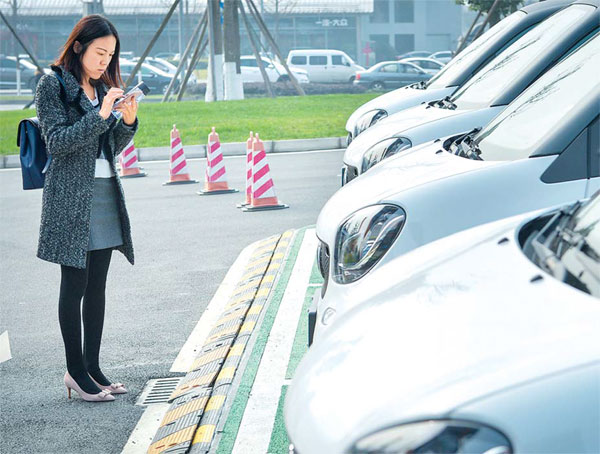
| A citizen in Chengdu, Sichuan province, uses time-sharing cars via online apps. Tan Xi / For China Daily |
Analysts view the boom in car rentals - also known as time-sharing - as a future possibility. But at the moment, it appears breaking even may not be among the possibilities, let alone turning a profit.
"The charges are pretty low, and users are few. Users pay tens of yuan for a half-hour or even shorter ride," says Yale Zhang, managing director of consulting service Automotive Foresight (Shanghai).
The business was inspired by Zipcar, a car-sharing service in the United States that issues cards to members to unlock vehicles for rent in neighborhoods, urban areas and airports. However, Zipcar users are charged by the hour or day on top of monthly membership fees.
Uucars calculates a fare based on both time and distance, with a typical drive costing 0.8 yuan ($0.10) per kilometer and 0.09 yuan per minute. Insurance and gasoline are included in the fare, but users must pay a 1,000-yuan deposit in advance.
A local media report quoted the co-founder of Uucars, Jiang Qing, as saying that the company almost broke even in each vehicle's operation, but fell into deficit after deducting the costs of personnel and housing rentals.
The company operated a fleet of more than 300 new-energy vehicles during its peak, but the majority of them were rented from other traditional car rental companies.
"The biggest cost incurred was in the mounted rental expense. There's no profit model yet," says Li Yu, another co-founder of Uucars.
Zhang, the consultant, says, "A traditional car rental company usually charges hundreds of yuan for daily use - for example 200 yuan for a compact car per day. And selling the cars after several years of service provides another income source."
In a recent research report, Strategy&, a subsidiary of PricewaterhouseCoopers, said that "almost all car ride providers' books remain in the red, with each car losing 50 to 120 yuan a day".
The report predicted that car-sharing services will see fast growth in China in the coming years, and fleets of such service providers are expected to reach a collective 170,000 cars by 2020.
Earlier, Bill Peng, a partner with Strategy&, told China Daily: "The segment, after rounds of mergers and acquisitions, will see three to four dominant companies."
More than 350 companies are currently involved in the car sharing industry, including car manufacturers, rental companies and startups like Uucars, according to Yang Yang, CEO of New Harmony Commercial Factoring Co, a car-sharing solutions provider.
Both of Uucars' co-founders agreed that the sector deserved attention from many stakeholders, including local governments, car manufacturers and electric charging facility operators. They see advantages for those players backed by carmakers and state-owned enterprises.

The car-sharing subsidiaries under premium automakers and state-owned vehicle rental companies are at the forefront of the game in the world's largest car market, which is set to lead future mobility trends.
State-owned Beijing Shouqi Group, which founded Gofun Chuxing in 2015 to provide car-sharing services, announced an expansion of its operations to 20 cities, saying it would have more than 15,000 cars nationwide by the end of 2017.
Gofun's ambitious target is 50 times larger than Uucar's, and its current 1,100-unit fleet in Beijing is already four times the size of the startup.
Chinese Lifan Motors has added 1,100 electric cars to its Chongqing based car-sharing service provider Pand Auto, increasing the fleet to 1,400 units.
Data from Strategy& showed that 95 percent of the cars shared now are new-energy vehicles, and 77 percent of them are operated by automaker-backed ride providers.
It expects automakers to continue to expand such providers' fleets to boost sales of their own new-energy cars.
Contact the writers through haoyan@chinadaily.com.cn.
(China Daily European Weekly 03/24/2017 page28)




Today's Top News
- UN envoy calls on Japan to retract Taiwan comments
- Innovation to give edge in frontier sectors
- Sanctions on Japan's former senior official announced
- Xi stresses importance of raising minors' moral standards
- Coordinated reform key to country's growth
- Shandong gives new life to traditions