Going against the grain







World-renowned geneticist J Craig Venter, who received an award for international cooperation from a large Chinese biotech company, talks about the future of science
Being a scientist means one must challenge existing dogma and authority, says J Craig Venter, a biotechnologist and geneticist who visited Beijing at the end of 2016 to receive Chinese biotech company VCANBIO's Award for International Cooperation in Life Sciences and Medicine.
Venter, 70, was one of the first to sequence the human genome and the first to create what is called man-made life - inserting a synthetic genome into the cell of a bacterium, whose original genome was destroyed.
Venter and his team were able to put 'watermarks' on the synthetic genome. One of those marks was a quote from Irish writer James Joyce: "To live, to err, to fall, to triumph, to re-create life out of life".
| J Craig Venter, who has been challenging authority all his life, says, "You need big ego to succeed." Photos Provided to China Daily |
The first man-made cell survived and reproduced.
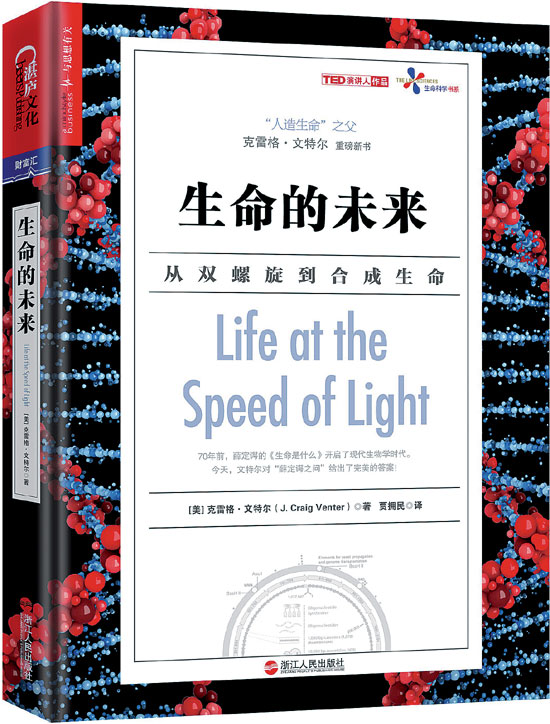
Now a Chinese language version of Venter's book Life at the Speed of Light is available in China.
The book, is based on a speech he gave in July at Trinity College, Dublin, Ireland.
The speech was titled What is Life? The Physical Aspect of the Living Cell, and was influential because "it confronted the central problems of biology - heredity and how organisms harness energy to maintain order - from a bold new perspective.
With clarity and conciseness he argued that life had to obey the laws of physics and, as a corollary, one could use the laws of physics to make important deductions about the nature of life.
Motivated and eager
Though he became one of the leading scientists of the 21st century, Venter almost failed to graduate from high school. Growing up in California, he had bad grades in school.
In high school, his only chance to succeed seemed to be swimming, and he said he might have competed in the Olympic Games if he had not been drafted into the military for the Vietnam War.
In Vietnam, Venter was assigned to a Navy hospital because of his high score in an IQ test. One of his tasks was triage - decisions about how to prioritize wounded soldiers returning from battle, including the Tet Offensive. His job was literally to decide who would get a chance to live and who would be allowed to die.
The job traumatized him, and Venter decided to drown himself in the ocean. But as he swam, a shark prodded him and he changed his mind.
The experience in Vietnam influenced him in many ways, he says.
For one thing, it convinced him to go back to school.
"I decided that I definitely wanted a college education. I enjoyed the work I was doing in medicine so much that I was really interested in practicing it," he says.
Another major influence of the experience in Vietnam was that "it made me unafraid to take risks and try to do things", he says. Venter would have stayed in the Navy, but he took a risk and went back to school.
Although he had been a terrible student in high school and worried about starting college from scratch, Venter was motivated and eager to gain medical knowledge.
He started college at 22. In six years, he completed his PhD in physiology and pharmacology.
In 1976, he became a professor at the State University of New York, and in 1984 he joined the National Institutes of Health.
Genome of life
Then, to sequence genomes, he started a nonprofit institute in 1992. In 1995, the institute made a breakthrough, mapping the genetic code of a type of bacterium.
The Venter team's technique outpaced scientists in six countries including the United States, China and the United Kingdom, and in 1997 Venter was invited to join the human gene-sequencing program.
In the previous seven years, the scientists had only sequenced about 3 percent of human genes, but Venter used the next three years to complete 90 percent. In 2000, US president Bill Clinton announced that the program had completed 99 percent of the human genome sequencing.
In 2010, Venter and his team created the first man-made cell.
The team is also developing a technology that will help to bring the genome of life from other planets to Earth to replicate alien life.
For instance, Venter says that if life is found on Mars, which he is sure will happen, machines sent to Mars will be able to sequence the genome of life and send the data back to earth.
'Big ego'
For years, Venter has been characterized as having a big ego, although one of his colleagues told The New York Times: "He's a very insecure person who compensates by coming across as very arrogant and aggressive."
"You need big ego to succeed," says Venter, who has been challenging authority all his life.
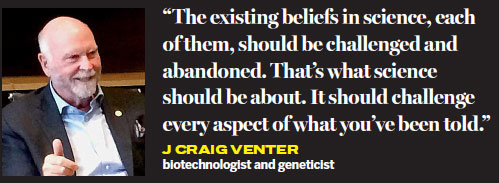
"Scientists used to believe that proteins are the carriers of the genetic message. ... But the existing beliefs in science, each of them, should be challenged and abandoned. That's what science should be about. It should challenge every aspect of what you've been told," he says.
If people are successful scientists, that does not mean they are smart about looking forward and coming up with ideas beyond their narrow space, he says.
Venter says rigid ideas about proteins and DNA set science back half a century: "Just imagine where we would be with the genetic code if we had started in 1900 and tried to understand the genome instead of just thinking that proteins were the genetic material."
For him, the history of science is loaded with belief systems that ultimately were proved wrong.
"So the starting assumption of science should be that it is wrong," he says.
Without challenging or questioning, accepting the existing dogma will kill creativity, so most of the major breakthroughs in science have happened from people changing fields and working in a different space, he says.
Speaking of himself, Venter says: "I was a protein chemist. But I moved to molecular biology and made all these discoveries that the molecular biologists could not make because they believed it was impossible."
yangyang@chinadaily.com.cn
(China Daily European Weekly 03/31/2017 page21)






Today's Top News
- China reports 20% rise in inter-regional trips on first day of holiday
- China rebuffs criticism over drills around Taiwan
- Mainland pledges deeper cross-Strait integration in 2026
- Lai's 'separatist fallacy' speech rightly slammed
- Xi's message for New Year widely lauded
- Swiss bar fire kills around 40, injures more than 110