Chinese banks 'help meet national goals'







Biggest mistake Western observers make about the system is to believe that it is somehow unreformed, says veteran
James Stent insists China is not heading for a banking and financial crisis any time soon. The 71-year-old veteran banker says those who say that it is underestimate the ability of China's financial managers to deal with the issues.
"The Western critics are not wrong in identifying the problems. They are all real and big and challenging problems," he says.
"The only thing is by the time they've identified them, we've long since identified them and are working on trying to solve them within the Chinese political framework."
| James Stent says the role of China's banks is to target money where it is needed and help meet overarching national goals. Zou Hong / China Daily |

Stent, who is speaking in the lobby of the Beijing Jianguo Hotel, is one of the few foreigners to have first hand experience of Chinese banks, having been an independent director of China Minsheng Bank, China's biggest private bank, and China Everbright Bank.
He was in the capital to promote his new book, China's Banking Transformation: The Untold Story, an often brilliantly informative insider's account of how the Chinese banking system works, as well as examining many of the challenges it faces.
He says he wanted to address, in particular, some of the misconceptions many in the West have about the Chinese financial system.
"What a great deal of the book is about is that the Chinese political and economic framework, for cultural reasons, is extremely different from the American or the Western European ones."
Stent, both engaging and softly spoken, and who now divides his time between homes in Thailand and California, argues China has more of hybrid banking system.

"Western banks serve really one end, shareholder value; and incidentally, bonuses for senior management. In China, banks are not really very much about shareholder value at all, apart from keeping a score of their efficiency and competence.
"The role of China's banks is to target money where it is needed and help meet overarching national goals. Hence, the annual reports of many Chinese banks begin with the chairman reporting that the bank has successfully supported national economic goals."
Stent says this does not make China's banking system unique since it was also what led South Korea's economic transformation in the 1970s and is also an echo of that of Germany's emergence as an economic power in the 19th century.
"Park Chung-hee (South Korean president, 1963-79) used the same method and it is a development state model of banking. The German economist Friedrich List said that the free market approach of Adam Smith (the Scottish 18th century economist) was very good for Britain but it wouldn't work for Germany, who were the catch-up players of the day."
One of the major concerns about China is asset bubbles, particularly in the property sector, and the rising level of debt, which by some estimates is now 260 percent of GDP.
"It (the level of debt) is very much to do with the banking system. People are right to worry about this. The actual absolute level of debt, however, is not all that scary - the level is much higher in the US."
Stent is dismissive of those who suggest the US can support a higher level of debt because they have a more sophisticated and advanced financial system.
"Yes, you can see that in 2008, can't you?" he laughs.
"In the US, we like these crashes and we are going to have many more. I am going to live to see at least one or probably two more in my lifetime. They are part of how the US works. It is our frontier culture. The Chinese don't like this and they have a very different system."
Stent, who was born in San Francisco, just after the end of World War II, had his first experience of China when he went to the Chinese University of Hong Kong as a foreign exchange student while doing his degree at Berkeley.
"I studied Mandarin intensively there and that changed my life and everything has proceeded from that then on."
He experienced Asia again as a young officer in the Vietnam War but after graduating he started his career at Citibank in 1973, where he was soon transferred to its operations in the Far East. He then spent nearly two decades with the Bank of Asia in Bangkok, rising to be senior executive vice-president.
It was in 2003 he was approached by the late Jing Shuping, the then 83-year-old founder and chairman of China Minsheng Bank, China's biggest private bank, to join the bank's board.
"He wanted someone who had worked for a foreign bank on the board. Our first meeting was a broad ranging conversation. I think he basically wanted to see whether I could carry on a conversation with him in Chinese. I guess I passed that test."
Stent served three years on the board and then joined the board of China Everbright Bank, where he also became chairman of the audit committee.
His role was to help with instilling modern practices but the banker says the biggest mistake Western observers make about the Chinese banking system is that it is somehow unreformed.
He says former Chinese premier Zhu Rongji's reforms of the 1990s led to a "night-and-day" transformation of the banks.
"(Before the reforms) the banks weren't commercial banks. They were cashiers dispensing money like the treasury does. The people in the state-owned enterprises got the money and they never had to pay it back. It was like a grant."
He says that while some in the West think Chinese banks still operate like this, the reality could not be more different with modern systems in place and often employing China's "brightest and best". 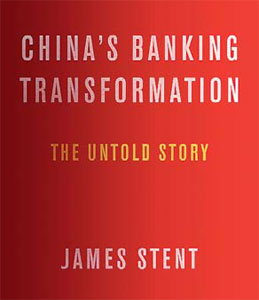
"They were charged from the 1990s onwards with making sure the banks were very cautious about taking on risk and that they gradually adopted global best practices in banking, which was essentially that of the Anglo-American model," he says.
"It was done aggressively and very successfully, step-by-step prioritizing areas initially like corporate governance, which is where I first came in."
Chinese banks have gone on to be significant global players. Industrial and Commercial Bank of China, the world's biggest bank by assets, has a controlling stake in Standard Bank, Africa's largest bank. There have also been many other link ups between Western and Chinese banks.
Stent says there is no denying that the Chinese government still has a major influence on where banks put their money in China.
"There can be weaknesses with this but it is also a great strength because it enables the mobilization of savings under a development state model so that funds go to priority areas."
andrewmoody@chinadaily.com.cn
(China Daily European Weekly 04/07/2017 page32)





Today's Top News
- China reports 20% rise in inter-regional trips on first day of holiday
- China rebuffs criticism over drills around Taiwan
- Mainland pledges deeper cross-Strait integration in 2026
- Lai's 'separatist fallacy' speech rightly slammed
- Xi's message for New Year widely lauded
- Swiss bar fire kills around 40, injures more than 110