Survey shows new energy vehicle owners' views







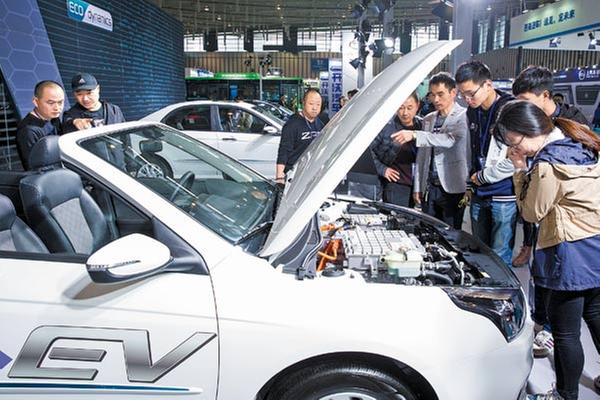 |
| Visitors look at a new energy car during an auto show in Nanjing earlier this month. [Photo by Su Yang/For China Daily] |
China' new energy vehicle market saw impressive growth in 2016, with over half a million sales in the year. Why would Chinese customers choose new energy vehicles? What do potential buyers think about these vehicles?
The findings in a KPMG China and Automotive Foresight survey of 220 new energy vehicle owners and potential buyers help to create a clearer picture of their preferences and expectations.
With electric cars gaining traction in the Chinese market and greater acceptance in society as a real alternative to traditional gasoline vehicles, consumers are raising their expectations of electric vehicles' ability to fulfill their mobility needs.
Chinese consumers are realistic and so realize technology needs to improve in order to ensure safety. However, they have very clear expectations about how they see electric vehicles' role in daily life as well as in wider society.
The survey found that electric cars are primarily used for daily commutes. About 70 percent of respondents said they need to travel an average of up to 40 kilometers on weekdays. That figure drops to 65 percent on weekends.
Respondents believed that, compared to internal combustion engines, electric vehicles are more economical and environmentally friendly. Government subsidies were also considered an important factor in buying or owning a car, especially in populous cities with car license plate quotas.
However, potential buyers said lower maintenance costs and environmental protection are more important, followed by free license plates.
Nevertheless, previous concerns about new energy vehicles remain. Both first-time owners and potential buyers saw drawbacks to owning electric vehicles: battery range and technology, charging speeds and insufficient charging stations were major factors on the list of concerns. The majority of new energy vehicle owners primarily charge their cars at home or at their workplace, if charging infrastructure is provided.
Despite the downsides, 45 percent of new energy vehicle owners said they would purchase a second one, demonstrating their confidence in the sector's future.
More than 70 percent of the respondents said they wanted electric cars to have a range of 350 km, which they believed would sufficiently cover their mobility needs. In terms of battery charging time, more than 53 percent of new energy vehicle owners would currently accept a charging time of up to four hours. For potential owners that figure stood at 73 percent. Some 84 percent of new energy vehicle owners expect a fast charging time of less than one hour, while 61 percent of potential owners expected the same.
Chinese brands are currently driving the majority of new energy car sales, which is perhaps unsurprising given the government's encouragement through tax incentives, subsidies and free license plates.
The survey also found that the key driver for both owners and potential owners to choose a new energy vehicle is brand awareness, with a mix of international and domestic brands gaining recognition from respondents.
Other key drivers are product quality and professional service for owners, and industry leadership and the maturity of new energy vehicle technology for potential customers.
What they want
Chinese customers - particularly younger ones - are open to new technologies, especially those that help to make everyday life easier, such as mobile banking, social media and mobile commerce. As such, new energy vehicle owners and potential owners have new expectations - if not demands - about future new energy vehicles.
Foremost, they expect the vehicles to have semi- and/or fully autonomous features.
Both customer groups would like to see autonomous driving features in their cars, such as parking assistance.
Forty-nine percent of current owners wanted new energy vehicles to have "eyes-off" autonomous driving, while 32 percent expected "hands off" functionality.
Some 68 percent of potential customers would like to see both in their future new energy vehicles. The two groups agreed that eyes-off autonomous driving would greatly improve their quality of mobility and so improve their quality of life.
Both surveyed groups were quite positive toward sharing electric vehicles. About 65 percent of respondents said that they would try shared self-driving electric vehicles, although they would still want to own their own cars.
In a nutshell, electric cars should meet Chinese customers' mobility needs, such as offering commuter comfort, charging at reasonable speeds and being environmentally friendly. These models should revolutionize the way that future mobility will shape the society and should be equipped with advanced technology, both autonomous and sharing. Most importantly, they should improve consumers' lifestyles.
The writers are Huu-Hoi Tran, head of the automotive sector at KPMG China, and Yale Zhang, founder of Automotive Foresight.