Industrialization is the way forward







It offers a major pathway for addressing the serious underlying factors that continue to fuel poverty on the continent
Why is Africa, a vast region endowed with natural resources, still poor more than 50 years since countries on the continent attained independence from colonialism?
Current statistics indicate that over 200 million people across the continent face starvation. Such woeful statistics are replicated in many other areas. For instance, against the backdrop of huge increase in the youth population, levels of unemployment are as high as 30 percent in some African countries.
Situational analyses are quite in order as means of pinpointing "how this has come about": poor and predatory leadership, armed conflicts, historical colonial injustices, climate change. However, this resource-rich continent needs to go beyond the blame game, so as to fashion strategies that can get it out of the rut.
Some have spoken of analytical paralysis, in which problems are overanalyzed to the point that they become the self-fulfilling promises of African woes. China, having overcome extreme poverty in a generation, offers great examples of how situational analyses can be converted into tangible action - with industrialization at the core of this action.
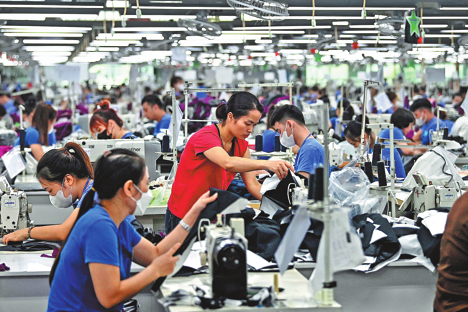
To the extent that industrialization means taking action, it is perhaps one of the major pathways for addressing the underlying factors that fuel all forms of poverty on the continent. The problem of armed conflicts could do with a dose of industrialization as a means of producing food and nonfood commodities that would nudge populaces toward a peace dividend. Historical challenges can be addressed by investment in industrial capacity, ultimately spurring the economic rights upon which human rights are based. Indeed, for every aspect of poverty on the African continent, there is an industrialization dimension that offers an upward-looking vista.
From the global, continental and national perspectives, there is no doubt that industrialization holds the promise for long-drawn attempts by Africa and Africans to kick poverty out of the continent. For instance, goal No 9 of the United Nations Sustainable Development Goals is in many respects more relevant to Africa than many other regions of the world - essentially because Africa remains the least industrialized region of the world.
Commentators have pointed out that the Africa-rising narrative will be hollow and short-lived if the high levels of economic growth are based on Africa's export of natural resources rather than the establishment of manufacturing bases. For instance, the continental economic growth rate that touched highs of 7 percent before 2015 fell to lows of 3 percent, thanks mainly to a global slowdown in natural resource demands. This is a wake-up call for African policy strategists to devise ways for boosting domestic manufacturing, not only to ward off fluctuations in commodity prices, but also to ensure local supply of goods and gain higher premiums from exports. For instance, it is a well-known fact that the concept of "made in Africa" is dead in the water, in part because technological innovations and technology transfer are utterly missing.
At the continental level, the African Union crafted an action plan for the accelerated industrial development of Africa as one of the key pillars for the continent's Agenda 2063 socio-economic blueprint. Accordingly, a good number of African countries have incorporated UN and AU industrialization strategies into their national plans. The underlying logic is that Africa will continue witnessing the many manifestations of poverty - particularly food insecurity - as long as the continent continues to rely on unmanufactured natural resources and rudimentary means of production. The challenge with many of the continental and national plans is that they are read very well on paper but remain just that - unimplemented dreams.
One of the timely opportunities that Africa should seize is the continent's industrial collaboration with China. At the Forum on China Africa Cooperation summit in Johannesburg in 2015, China said it would transfer some of its overcapacity manufacturing units to the continent. Walking the talk, China earmarked a $10 billion (9.39 billion euros; £7.96 billion) industrialization fund. In the two years since the launch of the Africa-China industrialization plan, the number of special industrial zones on the continent has considerably shot up. Since policies are in place at the global, continental and national levels, African countries need to move with speed to rope China's assistance into the said policies.
Looking into the crystal ball, there is no doubt that the youth demographic bulge being experienced on the continent is potentially both a boon and a bane. The continent is expected to hit a population of 2.5 billion by 2050, most of them young. Nigeria is expected to reach a population of 400 million in the same year, while Ethiopia will reach approximately upward of 200 million. From the Cape to Cairo, Mombasa to Dakar, the continent will soon be teeming with a huge, young population.
While the youth bulge can be a boon in terms of an educated and skilled workforce, it can become a bane if the young people are hungry and unemployed and therefore a trigger of political uprisings and turmoil. African countries can work with China under the joint industrialization plans to enhance the training of youth in science fields for absorption into the industrial economies of the future. Rather than being a strain on economies, the youth can be drivers of new economies. High levels of industrialization are a sure bet in these respects.
The writer is a postdoctoral fellow at University of the Witwatersrand, in South Africa.
The views on this page do not necessarily reflect those of China Daily.