Wat a time to be young







A survey of the interests of China's 'post-1995 generation' finds they are willing to spend cash - sometimes a lot - on their hobbies
When the world stepped into the new millennium, they entered elementary school. When smartphones sneaked into people's lives (the first iPhone was launched in 2007), they were in middle school. Now, most Chinese born in the late 1990s are graduating from college.
They're called the "post-1995 generation" in China. About 78 million people-nearly 6 percent of the country's population - were born in this period, according to the latest nationwide census, conducted in 2010.
They live in a time when the economy has already taken off - China's GDP exceeded 10 trillion yuan ($1.45 trillion; 1.33 trillion euros; £1.13 trillion) when they were around 5 in 2000.
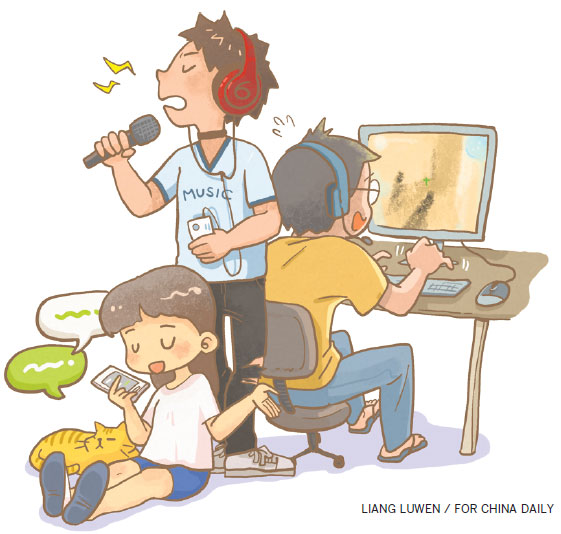
They witnessed the country's showcases to the world - namely the Beijing 2008 Olympic Games and the Shanghai 2010 World Expo-on television, through smartphones and, sometimes, in person.
And they enjoy a range of hobbies and interests that influence their life choices, according to a survey released last month by City Zine magazine and the country's IT giant Tencent.
It found that 73 percent of the 4,000 respondents have hobbies.
Others view 22-year-old Wang Zilu as a super student. He graduated from high school a year early through an experimental program in Hebei province's Handan.
He was accepted by the country's top aeronautics science and engineering school, Beihang University.
He spent his senior year as an exchange student at Sweden's Lund University.
He enrolled as a doctoral student at Beihang's Fert Beijing Research Institute, studying spintronics in the school named after Nobel physicist Albert Fert.
While his academic career is outstanding, his hobbies are typical.
"I play games - all kinds of them," Wang says.
"I've played computer games since I was a kid. I also like Japanese anime, such as Detective Canon and Naruto."
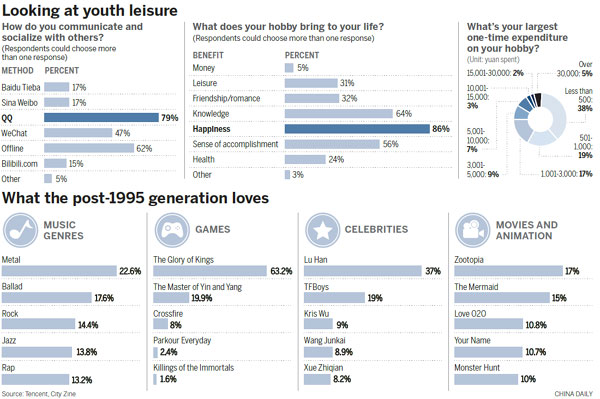
Gaming is the second-most popular pastime among the demographic, with 58 percent of those surveyed naming gaming as their favorite leisure activity.
Music took the top spot, with 62 percent.
Perhaps surprisingly, reading was more popular than watching videos - albeit by just 1 percent at 40 percent.
Cartoons and anime (considered a separate category) followed closely - and tied with travel-at 37 percent.
The age group is particularly fond of nijigen - literally, the "two-dimensional realm" - a Japanese word they use to refer to anime. Many frequent the video-streaming site Bilibili.com, which is hailed as "the portal to nijigen".
The post-1995 generation is willing to spend cash for a good time - 85 percent spend some money on their hobbies. About 10 percent report blowing more than 10,000 yuan at a time for a single experience.
"Many of my friends skimp on food costs to save for concerts," says 19-year-old Yunnan Normal University freshman Gao Yan.
"One even bought a 2,000 yuan ticket for Jay Chou's April 15 concert in (Yunnan's provincial capital) Kunming."
Gao adores not only watching but also playing music.
The pop fan joined a campus guitar club after starting college and spends an hour a day practicing.
She's more into less-known indie performers like Tang Yao, Ma Di and Zhao Lei than superstars like Chou.
"Sometimes, I don't even want them to be liked by too many people," Gao says.
She spent 500 yuan on two concerts last year and got into another one for free by working as a volunteer.
The teen earns pocket money with part-time gigs like tutoring elementary schoolers and handing out flyers.
Chinese people born after '95 are unlike their parents in that they select majors based on interest.
That's why 21-year-old Wang Zeping chose traditional Chinese medicine.
"I like traditional Chinese culture, and TCMis part of it," the Beijing University of Chinese Medicine student says.
"Some relatives and neighbors thought TCM wasn't a good choice for me. But my parents have let me make my own decisions since childhood."
The Heilongjiang province native wanted to become a doctor when he was in high school.
He's the president of Qihuang Volunteers, a collegiate society of medical students.
The group visits Beijing universities and neighborhoods to offer free health checkups and massage therapy on weekends. Its members also promote TCM awareness.
"Being a doctor requires a selfless, empathetic and volunteering spirit," he says.
He has visited every university in the city but two since he joined three years ago.
Many young people like 19-year-old Liu Mingwan develop their interests after entering university.
The Sichuan native didn't have any hobbies until she enrolled in Beijing's University of International Business and Economics to study insurance.
Her roommates watch anime. One draws.
She roller-skates - an activity she started after joining a student club last year.
During the recent Tomb Sweeping Day holiday, Liu and friends took the subway to Beijing's northernmost suburb and skated several kilometers to the Ming Tombs, the final resting place of 13 Ming Dynasty (1368-1644) emperors.
"I enjoy being with like-minded people," Liu says.
"It's interesting to chat."
Indeed, communication is a yearning shared by her peers.
They not only talkin person but also through Tencent's instant-messaging apps QQ and WeChat; Sina's micro blog, Weibo; and Baidu's online bulletin board, Tieba.
They often use platforms with danmu, or real-time comments that flash across the screen during videos.
Nearly every clip on Bilibili.com has danmu.
The site has around 100 million active users, about 90 percent of who mare younger than 25, the news outlet The Paper quoted the company's chairman, Chen Rong, as saying.
Chen Zhiwen, major online-education portal Eol.cn's editor-in-chief, says the younger generation's preferred pastimes are natural results of the country's economic growth.
"It's nothing surprising," he says.
"But parents and educators should be careful not to place too much emphasis on children's hobbies."
Chen says many media blur the distinction between being distinctive and obstinate.
"We hail the increasing individualism of our children," he says.
"But we should still teach discipline."
Indeed, the world is waiting to see what these young people will be like as they move into the next age and the world shifts into the next era.
Contact the writers through xingyi@chinadaily.com.cn
(China Daily European Weekly 04/28/2017 page21)




Today's Top News
- Mainland pledges deeper cross-Strait integration in 2026 message
- Lai's 'separatist fallacy' speech rightly slammed
- Xi's message for New Year widely lauded
- Swiss bar fire kills around 40, injures more than 110
- New Year's address inspiring for all
- Xi congratulates Science and Technology Daily on its 40th anniversary