Maternal instinct







Postnatal care is a booming industry in China, but the price tags may mask some problems
Lying comfortably in bed, Wang Ying, 29, doesn't think having a baby was as difficult as people said it would be.
In the 26 days since she gave birth to her son, aside from getting up a few times at night to feed him, she has had nothing to busy herself with - meals are served to her bed, warm bathwater is prepared, and she even enjoys an abdominal massage every day. This is all part of the 24-hour care offered by her "maternity matron".
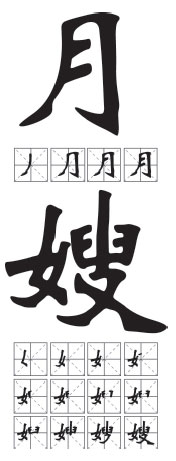
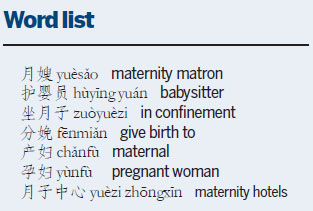
In China, maternity caregivers such as Wang's are called yuesao, or 月嫂, with月meaning "month", and 嫂referring to relatively young married women. According to tradition, the month following childbirth is an important period of recovery for the mother. In this month, mothers are required to zuoyuezi, or坐月子, which literally translates to "sit the month", which means staying indoors, resting, keeping away from cold air and physical exertion, and focusing on nutrition.
| Maternity matrons, or yuesao, learn how to take care of babies in a school. Provided to China Daily |
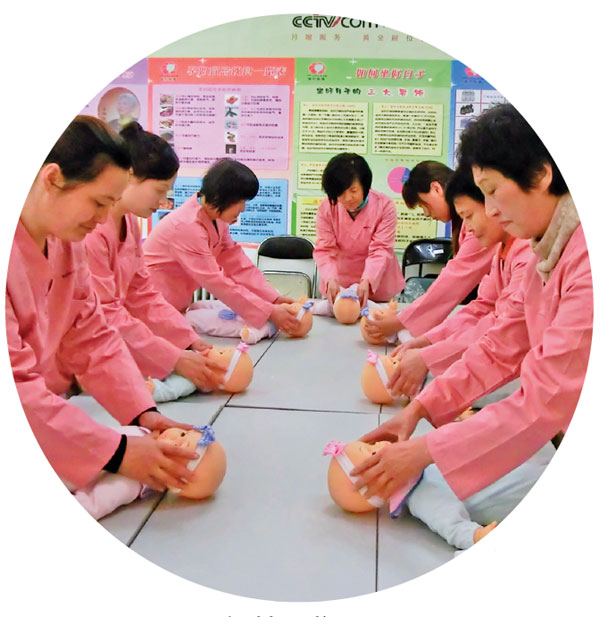
Yuesao, as the word implies, are married women who assist new mothers as they "sit the month". They are on duty around the clock: cooking special meals for the mother, taking care of the baby and serving as health consultants.
This crucial postnatal care, once done by older family members, is now done by paid professionals. Yuesao services have become increasingly popular in recent years, especially among young parents whose child-rearing ideas may clash with the elder generation.
With the demand for yuesao increasing year after year, many of them have seen their salaries triple or even quintuple over the past 10 years in first-tier cities such as Beijing and Shanghai. Certified yuesao specializing in areas like nutrition, lactation and mental health are in especially high demand. Though it's a profession that doesn't require a university degree, yuesao can earn more than many white-collar workers. The price to hire a yuesao for one month typically ranges from 6,000 yuan ($870; 790 euros; £670) to 20,000 yuan.
High demand and decent pay are drawing more women to this emerging profession. Cui Jingwen, founder and manager of the Liming Jiayu Baby Care and Education Co and a council member of the Beijing Homemaking Service Association, has witnessed the great strides this industry has made over the past two decades. Cui worked as a midwife in a hospital until 2000. At that time, she says, there was no such thing as a professional yuesao. Babies were born and taken home by their inexperienced mothers. Often unaware of the tribulations of early motherhood, they came to Cui for help.
In 2004, Cui established her own infant-care center, recruiting and training professional maternity matrons. But in those days, the market was very different from today. Cui's first training camp only recruited about 40 trainees, most of whom were laid-off female workers, and when they finished the training course, only two or three successfully found a job. "People at that time knew nothing about yuesao. They thought yuesao were no different from housemaids, but a yuesao costs almost three times as much," says Cui.
Before long, this emerging service was getting noticed, garnering media attention for the services they provided and the novelty of the industry. However, real recognition came in 2008, when, in honor of the Olympic Games, many families decided to have an "Olympic baby." The baby boom pushed the yuesao industry to new heights.
"In 2007 or 2008, the market rate (for a yuesao) was about 2,400 yuan per month, and the demand far exceeded the supply," Cui says. "Since then, the price for yuesao has been increasing year by year. And more and more people have joined this industry." Today, Cui's company employs more than 500 yuesao, and most of them are fully booked; some are reserved seven months in advance.
Cui says her company has three basic requirements when recruiting yuesao trainees: They should be 25 to 45 years old, have at least a middle school diploma, and have given birth before. People who meet these conditions need to take three-month training program, which includes theoretical knowledge, cooking, singing to infants, massaging and other subjects.
Trainees take in-class quizzes and a final exam. Those who pass the exam can graduate from the course, but they still need to undergo a probation period of several months before finally becoming a formal yuesao. When they are eventually assigned to a client, they are still regulated by working standards. Yuesao need to write a detailed work log and get approval from their client, indicating that they are satisfied with the service.
"A yuesao is not a babysitter. Ideally, they should pay 60 percent of their attention to the mother, and 40 percent to the baby. But in practice, most yuesao spend too much time caring for the baby, which results in the connection between mother and baby being broken to some degree. That's not good for either the mother or the baby, but most yuesao and the family don't realize it," says Cui.
For many without a proper education or specialized skills, being a yuesao is an ideal career, or at least one that commands a respectable income. Zhang Jige, a senior yuesao from Zhoukou, Henan province, has been working for Liming Jiayu since 2005 and was recently able to buy a house in her hometown. Zhang feels satisfied with her current job: "I feel that dealing with a baby and a mother is simpler than working in an office. You don't have to worry too much about interpersonal relations."
Not everyone is as optimistic as Zhang about this career. Though the yuesao industry has developed quickly, prestige has not been as ascendant as the prices. Among the over 500 yuesao in Cui's company, the majority only have a middle-school or high-school diploma. A yuesao working in Changchun, Jilin province, who prefers to be known as Zhao, stopped working as a yuesao after the Spring Festival this year.
"It's too exhausting. I could never sleep for long at night. Most important, this job doesn't sound good (to others). I feel uncomfortable letting my relatives and friends know I am a yuesao, and I am afraid that people will think my son doesn't treat me well," says Zhao.
Zhao is not a special case. Cui says only about 60 percent graduates from her company's training program actually practice as yuesao. For those who leave the industry, the most frequent complaint Cui hears is that they'd "rather make no money than be a doormat in the (employer's) family".
But Wang, as a client, doesn't think the client is the problem. "The problem is that the (yuesao's) services should be worth the money paid," says Wang.
Though the yuesao provided a great deal of assistance during Wang's recovery, she was also critical about some of their work: "I gave birth to my baby at midnight. Our yuesao didn't wait for me to breastfeed my baby. Instead, she fed the baby with formula." Wang was angry because she believes that if the babies are fed for the first time with formula, they will be less willing to drink breast milk in the future, and their immunity will be compromised.
A lack of market regulation makes it difficult to guarantee the quality of the yuesao service. There are many organizations providing yuesao courses and certificates, including many that require only one week of training.
Courtesy of The World of Chinese, www.theworldofchinese.com
The World of Chinese
(China Daily European Weekly 05/12/2017 page23)



Today's Top News
- China rebuffs criticism over drills around Taiwan
- Mainland pledges deeper cross-Strait integration in 2026 message
- Lai's 'separatist fallacy' speech rightly slammed
- Xi's message for New Year widely lauded
- Swiss bar fire kills around 40, injures more than 110
- New Year's address inspiring for all