Xi's handshakes symbolize new era, professor says







China's eagerness to engage with rest of world welcomed amid rise of protectionism
A handshake can be many things: an informal contract, a greeting, a battle for supremacy. But for Jean-Pierre Lehmann, the world renowned professor of international political economy, the handshakes of President Xi Jinping symbolize China's new spirit of openness.
The 71-year-old professor has stored images of all the Chinese leaders, from Mao Zedong to Xi, shaking hands with foreign leaders at summits and meetings.
Lehmann, who still teaches at the International Institute for Management Development and Hong Kong University, says Xi's handshakes reflect China's embrace of the rest of the world. "All of the photos of President Xi shaking hands are impressive, and the messages showcase a new era that we're talking about," Lehmann says in his office on the banks of Lake Geneva.
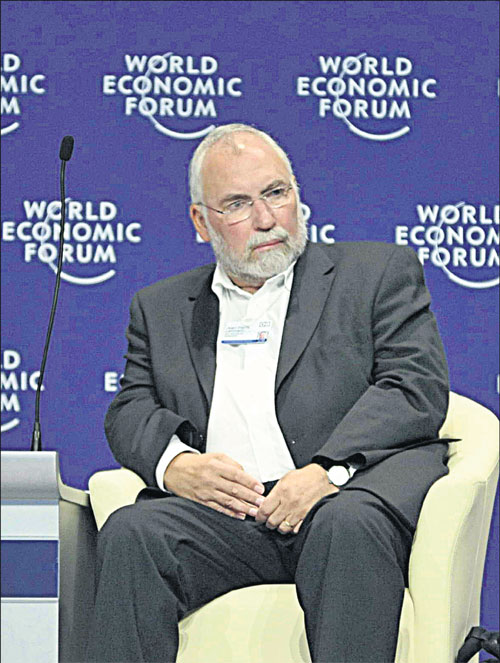
| Jean-Pierre Lehmann is professor of international political economy. Provided to China Daily |
As he surveys the photos, he says: "It is evident no other leader has shaken so many hands in such a short time. This is China's coming out, and it's a gesture but it's also a symbol."
Xi has led China since late 2012 and has traveled to about 50 countries and hosted APEC, G20 and Belt and Road Initiative summits in Beijing.
Lehmann describes Xi's proactive meetings with leaders as good news that shows China's determination to engage with the rest of the world at a time when some international powers appear to be disengaging from it.
Lehmann is critical of former US president Barack Obama's China policy, especially the Trans-Pacific Partnership, which excluded China. President Donald Trump announced soon after taking office that the United States would withdraw from the partnership.
"Obama said we need to write trade rules without China. Why say that? Why not say, let's write the rules together?" asks Lehmann, a staunch globalist. "It is a new era, so there have to be adjustments."
Lehmann says he is concerned by the rise of protectionism: The World Trade Organization's Doha Round of talks are frozen; Trump has threatened to withdraw from the Paris climate change agreement; and Western Europe has begun looking inward.
Against this backdrop, Lehmann sees China's intervention on the world stage as a big change.
While shaking hands and talking with leaders, Xi and China have developed a grand vision to bring together various parts of the world, Lehmann says.
He adds that China's Belt and Road Initiative is still a vision that needs to be developed with the rest of the world.
Regarding the opinion by some that the Belt and Road Initiative is for China's interests, Lehmann replies: "You have no country in the world ever that will do something just for the other's interest, without mentioning its own."
He adds that China has explained that it wants the initiative to benefit China and its partners.
There will be difficulties and obstacles in implementing the vision in the coming five to 10 years, Lehmann says. "But my position has been that it should be welcomed rather than contained."
Lehmann attended the Belt and Road Initiative Forum in Xi'an in 2015. He says he was tremendously encouraged that there were representatives from all over Eurasia. "But there were no Americans and no Japanese. This is a global initiative, and you need to do something," he says.
He says business sectors across Eurasia and Africa have accepted the initiative, and the world must recognize China's courage in making the initiative open, global and inclusive.
However, he warns that as China moves to the center of the global stage, it is likely to attract some suspicion and apprehension in Europe and Asia, which he says is not fair, since China has been at the global center for a long time and cannot be regarded as the "new kid on the block".
Lehmann says China still has a lot of work to do to communicate better with the rest of the world. "China has to make efforts in soft power, and so the initiative has to be well marketed by the Chinese."
He recalls that in his youth, there was a lot of apprehension about the rising US power in the 1950s. "But then you have to make efforts to reassure, to engage the rest of the world in a sophisticated manner," says Lehmann.
Lehmann says China has a tremendous amount to offer the world, culturally, economically and technologically.
The professor joined the International Institute for Management Development almost 20 years ago and retired in 2012, though he continues to teach there and at Hong Kong University. He says the students from Asian business sectors have consistently enriched his perspectives on how to look at the changing world.
"I enjoy the teaching environment here (in Switzerland). The birds are singing outside and spring is here. It's very pleasant," he says.
Lehamnn is a French national, although he was born in the US. He moved to Switzerland in 1997 and has lived in Japan, Sweden, the UK and the US.
For the past five decades, Lehmann has focused his research on Asia and has witnessed the dramatic changes there.
Lehmann believes the world shares similar values, despite discussions on the differences between Western and Chinese values. "But I think in many cases our values are the same, though the expression is somewhat different," he says.
Lehmann says he has taught many young parents from China and the rest of Asia and other parts of the world at Hong Kong University. What they all want is for their children to be well brought up, to be happy and to contribute to the rest of the world, he says.
fujing@chinadaily.com.cn
(China Daily European Weekly 06/02/2017 page29)

Today's Top News
- Lai's 'separatist fallacy' speech rightly slammed
- Xi's message for New Year widely lauded
- Swiss bar fire kills around 40, injures more than 110
- New Year's address inspiring for all
- Xi congratulates Science and Technology Daily on its 40th anniversary
- Xi congratulates Guy Parmelin on assuming Swiss presidency