Between worlds







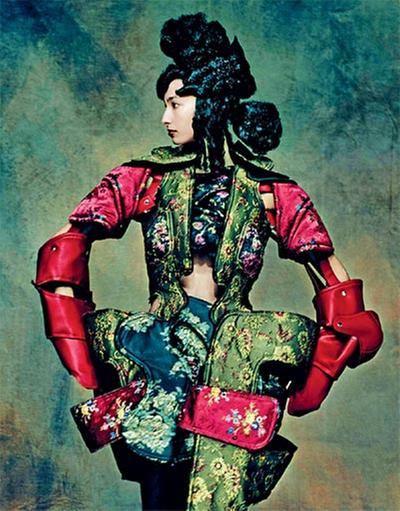 |
| One of the first designers to truly challenge the notions of classic tailoring, Rei Kawakubo's cri de coeur has become deconstruction, bias cuts and all sorts of experiments in shape, seams and asymmetry. [Photo by Paolo Roversi/China Daily] |
Rei Kawakubo clearly isn't Miuccia Prada, but in the countercultural ecosystem of fashion for the disenfranchised, the two bear remarkable similarities. Geography has seemingly dictated the impact of both.
Prada has been subject to an A to Z of academic rigor across the fashion campuses of Europe and America, and she been the subject of a Metropolitan Museum exhibition herself in tandem with Elsa Schiaparelli.
But Kawakubo, the creator of Tokyo-based Comme des Gar?ons ("like boys"), which has grown into a business that churns more than $220 million a year, has remained largely the preserve of the Japanese. She's also the co-founder of London's hip Dover Street Market fashion destination, which she founded in 2004 with her husband, Adrian Joffe.
Now, it seems Kawakubo's global moment is at hand as she gets a five-month-long run at the Metropolitan Museum of Art's Costume Institute in New York with Art of the In-Between, running until September. It's the first monographic exhibition of a living designer at the Met since the Yves Saint Laurent show in 1983.
Prada basically epitomizes "ugly chic" in the world today, through her use of fabrics that challenged notions of luxury coupled with provocative designs, but Kawakubo was doing the same several years earlier (at least as far as the West was concerned) when she made her Paris debut in 1981. Kawakubo's early collections established an unsettling zone of ambiguity that challenged the accepted notions of beauty, good taste, and even fashionability.
One of the first designers to truly challenge the notions of classic tailoring, Kawakubo's cri de coeur has become deconstruction, bias cuts and all sorts of experiments in shape, seams and asymmetry-much of it gender-bending, such as men's buttoning on an assortment of women's garments. "Since her Paris debut in 1981, Rei has consistently defined and redefined the aesthetics of our time," remarked Andrew Bolton, curator of the Kawakubo exhibition at the Met, at a press conference to announce the upcoming show. "Season after season, she changes our eye by upending the received notions of conventional beauty and by disrupting the defining characteristics of the fashionable body."
For Kawakubo, clothes seem to be her mode of expression on an endless search for newness and originality. Speaking about her spring/summer 2014 collection, she said in a 2013 interview with System magazine: "I tried to look at everything I look at in a different way. I thought a way to do this was to start out with the intention of not even trying to make clothes. I tried to think and feel and see as if I wasn't making clothes."
Kawakubo didn't study fashion, but art and literature, at Keio University. Her first job was at a textiles factory in 1967, which led to her becoming a freelance stylist. Two years later, Comme des Gar?ons was born, but it wasn't until 1975 that she opened her first store in Tokyo, by which time the Japanese press referred to her tribal followers as "the crows". She soon inspired the likes of Martin Margiela, Ann Demeulemeester and Dries Van Noten, and helped launch the careers of Junya Watanabe, Tao Kurihara and Chisato Abe. But the fashion mainstream in the West never really got to know her. Many attribute Prada's success to Miuccia's ability to bridge the gap between antifashion and commercial high fashion.