Now China's in the driver's seat







As the US backs away from its customary role, expert sees Asian giant leading the drive for global growth
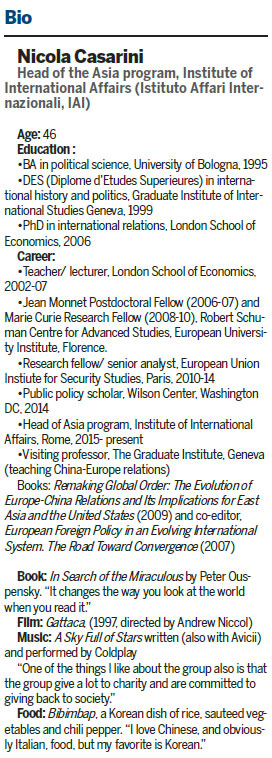
Nicola Casarini says it is China and not the United States that now has a grand plan to drive global growth.
The head of the Asia program at the Institute of International Affairs, the Rome-based foreign policy think tank, was speaking ahead of the G20 summit in Hamburg, which begins on July 7.
| Nicola Casarini says the Belt and Road Initiative is very important for Italy because the country could become an access point for Chinese and other goods into Central and Northern Europe. Provided to China Daily |

He believes China, with its own vision of globalization embodied in its Belt and Road Initiative, is the one country that is now taking a lead while the world's largest superpower is looking increasingly isolationist.
"China has a growth plan. The United States used to have one, particularly after World War II with the Marshall Plan and other initiatives," he says.
"The big problem now is that the US is retreating from a system it itself created and this could have some very fundamental consequences for the global order."
Casarini, 46, says he hopes the G20 meeting will build on the success of the last one, held last year in Hangzhou, where the final communique called for fiscal stimulus measures and made clear its opposition to protectionism. The meeting also saw the ratification of the Paris climate change agreement by President Xi Jinping and then US president Barack Obama.
"I expect climate change to feature quite big at the meeting. You could have a situation where you have 19 countries in agreement and just the United States in opposition. This would be remarkable, given that Washington has traditionally been a global leader."
Casarini, who was speaking from Rome, addressed the Belt and Road Forum for International Cooperation, which was attended by 29 foreign heads of state, in May.
He said the initiative is very important for Italy because the country could become an access point for Chinese and other goods into Central and Northern Europe.
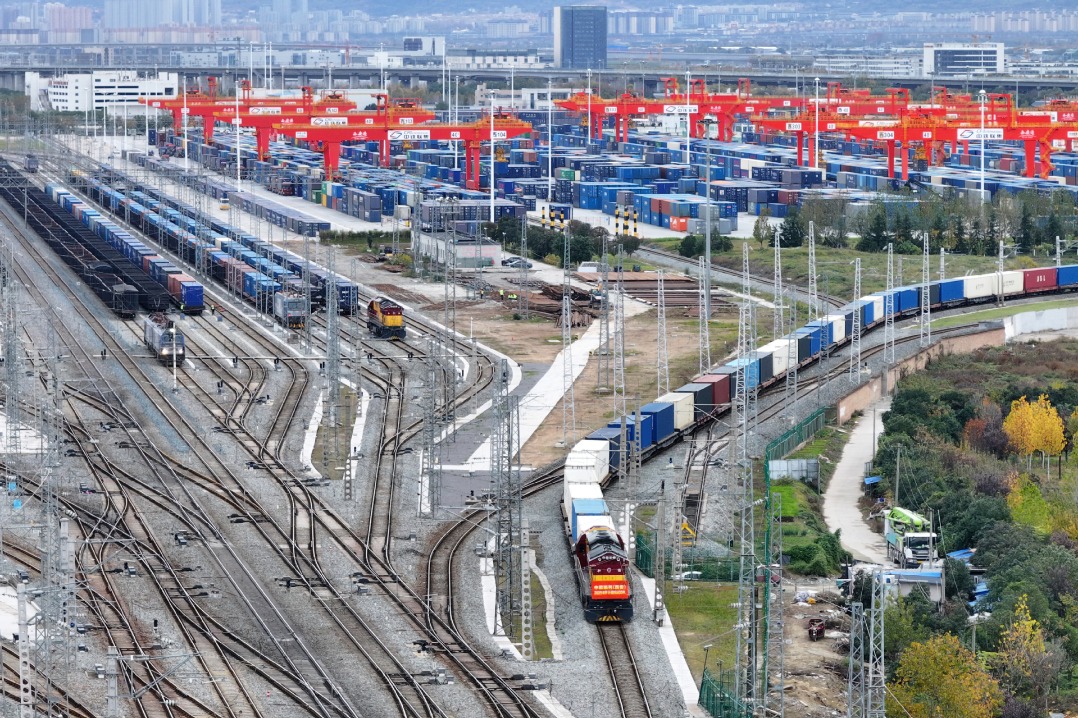
China is investing through its Silk Road Fund in a network of five ports in the northern Adriatic, including the Italian ports of Venice, Ravenna and Trieste, and Koper in Slovenia and Rijeka in Croatia. This will give it an alternative to the port of Piraeus in Greece as a route into North and Central Europe.
"China's 21st Century Maritime Silk Road is very important to Italy because it ends up in the Mediterranean, and Italy is in the center of the Mediterranean," he says.
"Our ports provide an alternative route for goods bound for Central and Northern Europe."
Casarini believes many in Europe and elsewhere have yet to catch up with the significance and scale of what China's initiative could deliver.
"The Belt and Road is a strategic vision of great significance and magnitude. We have yet to see a proper response to it from many countries in Europe, particularly my own. I think countries like Vietnam, Russia and even Tajikistan, for example, have been better at doing that. From Italy's point of view, we need to make an assessment as to the importance of China for us for the next 30 to 50 years and not just the immediate short term."
Casarini, who is from near Bologna, studied political science at his hometown university before studying in Geneva and then at the London School of Economics, where he earned a doctorate.
His main specialization is China-Europe relations, and he has held senior positions at a number of leading institutions, including the European Union Institute for Security Studies in Paris, where he worked under Catherine Ashton, the EU's high representative for foreign affairs and security policy.
Two years ago, he joined the Institute of International Affairs, one of Italy's leading foreign policy think tanks, which was founded by Altiero Spinelli, a founding father of the European Union in the 1960s.
Casarini has written a number of books, including Remaking Global Order. The Evolution of Europe-China Relations and Its Implications for East Asia and the United States, which examines the state of the China-Europe relations.
He believes one of the major issues as far as the European Union is concerned is reciprocal access to China's markets. This was an issue raised at the EU-China summit in Beijing in June.
"To what extent China is prepared to open up to investment coming from Europe is one of the key questions. We have leading technology in a wide variety of areas, including high-speed rail," he says.
"This is one of the questions about Belt and Road. European companies want as much a part of infrastructure development in China as Chinese companies want to be in Europe."
One of the stress points of the euro is seen as the instability of Italian banks, which some suggest could see the country crashing out of the single currency.
Casarini does not expect Italians to vote for either a euro or EU exit, even if the populist Five Star Movement founded by veteran comedian and activist Beppe Grillo wins power in next year's general election.
"Like in France, you have growing sections of the population that are fed up with the European Union but in the end they still voted for (Emmanuel) Macron (new French president) and I would expect something similar in Italy, even if we have a Five Star Movement government."
He believes the UK, which voted to leave the EU last year, has always had a profoundly different attitude toward Europe.
"I spent five years in London doing my PhD and I don't think I ever saw a European Union flag. It was always a pragmatic relationship. They always had a lukewarm relationship with the continent and always looked more globally toward the United States, Australia, New Zealand, South Africa and South Asia."
He believes there are many complex aspects to the possible future relationships between the EU, China and the UK, given that there is no existing China-EU trade treaty.
"If the UK and China reach a trade agreement on their own, will goods from China entering the UK be allowed to enter the EU also, even if there are differing regulations?" he asks.
Casarini believes that China will shift some of its investment away from the UK, despite the new "golden era" of relations, as a result of Brexit.
"You will see a reconfiguration of investment. Chinese company headquarters will be moved to other parts of Europe. Some of the clearing of the RMB will be moved from London, to places like Paris, Frankfurt and Luxembourg," he says.
"Over the next five to 10 years, I believe that the UK will be poorer not just in terms of investment but also in human capital, with many European professionals, including academics and doctors, leaving for the Continent."
andrewmoody@chinadaily.com.cn
(China Daily European Weekly 07/07/2017 page32)


Today's Top News
- New Year's address inspiring for all
- Xi congratulates Science and Technology Daily on its 40th anniversary
- Xi congratulates Guy Parmelin on assuming Swiss presidency
- China Daily launches 'China Bound'
- Manufacturing rebounds in December
- PLA wraps up military drills around Taiwan