Working to capture a cure for old age







As populations around the world get older, scientists strive to find ways of making our senior years more healthy and rewarding
Image capture technology is more commonly associated with Hollywood films and advanced computer games but at Imperial College in London, researchers are using it to help people live independently for longer.
The world is aging quickly. People over the age of 60 make up 12.3 percent of the global population, but that figure is forecast to rise to 22 percent by 2050.
This is a problem born of success - in improving sanitation, developing economies and improving healthcare in many parts of the world.
Greater life expectancy offers great opportunities and challenges, but longevity is worth little if the added time is to be spent immobile and in ill health.
That's why Sam Smith is studying the process by which people sit down and stand up, using the latest technology as part of his bioengineering PhD.
I offered to be his final guinea pig after he had tested a group of elderly men and a control group of younger men. First, I put on a pair of shorts to allow Sam and a colleague to place 90 adhesive sensors on moving areas of the body, such as shoulders, knees and feet. These sensors would be picked up by 10 cameras in much the same way as Star Wars characters are filmed on green screens, but with more accuracy.
I then had to do a series of movements, culminating in getting out of a chair equipped with pressure pads on the seat, armrests and the floor beneath my feet.
The result is the image of headless figure on a three-dimensional screen, which moves, it seems to me, with fluidity and almost athleticism. More important, it can be compared with every other test subject.
Analysis of the data has just begun but Sam hopes it could lead to a greater understanding of how the body reacts to aging and could suggest training and strategies to help the elderly deal better with tasks such as getting up out of a chair in greater comfort, and thus ultimately help them lead independent lives for longer.
Sam is just one of thousands of scientists all over the world studying aging and age-related conditions. Every day the international media is packed with reports of studies on dementia, statins and the importance of exercise and diet.
The developed world has the oldest populations now. According to the UN, the median age in the UK is 40.5, in France 41.2 and in Germany 46.8. China is catching up fast; its median age is 37.1 but it is forecast to rise to 46.4 by 2050. By then it will have an older population than the UK, with a median age of 43.1, and France 42.4, but not Germany at 52.
Pension funds and government spending will have to cater to the new retirees as the proportion of economically active workers falls. Already European countries are increasing their retirement ages to 67 or 68 for the coming decades. Chinese authorities have indicated that a decision is pending on whether to raise the retirement age from 60 for men and 55/50 for women this year.
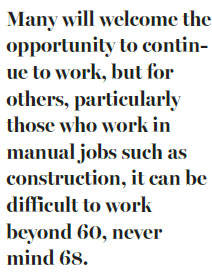
Many will welcome the opportunity to continue to work, but for others, particularly those who work in manual jobs such as construction, it can be difficult to work beyond 60, never mind 68.
Even if we get the sums right and there is adequate provision for our elongated lives, there still remains the question of quality of life. Can we ever ensure old age that is more than just a succession of illnesses and hospital trips, terminating in a long stay in a care home?
We have to place our faith in science and technology - and scientists such as Sam. Soon the adhesive sensors that were necessary for image capture will be redundant, and cameras will be able to track muscle movements without them. Maybe the discomfort of getting out of a chair will also one day become a thing of the past.
Conal Urquhart is a senior editor at China Daily UK. Contact the writer at Conal@mail.chinadailyuk.com.
(China Daily European Weekly 08/04/2017 page10)




Today's Top News
- Xi urges solid work for more progress
- Confidence, resolve mark China's New Year outlook: China Daily editorial
- Key quotes from President Xi's 2026 New Year Address
- Full text: Chinese President Xi Jinping's 2026 New Year message
- Poll findings indicate Taiwan people's 'strong dissatisfaction' with DPP authorities
- Xi emphasizes strong start for 15th Five-Year Plan period