Royal garden brought back to life







Yuanmingyuan, a resort used by Manchu royalty, was burned down by Anglo-French expedition forces in 1860. Archaeologists are now rediscovering the magnificent landmark
In China, the destruction of Yuanmingyuan ("the garden of perfect brightness"), or the Old Summer Palace, in Beijing is seen as a national tragedy.
In 1860, Anglo-French expeditionary forces burned down this exquisite resort, used by the Manchu royalty of the Qing Dynasty (1644-1911), during the Second Opium War (1856-60).
But now there are efforts to discover more about the magnificent garden. Archaeologists, with the help of paintings and historical records, are trying to get a better picture of this landmark.
| Remains of Western-style architecture in Yuanmingyuan. Wang Kaihao / China Daily |
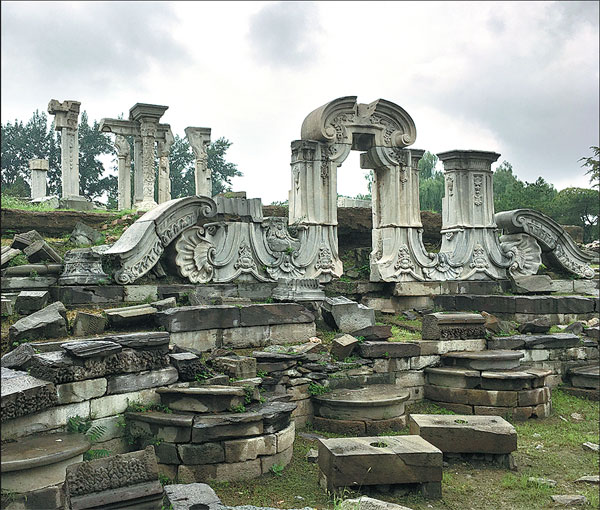
In a project to the east of the Yuanmingyuan ruins, the remains of Ruyuan, an exquisite garden in typical Jiangnan style (which refers to areas in East China on the southern banks of the Yangtze River), was unearthed.
The 19,000 square meter garden is a replica of Zhanyuan, a garden in Nanjing, in eastern Jiangsu province, and it was built following an edict by Emperor Qianlong (1711-99).
The garden, completed in 1767, was called Ruyuan, which means "a garden just like Zhanyuan".
Huge, and almost intact, bases of buildings have been found at the site, as well as a garden with paths paved with colorful stones.
"It was a surprise to find the foundations so well-preserved," says Zhang Zhonghua, an archaeologist from the Beijing Research Institute of Cultural Heritage and leader of the Yuanmingyuan project.
"Only some scattered and broken sections were visible before the excavation."
For example, the 1-meter-high foundation of Yanqing Hall is there, as well as a 1.4 meter part underground, says Zhang.
"The deep foundation indicates that the hall was grandiose," says Zhang.
The 322-square-meter hall was the main building in Ruyuan.
The discovery of ceramic tiles that are hollow indicates that Ruyuan was equipped with a central heating system.
The excavations also show that there was an artificial lake and special equipment to regulate water flow.
As a result, emperors were able to take a boat on entering the garden to a pier by Yanqing Hall.
Zhang's team is also analyzing seeds found in the area to find out what kind of flowers used to blossom in Ruyuan.
Zhang says that when compared with the Forbidden City, which emphasized formal rituals, Yuanmingyuan was a place where emperors could relax.
"The patterns on walking paths in Ruyuan are irregular, which shows the rulers' casual lifestyle," he says.
"We even found the prototype of a modern urban road network, like today's relief roads and roundabouts, that show advanced design."
Also, though houses face southward in traditional Chinese architecture, those in Ruyuan broke the rule, probably to give the emperors a view of the lake from all corners of the garden.
Two stones bearing Emperor Jiaqing's calligraphy indicate renovation of Ruyuan during the Jiaqing reign (1796-1820).
In addition, Zhang says that tiles found at the site have reddish marks on them, indicating they were burned.
"All the tiles we found had cracks," he says.
"These tiles, only used in imperial institutions, were of top quality. The cracks prove that they burned for a long time."
Zhang's team is seeking to establish a date for the fire.
"But, for now, I can tell you that the fire was in the late Qing Dynasty," he says.
"So, it is still premature to connect this fire to the looting of 1860."
However, he says that there are no historical records of Ruyuan after Emperor Xianfeng's reign (1851-61) ended. So, this probably means that the garden had been destroyed by then, coinciding with the Anglo-French invasion.
Preliminary investigation of the site began in 2012, but the main project was launched in 2016 and covers an area of 3,800 sq m.
Parts of Ruyuan are still buried today, as they are beyond the Yuanmingyuan Ruins Park.
"So, it is up to the urban planning department if they want to expand our excavation site," says Zhang.
"It will cause trouble if we block the artery - Zhongguancun North Avenue - for archaeology."
Zhang says that the designs of Ruyuan show there was a pedestrian overpass connecting Ruyuan with nearby gardens, and he says that there are possibly ruins beneath the Tsinghua University campus, which is across Zhongguancun North Avenue.
"Yuanmingyuan was much bigger than the ruins we see today," he says.
Though most ongoing archaeological works are not accessible to the public for safety reasons, the Yuanmingyuan site is a popular tourist destination, since visitors are allowed to have a look at the archeologists working.
Yang Yulian, from the Beijing Administration of Cultural Heritage, says: "Archaeology is also a good opportunity to educate the public. And fans of cultural heritage upload pictures on social media and even do live broadcasts."
Yang directs the bureau's education office. She says the Yuanmingyuan model could be replicated at other archeological sites in Beijing.
Some artifacts from Ruyuan are now displayed at the exhibition hall of the Yuanmingyuan Ruins Park, and the display will run through October.
Separately, Zhang says that more archaeological work is to follow at the site.
Research on the Yuanmingyuan ruins began in 1996, and the excavation of Ruyuan is a part of a five-year project that started in 2015 to figure out the original layout of this complex.
Because of surviving stone relics like fountains and columns, people get the impression that Yuanmingyuan was a Western-style garden, says Chen Hui, a researcher at the administration office of the Yuanmingyuan Ruins Park.
"But Western construction comprises a small part of the architecture in Yuanmingyuan," says Chen.
"It's a pity that Chinese-style architecture was mainly in wood that easily disappeared. So the excavation can give people a panoramic view of the complex."
Zhang says it will take a long time to learn about this destroyed wonder in detail.
"I will be satisfied if we can use archaeology to show what 10 percent of Yuanmingyuan was like before I retire," says Zhang.
wangkaihao@chinadaily.com.cn
More about Yuanmingyuan
The construction of Yuanmingyuan began in 1707 during the reign of Emperor Kangxi (1654-1722), and went on throughout the next century.
It was approximately five times the size of the Forbidden City.
Yuanmingyuan was known as the "garden of gardens" for its gardens and palaces as well as its temples, pavilions and galleries.
Many famous gardens from the Jiangnan area in southern China were reproduced in Yuanmingyuan, and Western architectural styles also got mixed in.
The most visible remnant of Yuanmingyuan today is the Xiyang Lou (Western Mansions). This group of European-style palaces, fountains and gardens was planned by Giuseppe Castiglione, an Italian missionary.
A fountain, with bronze heads of the 12 animals of the Chinese zodiac spouting water was the best-known icon of this section.
Besides functioning as an imperial resort, Yuanmingyuan was also a place where four Qing emperors (Qianlong, Jiaqing, Daoguang and Xianfeng) handled the affairs of state.
Yuanmingyuan was burned down by Anglo-French expedition forces in 1860.
Though it was proposed to be reconstructed during the reign of Tongzhi (1862-74), the plan was dropped due to a lack of money.
During an invasion by the Eight-Nation Alliance in 1900, Yuanmingyuan was hit again by bandits.
In 1988, the Yuanmingyuan Ruins Park was set up to better protect the site.
(China Daily European Weekly 08/04/2017 page20)




Today's Top News
- Full text: Chinese President Xi Jinping's 2026 New Year message
- Poll findings indicate Taiwan people's 'strong dissatisfaction' with DPP authorities
- Xi emphasizes strong start for 15th Five-Year Plan period
- PLA drills a stern warning to 'Taiwan independence' separatist forces, external interference: spokesperson
- Xi, Putin exchange New Year greetings
- ROK leader's visit to help boost bilateral ties