Times Square stunt drives home a bittersweet reality







A display in Times Square includes a sugar tower that is 15 feet wide by 24 feet high. It is made of cartons depicting more than 45,000 pounds of sugar, surrounded by life-size models of "crystallized" children. Judy Zhu / China Daily |
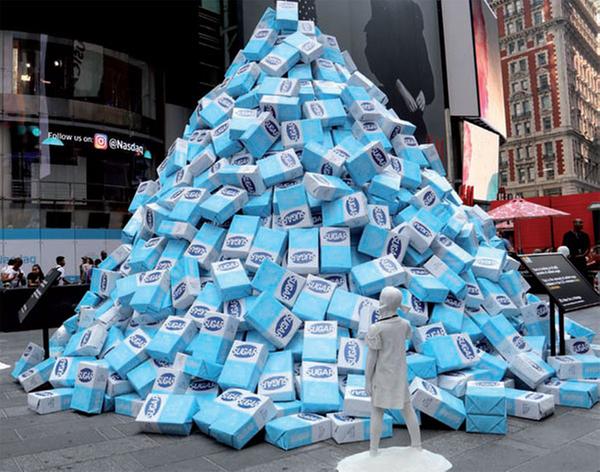
A 24-foot-tall pyramid of boxes marked "sugar" in the middle of Times Square makes a point that's kind of hard to ignore.
The publicity stunt, created by Magnetic Collaborative agency to promote power bar-maker Kind's new line of fruit snacks, which have no added sugar, is meant to sound an alarm. One sign says you're looking at 45,485 pounds of added sugar - the amount that Kind says children in the United States consume every five minutes.
The numbers are spun out by Kind from there: children consume 13.1 million pounds of added sugar a day - enough to fill 273 yellow school buses. That's 4.7 billion pounds a year.
Standing sentinel around the mound are ghostly sculptures of small children, apparently made out of sugar-like granular material, wearing tags that read: "I am 9 years old and weigh 64 pounds. I will eat my weight in added sugar every year."
It's time to wake up, their slogan goes.
The world does consume too much "added sugar" - a term the USDA began using in 2000 to help people spot processed foods that have added energy with no added nutrition. High fructose corn syrup, raw, brown and white sugar, honey, maple syrup, molasses make up about 16 percent of the calories Americans consume and have zero nutritional value.

As early as 2006 the Centers for Disease Control and Prevention (CDC) identified sugar drinks as one of the main culprits in rising obesity rates. Around 12.5 million children in the US are obese, the CDC says, blaming snacks and foods high in sugar and salt.
The American Heart Association (AHA) recommends that people should drink no more than three cans of soda (about 450 calories) a week, but men drink 175 and women 94 calories a day.
For children aged four to eight, the AHA suggests no more than three teaspoons of sugar a day, about 130 calories of a 1,600-calorie diet. The average child takes in 21 teaspoons a day, the AHA says.
A can of soda has the equivalent of seven to 12 teaspoons of sugar.
According to the National Soft Drink Association, the industry produces 600 12-ounce cans of sugary drinks per person per year, most of it what they call the full-sugar variety, and supplies more than a quarter of what Americans drink.
It's not just a US problem, of course. "Every country that has adopted the Western diet, one dominated by low-cost, highly processed food, has witnessed rising rates of obesity and related diseases," the journal Nature commented recently. "There are now 30 percent more people who are obese than who are undernourished."
A report from a survey of 14 provinces in China found that the daily intake of sugars for Chinese people was lower than the level recommended by the World Health Organization, but for children between the ages of 3 and 17 it was much higher because of the growing popularity of sugary drinks, China Daily reported in May.
The survey, conducted in 2014 by China's health, education and sports authorities, found that the sugar intake of males 13 to 17 surpassed 8.1 of total caloric intake. WHO recommends it not exceed 5 percent.
About 12 percent of children aged 7 to 18 in the survey were overweight.
"An effort to reduce sugary drink intake of teenagers is urgently needed," Liang Xiaofeng, deputy director of the Chinese Center for Disease Control and Prevention, said. "In addition, I have found that sugar imports are increasing."
It was not always so. Until the 18th century, when the technology for extracting sugar from cane was developed, and 19th century, when we learned how to get it from beets, sugar was only available when the fruit ripened or the bees got busy.
According to the US Department of Agriculture, global production of sugar is up 9 million tons to a record of 180 million metrics tons a year and consumption hovers at the 172 million metric ton level, also a record high level.
In descending order, Brazil, India, the EU, Thailand, China and the US are the top producers.
The top domestic consumers, in descending order, are India, the EU, China, the US and Brazil.
Last year, the US produced 7.893 million tons and consumed 11.178 million tons. China produced 10.5 million metric tons and consumed 15.8 metric tons.
As the researchers in Nature put it: "In recent years, sugar has been added to virtually every processed food, limiting consumer choice. Nature made sugar hard to get; man made it easy."
Contact the writer at chrisdavis@chinadailyusa.com.